arXiv caps submitters at two submissions a month as AI-driven volume surges
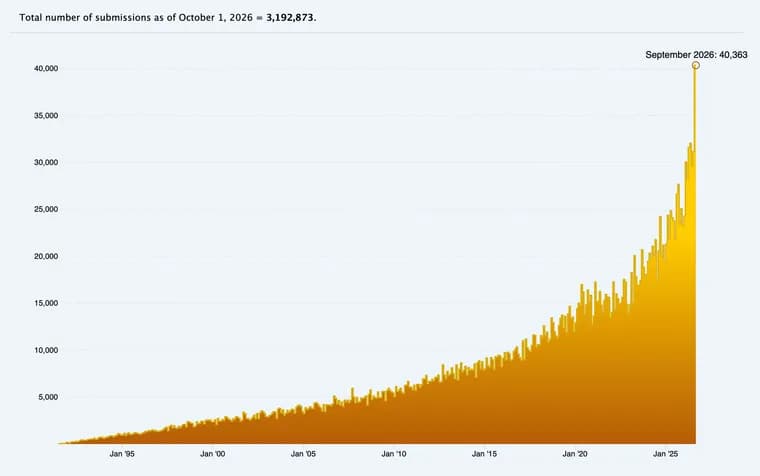
arXiv has announced an updated rate limiting policy that took effect on October 1st, 2026, and applies to all submitters and all categories. Submitters are now limited to up to two submissions per calendar month, with a limit of three total active submissions at any given time. arXiv describes the change as a stopgap while it works out what may be the new best practice for authors using increasingly advanced AI tools, and while it improves its moderation tools and procedures.
The reasoning starts with volume. Before AI, arXiv says, there was a discernible practical limit to how many independent submissions one person could produce, and its volunteer moderators would limit submitters well above it. With AI tools more capable and accessible, that practical limit is now up for debate. The numbers: arXiv received 9,869 submissions in September 2016, 20,569 in September 2024, and 40,363 this September. The September 2026 batch alone generated almost 9,000 support tickets for staff and moderators. In the past two years, arXiv says, submissions have doubled.
arXiv says advanced AI tools are helping drive the increase by making parts of research faster and easier. Its policy allows AI as a tool in support of research, as long as it is disclosed and the work meets arXiv's standards of scholarly interest and advances its field. Many current submissions do not meet those requirements. Moderators report more thin papers of narrow scope, more 'salami' papers (one piece of work broken into a set of smaller papers), and a marked increase in dense, AI-written papers.
The detection and rejection of low-quality papers rests on volunteer moderators. arXiv says a relatively small proportion of authors submit a large number of low-quality papers and consume a disproportionate share of moderator time, which it calls unfair to authors of good papers, whose work can be delayed by days or weeks. The stated aims of the new limit are to distribute moderator time equitably, protect the arXiv corpus from a sharp rise in inappropriate submissions, and encourage authors to submit only their best work. Rate limiting itself is not new: it is an established arXiv policy, previously left primarily to moderator discretion.
The FAQ settles the practical questions. The limit counts submissions, not announced papers, so a rejected paper still uses up one of the two monthly slots; after two submissions an author waits until the next month. The cap applies across all subject categories combined. Submissions still on hold in the following month do not count against that month's limit, but they do count toward the total of three active submissions. The three-active limit has existed since 2024 and remains in place. Authors with a backlog, or with a conference deadline, are asked to plan their submissions carefully so the limits do not hurt them. Limits apply only to the submitter, so a co-authored paper counts only toward the submitter's rate, and co-authors are asked to coordinate. A paper deleted by the submitter before it is announced, for whatever reason, counts toward neither the monthly nor the active limit.
arXiv closes by saying it will keep monitoring the effect of the update on authors, readers and the arXiv corpus, and will modify the policy as needed.
Key facts
- Effective October 1st, 2026, every arXiv submitter is limited to up to two submissions per calendar month and three total active submissions at any time, across all categories.
- Monthly submissions rose from 9,869 (September 2016) to 20,569 (September 2024) to 40,363 (September 2026), which generated almost 9,000 support tickets for staff and moderators.
- arXiv links the surge in part to advanced AI tools and reports more thin, 'salami' and dense AI-written papers, with a small share of authors consuming a disproportionate share of volunteer moderators' time.
- The cap counts submissions, not announced papers, so rejected papers use up the monthly allowance; papers deleted by the submitter before announcement do not count.
- arXiv calls the rule a stopgap and says it will monitor the effect and modify the policy as needed.
Why it matters
arXiv is one of the central open repositories for research, and it is now saying in public that AI has broken the old assumption about how many papers one person can realistically produce. Its answer is a hard numerical cap on submissions rather than a ban on AI-assisted work: AI use is still permitted if disclosed and if the research meets arXiv's standards. The figures behind the decision are stark, with monthly submissions at 40,363 this September against 20,569 two years earlier, and almost 9,000 support tickets from that month alone. Other open access repositories, arXiv says, are seeing a similar sharp rise in submissions per author per month.
Who it affects
Every arXiv submitter, in every category, as of October 1st, 2026. Authors who post frequently, such as those with backlogs of work or conference deadlines, are the most exposed and are asked to plan ahead. Co-authors are affected indirectly: only the submitter's rate is charged, so groups need to coordinate who submits. Volunteer moderators are the intended beneficiaries, along with authors of good papers who arXiv says are being delayed by days or weeks by the volume of low-quality submissions.
How to use it
Plan around two submissions per calendar month and three active submissions at once. Remember that a rejected paper still counts toward the monthly total, so submit only work that is complete, polished and meets arXiv's guidelines. Submissions that remain on hold into the next month do not count against that month's limit but do count toward the three-active cap. If a paper has several co-authors, decide who submits, since only the submitter's count rises. If you spot a mistake right after submitting, deleting the paper before it is announced means it counts toward neither limit. If you use AI tools in research, disclose it, as arXiv policy requires.
How solid is it
This is arXiv's own announcement of its own policy, so the rule itself is stated first hand, including the dates, the limits and the FAQ rulings. The submission counts for 2016, 2024 and 2026 and the support ticket figure come from arXiv. The claims about AI-written and salami papers are moderators' observations as reported by arXiv. The source gives no counts of rejected papers and no share of submissions that are AI-written or low quality, so the link between AI tools and the volume increase is arXiv's assessment rather than something it quantifies.
Risks and caveats
arXiv calls the policy a stopgap and says it will monitor its effects and modify it as needed; no end date or review date is given. The cap is blunt: it counts submissions regardless of quality, so a rejected paper uses up an allowance just as an accepted one does, which arXiv defends as encouraging authors to be mindful. Prolific authors with legitimate backlogs or conference timing may find the limits restrictive, and arXiv's only guidance is to plan carefully; no exceptions for conference deadlines are described. The source does not name any detection method for AI-written papers.
“AI tools are making it easy for authors to flood arXiv and other repositories with these low-value papers.”
— arXiv, announcement of the updated rate limit policy