AskChem indexes 2.4M chemistry claims for AI agents
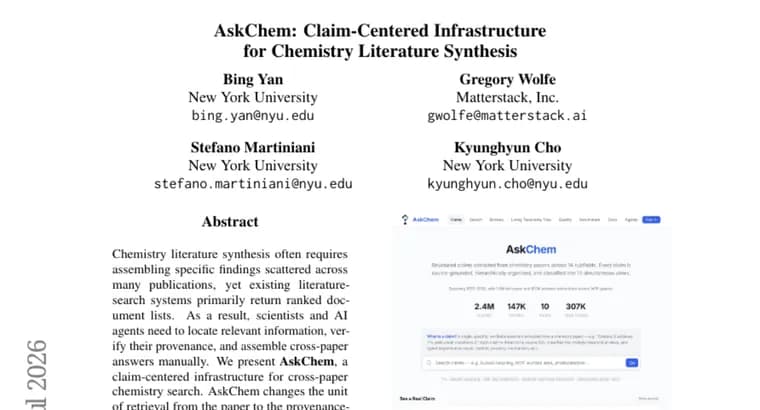
Researchers led by Bing Yan built AskChem, a claim-centered infrastructure for searching and synthesizing chemistry literature. Today's literature-search tools return ranked lists of documents, leaving scientists and AI agents to hunt through papers, check where a finding actually comes from, and stitch together answers that draw on more than one source by hand. AskChem changes the unit of retrieval from the whole paper to the individual claim: each paper is broken into atomic, typed claims, and every claim is grounded by a source DOI plus either a verbatim quote or an explicit locator pointing to where the evidence sits in the text. On top of this shared claim store, AskChem offers a stabilized faceted taxonomy for browsing and hierarchical retrieval, an evidence graph that links claims to one another through relations, and an exploratory living taxonomy that places indexed papers under the scientific principles they relate to. The system currently indexes 2.4 million claims drawn from 147,000 papers, and it is reachable through a web interface as well as REST, SDK, and MCP access built for AI agents. On the team's AskChem-Bench evaluation, a GPT-5.5 reader grounded in AskChem resolved 100% of the DOIs it cited, against 88.3% for the same reader without AskChem retrieval, and posted the highest citation density among five systems tested. AskChem is live at askchem.org.
Key facts
- AskChem indexes 2.4 million atomic, typed claims extracted from 147,000 chemistry papers, each grounded by a source DOI and a verbatim quote or evidence locator.
- It replaces document-level search with claim-level retrieval, adding a faceted taxonomy, an evidence graph linking claims, and a living taxonomy mapped to scientific principles.
- Access comes via a web interface plus REST, SDK, and MCP endpoints, the last aimed specifically at AI agents.
- On AskChem-Bench, a GPT-5.5 reader grounded in AskChem resolved 100% of cited DOIs versus 88.3% without retrieval, and had the highest citation density of five systems tested.
- The project is live now at askchem.org.
Why it matters
Chemistry findings are scattered across huge numbers of papers, and standard search only hands back a ranked list of documents; someone or something still has to open each one, confirm the claim is really there, and combine evidence from multiple papers by hand. AskChem's bet is to make the claim itself, not the paper, the searchable unit, with the source DOI and an exact quote or locator attached to every claim so provenance is checkable without re-reading the original text.
Who it affects
The stated audience is both human chemists doing literature review and AI agents that need to answer chemistry questions with citations they can stand behind. The MCP access in particular targets agent builders who want a chemistry knowledge source an LLM can query and cite directly rather than scrape and re-verify.
How to use it
AskChem is live at askchem.org with a web interface for browsing and search. Programmatic access is available through a REST API, an SDK, and an MCP server, so an agent or application can pull claims and their evidence directly rather than going through the web front end.
How solid is it
The authors ran their own benchmark, AskChem-Bench, comparing a GPT-5.5 reader with and without AskChem retrieval. Grounded in AskChem, the reader resolved 100% of the DOIs it cited, versus 88.3% for the ungrounded baseline, and it produced the highest citation density among five systems evaluated. That is a result from the team's own benchmark rather than an independent third-party test, and only Bing Yan is named as author in the available source metadata, though the underlying work may involve uncredited co-authors.
Risks and caveats
The reported numbers come from AskChem-Bench, a benchmark built by the same team that built the system, so the comparison has not been independently reproduced here. Coverage is currently bounded at 2.4 million claims from 147,000 papers, a fraction of the chemistry literature. The source text gives no detail on pricing, rate limits, or terms for the REST, SDK, or MCP access, so none of that should be assumed.
“AskChem changes the unit of retrieval from the paper to the provenance-carrying claim”
— AskChem paper