BAIR introduces ABBEL, graded belief states for long LLM tasks
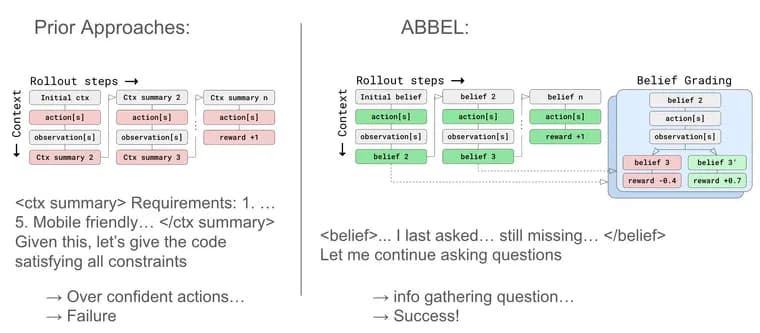
Long-horizon tasks such as collaborative software development can run for hundreds or thousands of interaction steps, far more than fits in an LLM's context window. The usual fix is self-summarization, often called context compaction: the model periodically compresses its own history into a shorter summary and works from that instead of the full transcript. BAIR researchers note that this approach is already in production use. Cursor's Composer 2.5 model reportedly uses compaction during training (Cassano et al., 2026), and Grandcode, described as the first system to consistently beat all human competitors in online coding competitions while running on the Qwen 3.5-397B efficient-attention model, still needed context summarization to function (DeepReinforce et al., 2026).
The catch is that compaction quietly hurts performance. Benchmarks tend to show only small gaps, yet coding-assistant vendors such as Cursor reportedly still advise users to avoid triggering compaction in the middle of a task (Heule et al., 2026). To illustrate why, the researchers ran reinforcement-learning fine-tuning on Combination Lock, a Wordle-like game that allows up to 16 guesses, comparing a model that must self-summarize its context against one that keeps the full context. Both model types improved over training, but the self-summarizing model never closed the gap in average guesses needed to reach the target word.
ABBEL addresses this by reformulating summaries as belief states, drawing on recursive Bayesian estimation: the model periodically updates a belief from new observations and actions, and chooses its next action based only on the current belief rather than the full history. The key addition is belief grading, an auxiliary reinforcement-learning objective that supervises what the belief states actually contain, rather than leaving summarization unsupervised. Where a domain-specific quality heuristic is hard to write by hand, the authors propose a general autoencoding-style grading function: the same language model acts as both encoder and decoder, producing a belief and then being graded on how well that belief lets it reconstruct the most recent observation, given the prior belief, the action taken and the task prompt.
The method was tested on CollabBench, a collaborative coding environment built on Sweet-RL (Zhou et al., 2025), in which an agent asks clarifying questions before submitting a function that is scored against hidden unit tests. With the general reconstruction-based belief grading, the researchers report cutting the performance gap to full-context models by about 50%, while training in 50% fewer steps than summarization without belief grading. Trained ABBEL models also used substantially less memory than the full-context setting; the source text supplied for this retelling was truncated before the exact memory figures were given.
Key facts
- ABBEL trains LLMs to compress long interaction histories into supervised belief states instead of unsupervised self-summaries.
- On the CollabBench coding benchmark, reconstruction-based belief grading cut the performance gap to full-context models by about 50% and needed 50% fewer training steps than summarization without belief grading.
- RL fine-tuning experiments on Combination Lock, a Wordle-like game with up to 16 guesses, showed self-summarizing models never close the performance gap to full-context models even as both improve with training.
- Cited real-world context includes Cursor's Composer 2.5 model, which uses compaction during training, and Grandcode, described as the first system to consistently beat all human competitors in online coding competitions while running on the Qwen 3.5-397B efficient-attention model.
- Coding-assistant vendors reportedly still advise users to avoid mid-task compaction despite benchmarks showing only small performance gaps.
Why it matters
Context windows cannot grow indefinitely, but assistive tasks like collaborative coding routinely run far longer than any window can hold. The stopgap, self-summarization, is already shipping in production coding tools, yet the post argues it silently caps performance: models trained to summarize their own history never fully catch up to models that keep the whole history, even after extended training. ABBEL's contribution is to make the summarization step itself a supervised, gradable target (a belief state graded on how well it preserves usable information) rather than an unsupervised byproduct, which is presented as the source of the gap.
Who it affects
The direct audience is researchers and engineering teams building long-horizon LLM agents, particularly coding assistants that must operate over many turns without keeping full history in context. It also bears on the vendors named in the post, such as Cursor, whose tools already rely on compaction, and by extension on the users of those tools who run into the recommendation to avoid compaction mid-task.
How to use it
This is a research method described in a BAIR blog post, not a released product or API. Belief grading is presented as an auxiliary reinforcement-learning objective that could in principle be added to the training pipeline of any agent that already relies on context summarization, using the general autoencoding-style reconstruction objective when a domain-specific quality heuristic for summaries is not available. The post does not state whether code, model weights or a paper release accompany the announcement.
How solid is it
The claims rest on two settings: RL fine-tuning on the Combination Lock word game, showing self-summarizing models never close the gap to full-context ones, and the CollabBench collaborative coding benchmark (built on Sweet-RL), where belief grading is reported to cut the full-context performance gap by about 50% and cut training steps by 50% versus summarization without belief grading. Both are quantified, controlled comparisons from the same research group, but confined to two benchmark environments; the source text made available for this retelling was cut off before further results or memory-usage figures could be checked.
Risks and caveats
The results are self-reported by the authors from a single lab and have not been cross-checked against outside benchmarks in the material available here. The core grading signal, using the same model to encode and then reconstruct an observation from its own belief, is a proxy for a good summary; whether it generalizes past coding and the two tested environments is not established in what was read. The source text was truncated mid-section, so any qualifications, limitations or memory-usage details the authors gave after that point are not reflected in this retelling.