Business Arena benchmark finds ninefold gap in LLM agents running a shop
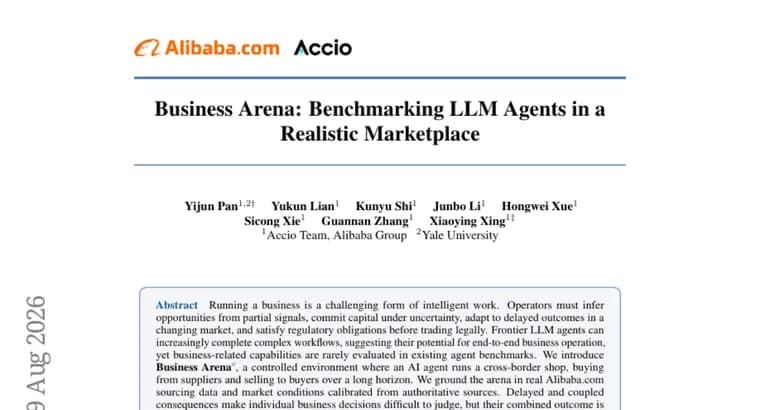
Researchers have introduced Business Arena, a benchmark environment where an AI agent runs a cross-border shop over a long horizon, buying from suppliers and selling to buyers. The environment is grounded in real Alibaba.com sourcing data and market conditions calibrated from authoritative sources, rather than a synthetic simulation. The authors note that running a business is hard to evaluate directly because decisions have delayed, coupled consequences, so individual choices are difficult to judge in isolation. Their solution is to measure the combined outcome through profit, then explain that outcome through several additional layers: comparing agents against human-designed strategies to estimate how much opportunity was actually available, using skill-level metrics to expose specific strengths and weaknesses, and tracing realized gains and losses back to the individual actions that produced them. The team also ran mechanism ablations to check that strong scores reflect genuine business intelligence rather than the agent exploiting quirks of the simulator or neglecting parts of the task. Evaluating 15 frontier models, the researchers found a ninefold difference in mean final net worth between them, a wide spread that indicates business operation is handled very unevenly across current models. Even the strongest model in the test still fell behind the human-designed strategies used as a reference point, meaning no model yet matches a competent human approach to running the shop. The skill-level analysis surfaced distinct operating styles among the agents, including margin-focused premium sellers, high-turnover wholesalers, and customer-service specialists, while the action-level attribution traced value creation and destruction to specific sourcing, pricing, and recovery decisions.
Key facts
- Business Arena grounds agent evaluation in real Alibaba.com sourcing data and market conditions calibrated from authoritative sources, not a synthetic simulator.
- 15 frontier LLM agents were evaluated running a cross-border shop over a long horizon, buying from suppliers and selling to buyers.
- Final net worth varied ninefold between the mean results of the 15 models, a wide spread in business performance.
- Even the best-performing model fell behind human-designed strategies used as a reference.
- Skill-level analysis found distinct operating styles, from margin-focused premium sellers to high-turnover wholesalers and customer-service specialists, with action-level attribution tracing outcomes to specific sourcing, pricing, and recovery decisions.
Why it matters
Business-related capability is rarely evaluated in existing agent benchmarks even as frontier LLM agents increasingly handle complex workflows. Business Arena targets that gap directly: instead of testing an isolated skill, it asks an agent to run an actual shop over time, where success depends on inferring opportunities from partial signals, committing capital under uncertainty, and adapting to outcomes that arrive with a delay. That combination is closer to what running a real operation demands than typical single-turn or short-horizon agent tasks.
Who it affects
The benchmark is aimed at researchers and developers building or evaluating LLM agents for real-world commercial tasks, particularly anyone considering agents for sourcing, pricing, or cross-border retail operations. It also matters to anyone assessing how close current agents are to handling open-ended, long-horizon business decisions rather than narrow, well-specified tasks.
How to use it
Business Arena is presented as an evaluation environment rather than a product: an agent is placed in a cross-border shop, sources goods using real Alibaba.com data, and sells under market conditions calibrated from authoritative sources over a long horizon. Its output is not just a final profit number but a layered set of diagnostics, opportunity estimates from human-designed strategy comparisons, skill-level metrics, and action-level attribution, meant to explain why an agent succeeded or failed rather than only whether it did.
How solid is it
The methodology goes beyond a single profit metric: the authors compare agents to human-designed strategies to estimate how much opportunity was actually available, and run mechanism ablations specifically to confirm that strong results reflect genuine business intelligence rather than the agent exploiting simulator-specific shortcuts or neglecting parts of the task. Testing 15 frontier models and finding a ninefold spread in outcomes, with even the top model trailing human-designed strategies, suggests the benchmark is discriminating rather than saturated.
Risks and caveats
The source text does not name which models were evaluated, give per-model net-worth figures or rankings, specify how the skill-level metrics are computed, or state the length of the 'long horizon' over which the shop runs. Without that detail, it is not possible to say from this material alone which specific models struggled most or how large a time window the results actually cover.
“Even the best model falls behind human-designed strategies, indicating that business operation remains challenging for LLM agents.”
— Business Arena paper