ChatGPT adds real New Yorker cartoonists' signatures to fake cartoons
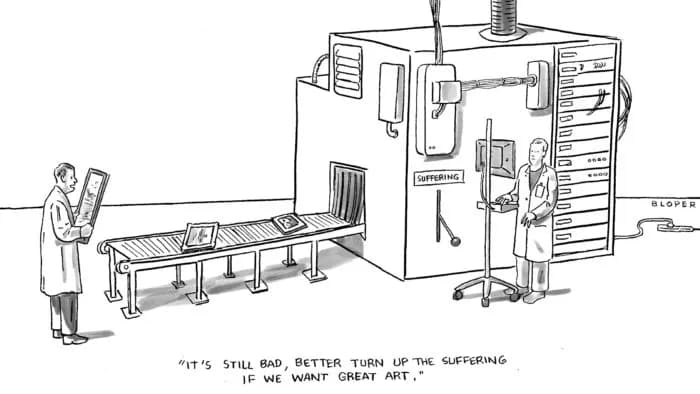
A cartoon showing Dolly Parton, in a sparkling gown, arm in arm with Tim Curry as Dr. Frank-N-Furter at the pearly gates went viral on Twitter in late August, in the days after the entertainers' deaths. Parton tells God, at heaven's reception desk, 'I knew I chose the right plus one.' One tweet of it drew 25,000 likes, and other versions circulated on Facebook, Instagram and Bluesky. The bottom right corner carried the pen name BLOPER, the signature of New Yorker cartoonist Brendan Loper. Loper neither drew nor signed it. ChatGPT generated it, and a Dolly Parton fan first posted it to Facebook, writing in the comments that she had simply asked ChatGPT for 'a New Yorker-style cartoon.'
Loper says people kept writing to ask whether the cartoon was his, starting with a text from his twin brother, whose friend had seen it. 'It was very surreal,' he said. It was not the first time: in May a stranger warned him over Instagram that his pen name had appeared in a ChatGPT image, and over the summer he found more examples in a Reddit forum about ChatGPT where users posted New Yorker-style cartoons they had generated. He already knew his work was being harvested for AI training, but a faked signature felt more personal: 'my name is my name. It felt very much like a violation of my personhood.' For him, 'The signature for me is the certificate of authenticity.'
Loper is not alone. In the same forums are dozens of images carrying the signatures of Harry Bliss, Emily Flake, Joe Dator, Pat Byrnes, Peter Vey and Jason Adam Katzenstein. In the reporter's own tests, ChatGPT produced cartoons signed by George Booth, Liza Donnelly, Ellis Rosen and Saul Steinberg. In all, the reporter documented more than 15 New Yorker cartoonists whose signatures the image generator used without permission or compensation. ChatGPT regularly produced images with the magazine's house style: a black-and-white single panel, sparse background, clean linework and a sardonic caption, though some punch lines make no sense. Not every image was signed, and some pen names were gibberish, but the signatures that did appear were regularly those of real contributors, including older ones such as Warren Miller, who published in the 1960s. Pat Byrnes signs with a period after his name, and every one of the more than a dozen ChatGPT cartoons found signed with his name ended with a period.
An OpenAI spokesperson said: 'We believe the future of creativity is one that is fundamentally human, and our focus is on building tools that empower human creativity and creators,' and added that the company appreciates the community flagging bugs and unintended behavior. After the reporter notified OpenAI, ChatGPT began answering requests for New Yorker-style cartoons with: 'This prompt may violate our guardrails concerning similarity to third-party content.' Still, as of publication, it continues to sign some of the generic cartoons it generates with the names of real New Yorker cartoonists. OpenAI declined to answer questions about how its models might have ingested signatures from The New Yorker's archives.
Condé Nast, The New Yorker's parent company, signed a multi-year licensing deal with OpenAI in 2024 covering much of its content. The terms are not public, but a New Yorker spokesperson said Condé Nast has never granted an LLM developer permission to train models on its cartoons, and that the magazine's logo, which some ChatGPT creations also reproduced, is likewise not allowed in any LLM deals. The reporter reviewed several templatized contracts for New Yorker cartoonists; none permits licensing for AI training. The work is not 'work for hire,' and the cartoonist keeps the copyright. Freelancers submit on spec and are paid only if a cartoon is selected.
How the models learned the signatures is unexplained. The reporter says it is possible they were scraped from the internet, pointing to court documents released last month in New York Times v. OpenAI, which the reporter says reveal the extent to which OpenAI knowingly circumvented publishers' paywalls. Unredacted Microsoft memos described ChatGPT as a 'product that destroys its supply chain' and the scraped training data as 'the largest theft of labor in human history.' In another memo, Jack Clark, then OpenAI's policy director (he went on to co-found Anthropic), wrote that the company's work on AI and creativity was 'going to increasingly lead to us creating systems that substitute for the labor of the people that define the "culture" of society.'
The cartoonists describe it as more than a copyright matter. Katzenstein, who has published in The New Yorker since 2014, says the output is 'trying to render individual cartoonists obsolete because we cost money and take time,' and that attaching his name to work he does not endorse is closer to false impersonation: 'slop that's pretending to be me.' Flake, a contributor since 2008, said she can see the DNA of her work in the images, 'kind of like seeing a distant cousin,' but each signature was undeniably hers, like a quote attributed to her that she never said. Dator, a contributor for 20 years, said having his credit card hacked 'feels like less of a violation than this.' Katzenstein was also part of the 2024 Authors Guild class action against Anthropic. A judge ruled last year that training Claude on the authors' work was fair use but that downloading and keeping pirated books was mass copyright infringement, and in July a federal court approved a $1.5 billion settlement, described as the largest in U.S. copyright history.
On the law, the reporter writes that U.S. case law has not caught up with image generators and that courts are likely to treat signatures and style mimicry as separate issues. A copyright claim would most likely hinge on reproduction of each cartoonist's drawing style. Cornell Law professor James Grimmelmann says a signature indicates authenticity, but 'attribution is a very small part of the fair use inquiry,' and the chief hurdle is that ChatGPT is usually not reproducing a specific cartoon but mimicking a general style. A 'right of publicity' claim would require proof of commercial use; the reporter found no evidence these cartoons are being bought or sold. Sarah Anderson's class action against Stability AI, Deviant Art and Midjourney has been in the courts since 2023 but makes no reference to signatures.
The reporter also points to signs that image generators are displacing cartoonists. The Baltimore Sun fired Kevin Kallaugher, a Pulitzer finalist with more than 30 years at the paper, last year, and earlier this year began regularly running AI-generated cartoons in its opinions section; OpenAI's watermark identification tool shows they were made with OpenAI products. Marc Murphy, president of The Association of American Editorial Cartoonists, wrote in an open letter last month that the group 'condemn[s] the use of AI for its theft from artists.' The New Yorker has not turned to AI cartoons, though none of the contributors interviewed could live on its commissions alone; the magazine's cartoon is a calling card that opens doors to commercial work, book illustration and other gigs, and that is the work they say AI threatens most.
Key facts
- A viral cartoon of Dolly Parton and Tim Curry, signed 'BLOPER' (New Yorker cartoonist Brendan Loper), was generated by ChatGPT; one tweet of it got 25,000 likes.
- The reporter documented more than 15 New Yorker cartoonists whose signatures OpenAI's image generator used without permission or compensation, including Emily Flake, Joe Dator, Pat Byrnes and Jason Adam Katzenstein.
- After being notified, ChatGPT began showing a guardrail message for New Yorker-style requests, but it still signs some generic cartoons with real cartoonists' names as of publication.
- A New Yorker spokesperson says Condé Nast has never allowed an LLM developer to train on its cartoons; OpenAI declined to say how its models picked up the signatures.
- Legal routes look hard: a legal scholar says attribution is a small part of fair use, and a right-of-publicity claim would need proof of commercial use, which the reporter did not find.
Why it matters
A signature is how a cartoonist marks work as their own, and Brendan Loper calls his 'the certificate of authenticity.' Here a chatbot stamps real names on images the named artists never made, and those images spread widely: one tweet of the Parton and Tim Curry cartoon got 25,000 likes. The cartoonists see this as impersonation, not just style imitation. The case also sits against a wider backdrop the reporter lays out: court documents in New York Times v. OpenAI, the $1.5 billion Anthropic authors' settlement approved in July, and newspapers such as The Baltimore Sun running AI cartoons.
Who it affects
First, the New Yorker cartoonists whose pen names appear on ChatGPT output, at least 15 documented, among them Loper, Flake, Dator, Byrnes, Katzenstein, Harry Bliss, Peter Vey, George Booth, Liza Donnelly, Ellis Rosen and the established names Saul Steinberg and Warren Miller, the latter published in the 1960s. Beyond them, editorial and freelance cartoonists generally, since the reporter says none of the New Yorker contributors interviewed could live on the magazine's commissions alone and the commercial work that fills the gap is what AI threatens most. Readers and platforms are affected too: people asked Loper whether the viral cartoon was his. Condé Nast and OpenAI are also in the frame because of their 2024 licensing deal.
How to use it
This is a report, not a product, but it has practical lessons for anyone generating or sharing AI cartoons. A signature on an AI image is not evidence of who made it: the viral cartoon carried Loper's pen name though ChatGPT made it. The Dolly Parton fan who posted it said she had only asked for 'a New Yorker-style cartoon.' ChatGPT may now answer such prompts with 'This prompt may violate our guardrails concerning similarity to third-party content,' but it still signs some generic cartoons with real names, so check provenance before reposting.
How solid is it
The reporting is first-person and detailed: named cartoonists on the record, an OpenAI statement, a New Yorker spokesperson, a Cornell law professor, and the reporter's own tests that produced signed cartoons. The count of more than 15 cartoonists is the reporter's own documentation. The claims about OpenAI's scraping rest on court documents the reporter cites from New York Times v. OpenAI, and the source frames scraping only as a possibility for how the signatures were learned. The terms of the Condé Nast deal are not public, so the spokesperson's statement about cartoons cannot be checked against them.
Risks and caveats
No explanation exists for how the signatures got into the models; OpenAI declined to answer, and the source describes scraping only as possible. No lawsuit by New Yorker cartoonists over the signatures is reported; right of publicity and copyright are discussed only as possible routes. Grimmelmann notes that ChatGPT usually mimics a general style rather than copying a specific cartoon, which weakens a copyright claim, and a right-of-publicity case needs proof of commercial purpose, which the reporter did not find. The source does not say whether OpenAI has fixed the problem, only that some generic cartoons still carry real names. Not every generated image is signed, and some signatures are gibberish.
“The signature for me is the certificate of authenticity.”
— Brendan Loper, New Yorker cartoonist