Chess.com launches Classic Games beta with 10 new games, built with AI-assisted coding
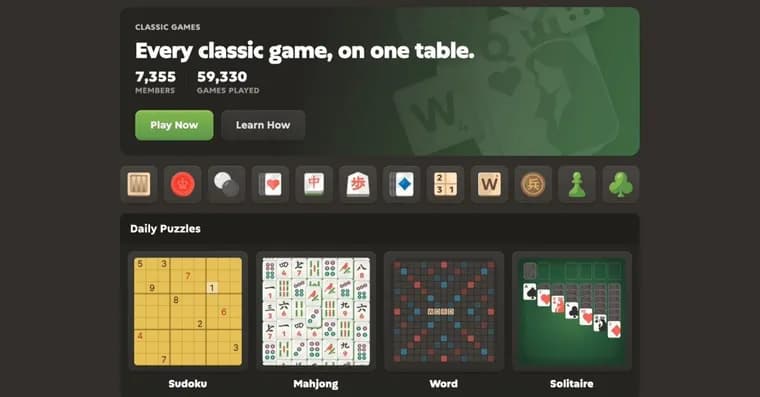
Chess.com is expanding well beyond chess. After launching Gambit, a gambling-free poker site, earlier this year, the company is adding 10 more games under a new Classic Games platform: backgammon, checkers, go, hearts, mahjong, shogi, sudoku, solitaire, xiangqi, and a Scrabble alternative called word. The public beta launches on Saturday on the web and in a new iOS and Android app.
Chief growth officer Albert Cheng told The Verge the idea came from people approaching Chess.com's cofounders, for example someone running a mahjong night on Wednesdays or a group of about five people at a Chicago bar who love playing go but lack a Chess.com for it. Cheng said the way Chess.com grew a community of almost 300 million members has not really happened for other classic games, and Classic Games is meant to fill that gap. Some of the new titles, like shogi and xiangqi, are strategy games similar to chess; others, like sudoku, solitaire and word, are further afield. The team picked them through "a mix of community feedback, market research, and then just our own confidence in our ability to serve that game well", and it focused on classics that have a lifelong journey of learning and a community.
The games will feel familiar to Chess.com players. Each has lessons, leaderboards and a rating system. Multiplayer games such as checkers or mahjong offer matches against other players or against bots, using the same bot characters Chess.com already has; Martin remains the lowest-rated bot on Chess, Gambit and Classic alike. Play modes differ: word and mahjong have puzzles, as chess does, while sudoku has a set of daily grids and solitaire has daily deals.
Cheng said the expansion has not pushed chess aside. He described chess as more in the public zeitgeist than he has seen during his time at the company, and said daily active users are higher than ever in the company's history. He declined to give the actual daily user count but said the site is "doing amazingly well". Fewer than 1 percent of the company, by his account, is fully dedicated to building new games.
AI was central to the speed. The Verge reports it helped Chess.com launch new games in a matter of months with a team of only a few people; the article's standfirst says 11 other classics, while the opening paragraph lists 10 new games, and the piece does not reconcile the two counts. Earlier this year Cheng said Gambit was built with AI help, mainly for coding. For Classic, the team used "almost entirely the same approach", with AI again speeding up coding. Cheng argued that building on the existing Chess.com code base, design system, bot characters and rating systems is a huge advantage, and that each added game gets faster because the infrastructure is already there rather than standing everything up from scratch.
AI was not used for the art and design of Classic Games, Cheng said. He described the look and feel as carefully crafted by humans, while also calling the process a blend: a small team with good product and design judgment who leverage AI. He said the ratio on the art and design side is shifting and the company is hiring more of those people, and that using what it learned from Classic Games' faster development, Chess.com has shipped many more major features than in previous years. The Verge notes there is increasing tension over AI elsewhere in the games industry, and suggests Chess.com's comfort with AI may come from human chess players having spent decades playing and learning alongside machines. Cheng pointed to AI and chess being intermixed for about 30 years, calling back to Garry Kasparov's 1996 match against IBM's Deep Blue, and said the idea that AI was powerful at chess was embedded in how the cofounders thought about the company even before it was founded 20 years ago. He said Chess.com will likely expand to "a lot more" games in the future.
Key facts
- Chess.com's Classic Games platform adds 10 games: backgammon, checkers, go, hearts, mahjong, shogi, sudoku, solitaire, xiangqi and a Scrabble alternative called word.
- The public beta launches on Saturday on the web and in a new iOS and Android app; each game has lessons, leaderboards and a rating system.
- AI sped up the coding, as it did for the earlier poker site Gambit, but Albert Cheng says it was not used for art and design.
- Cheng says fewer than 1 percent of the company is fully dedicated to building new games, and that Chess.com's daily active users are at a record high, though he gave no figure.
- Cheng says the company will likely expand to "a lot more" games in the future.
Why it matters
Chess.com, with a community Cheng puts at almost 300 million members, is trying to turn its chess playbook (lessons, ratings, leaderboards, bots) into a template for other classic games. The case it makes for AI is a narrow one: AI speeds up coding, and new games sit on an existing code base, design system, bot characters and rating systems, so a very small team can ship quickly. Cheng says the time saved has also let Chess.com ship more major features in its main product than in previous years.
Who it affects
Players of board, card and puzzle games who want a ranked, community-driven home for them, such as mahjong, go, shogi or xiangqi groups that Cheng says lack a Chess.com equivalent. It also touches existing Chess.com users, who get new games on the same bot characters and rating systems, and game artists and designers: Cheng says the company is hiring more of them as the ratios shift.
How to use it
Classic Games opens in public beta on Saturday on the web and through a new iOS and Android app. Each game has lessons, leaderboards and a rating system. Multiplayer games like checkers and mahjong offer matches against other players or bots, word and mahjong have puzzles, sudoku has daily grids and solitaire has daily deals. The source gives no pricing or subscription details.
How solid is it
The report is an interview with a named company executive, so the account of the launch, the games and the AI use is the company's own. The details of the platform come from The Verge's reporting. Cheng declined to give the number of daily active users, so the claim of record usage has no figure behind it. The source does not name the AI tools used for coding or say how large the team is beyond "a very small team". The article's standfirst says 11 other classics while its opening paragraph lists 10 new games, and it does not reconcile the two.
Risks and caveats
The AI claims rest on Cheng's description; the source does not say which tools were used or how much of the coding they produced. The claim that AI was not used for art and design is likewise his statement. The Verge notes increasing tension over AI use in the games industry, and the comfort-with-AI explanation is the author's suggestion ("may come from"), not a finding. No dates are given for further games beyond Cheng's remark that the company will likely expand to "a lot more".
“The look and feel of it is very carefully crafted by humans, and we’re proud of that.”
— Albert Cheng, chief growth officer, Chess.com