ChronoVision framework targets temporal reasoning in multimodal LLMs
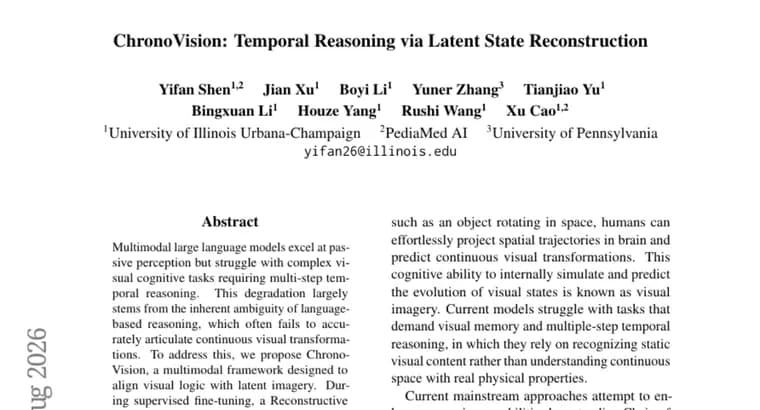
Researchers propose ChronoVision, a framework meant to fix a specific weakness of multimodal large language models: they are good at passive perception, recognizing what is in a single frame, but struggle with complex visual cognitive tasks that require multi-step temporal reasoning, tracking how a scene changes across a sequence. The authors attribute this gap to the inherent ambiguity of language-based reasoning, which often fails to accurately articulate continuous visual transformations when a model tries to describe change in words rather than perceive it directly.
ChronoVision addresses this by aligning visual logic with latent imagery instead of routing everything through language. During supervised fine-tuning, a Reconstructive Visual Head predicts the latent representation of the final transformed state of a scene, while an ROI Attention Locating module focuses the model on key visual evidence using semantic span queries. In post-training, the authors apply reinforcement learning with what they call an implicit process grounding mechanism, guided by a composite reward function that scores three things at once: outcome correctness, alignment of the latent reasoning process, and unsupervised visual focus. The abstract does not elaborate on what these components concretely compute beyond their stated names and roles.
Alongside the framework, the authors introduce Vbvr-VQA, a new dataset that evaluates temporal tracking by reformulating video reasoning as a strict image-ordering task. In experiments, ChronoVision reaches state-of-the-art performance on Vbvr-VQA, with 74.8% in-domain accuracy and 71.6% out-of-domain accuracy. On IntPhys2, described as a highly challenging cross-domain benchmark, it scores 55.0% accuracy. The abstract gives no comparison figures for prior or competing methods, only ChronoVision's own scores, and names no authors, affiliations, or institutions, nor any release date or plan for the code, model, or dataset.
Key facts
- ChronoVision combines a Reconstructive Visual Head and an ROI Attention Locating module during supervised fine-tuning to align a model's visual logic with latent imagery.
- Post-training reinforcement learning uses an implicit process grounding mechanism with a composite reward covering outcome correctness, latent process alignment, and unsupervised visual focus.
- The authors introduce Vbvr-VQA, a new dataset that reframes video reasoning as a strict image-ordering task.
- ChronoVision reaches state-of-the-art performance on Vbvr-VQA: 74.8% in-domain accuracy and 71.6% out-of-domain accuracy.
- On the cross-domain IntPhys2 benchmark, ChronoVision scores 55.0% accuracy.
Why it matters
Multimodal LLMs are strong at passive perception, describing what is in one image, but weak at multi-step temporal reasoning: following how a scene evolves across several steps. The authors trace this to language-based reasoning itself, which often cannot precisely articulate continuous visual transformations. ChronoVision's response is to let the model align its reasoning with latent visual states directly rather than forcing every intermediate step through language.
Who it affects
This is a research contribution aimed at people building or evaluating multimodal LLMs for video and temporal visual reasoning, not a consumer product. It offers both a training method and a new benchmark, Vbvr-VQA, that others in the field can use to test similar capabilities.
How to use it
The abstract gives no information on releasing code, model weights, or the Vbvr-VQA dataset itself, and states no publication or release date for the paper. There is nothing here about availability or how to reproduce the results.
How solid is it
The reported numbers are ChronoVision's own scores; the abstract includes no comparison figures for prior or competing methods, so the size of any improvement cannot be judged from this text alone. IntPhys2 is an external cross-domain benchmark, which adds some independent signal, but Vbvr-VQA is the authors' own new dataset, so the in-domain and out-of-domain results on it are self-reported on a benchmark they built.
Risks and caveats
No authors, affiliations, or institutions are named in the abstract, so there is no way to gauge the work's provenance from this text. The internal components, the Reconstructive Visual Head, the ROI Attention Locating module, and the implicit process grounding mechanism, are named and assigned a role but not concretely explained. Without baseline comparisons or release details, the claims of state-of-the-art performance and 'strong' accuracy on IntPhys2 cannot be independently checked from the abstract alone.
“Multimodal large language models excel at passive perception but struggle with complex visual cognitive tasks requiring multi-step temporal reasoning.”
— the paper's authors