CoCoEvolve trains AI to keep charts, tables and code consistent
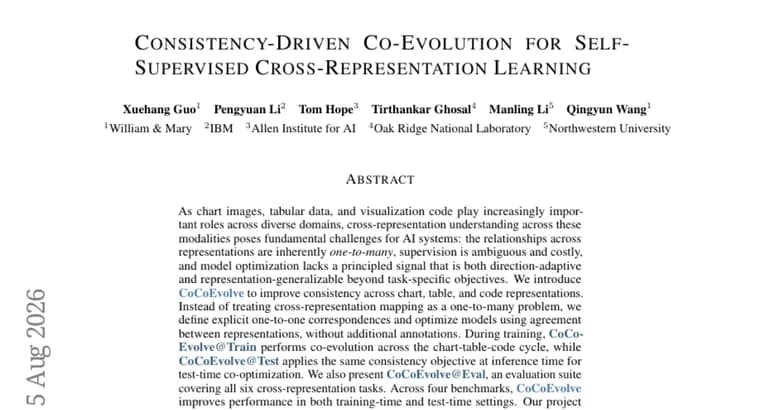
The authors introduce CoCoEvolve, a method for improving consistency across three representations of the same information: chart images, tabular data and visualization code. They argue that mapping between these representations is normally treated as one-to-many, which makes supervision ambiguous and costly, and leaves model optimization without a signal that works across directions and generalizes beyond narrow, task-specific objectives. CoCoEvolve instead defines explicit one-to-one correspondences between chart, table and code, and optimizes models by rewarding agreement between the representations rather than relying on additional labeled data. The method has two modes: CoCoEvolve@Train performs co-evolution across the chart-table-code cycle during training, while CoCoEvolve@Test applies the same consistency objective at inference time, letting a model refine its own outputs through test-time co-optimization. The authors also built CoCoEvolve@Eval, an evaluation suite covering all six cross-representation tasks that arise from the three modalities (converting each representation into each of the other two). Across four benchmarks, CoCoEvolve improves performance in both the training-time and test-time settings, though the text does not give the benchmark names, the size of the gains, or a comparison against specific prior methods. A project page is linked for further detail.
Key facts
- CoCoEvolve is a self-supervised method that improves consistency across chart images, tabular data and visualization code without requiring additional annotations.
- It replaces one-to-many cross-representation mapping with explicit one-to-one correspondences, optimizing models on agreement between representations.
- CoCoEvolve@Train applies co-evolution across the chart-table-code cycle during training; CoCoEvolve@Test applies the same objective at inference time.
- The accompanying CoCoEvolve@Eval suite covers all six cross-representation tasks spanning chart, table and code.
- CoCoEvolve improves performance in both training-time and test-time settings across four benchmarks.
Why it matters
Charts, tables and the code that generates visualizations describe the same underlying information in three different forms, and AI systems that work with data-heavy documents need to move between them reliably. The authors say that mapping between these representations is inherently one-to-many and that labeled supervision for it is ambiguous and costly, so a training signal that does not depend on extra annotations and generalizes across all three representations addresses a real gap rather than a narrow, task-specific fix.
Who it affects
The method targets AI systems that need to understand or convert between chart images, tabular data and visualization code, for example tools that read a chart and reconstruct its underlying table, or generate plotting code from data. The text does not name specific products, companies or research groups that would adopt it.
How to use it
CoCoEvolve is presented as a training and inference technique rather than a product: CoCoEvolve@Train is applied during model training across the chart-table-code cycle, and CoCoEvolve@Test can be applied at inference time on an already-trained model for test-time co-optimization. A project page is linked (https://xhguo7.github.io/CoCoEvolve/) for implementation detail; the source text gives no pricing, license or release information.
How solid is it
The authors report that CoCoEvolve improves performance across four benchmarks in both the training-time and test-time settings, and they built a dedicated evaluation suite, CoCoEvolve@Eval, covering all six cross-representation tasks between chart, table and code. The source text does not name the four benchmarks, does not give the size of the improvement in percentage or point terms, and does not compare CoCoEvolve against specific prior methods, so the claim of improvement cannot be independently sized from what is available here.
Risks and caveats
The text does not disclose author names, institutions or affiliations, nor a publication venue or date, which limits independent verification of the claims. The internal mechanism is described only as optimizing on agreement between representations, without further detail on how that agreement is measured or enforced. No numeric results are given, so the practical scale of the reported gains is unknown from this source alone.