GameHorizon Suite benchmarks 47 AI models on AAA gameplay
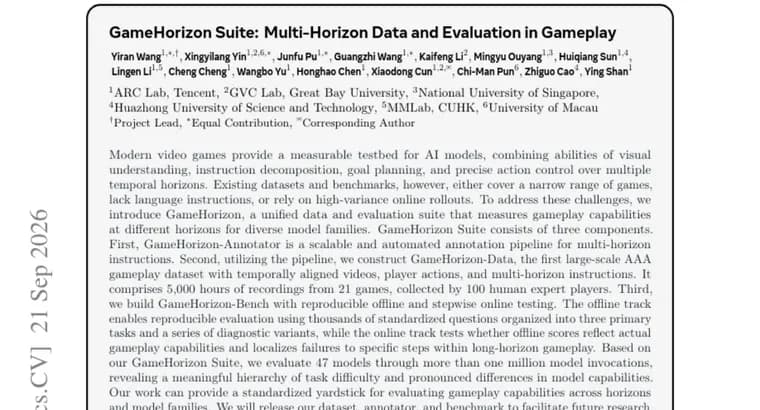
Researchers have introduced GameHorizon Suite, a data and evaluation package built to measure how AI models handle video games across different temporal horizons, from split second reactions to long stretches of planning and instruction following. Video games are useful as a testbed because playing them well requires several abilities at once: understanding what is on screen, breaking an instruction into steps, planning toward a goal, and controlling actions precisely over time. The authors argue existing datasets and benchmarks fall short in one of three ways: they cover only a narrow slice of games, they carry no language instructions at all, or they depend on high-variance online rollouts that make results hard to reproduce.
The suite has three parts. GameHorizon-Annotator is an automated, scalable pipeline for generating instructions that span multiple time horizons. Using that pipeline, the team built GameHorizon-Data, which they describe as the first large-scale AAA gameplay dataset of its kind: 5,000 hours of recordings across 21 games, collected by 100 human expert players, with video, player actions and multi-horizon instructions all aligned in time. The source text does not name which 21 games are included.
The third component, GameHorizon-Bench, provides two testing tracks. The offline track runs thousands of standardized questions organized into three primary tasks plus a series of diagnostic variants, giving reproducible scores without needing a live game session. The online track checks whether those offline scores actually predict real gameplay performance, and it can pinpoint which specific step in a long sequence of actions caused a model to fail.
Using the full suite, the authors evaluated 47 models across more than one million model invocations. They report this reveals a clear hierarchy of task difficulty and pronounced gaps in capability between models, though the source text does not give individual model names or scores. The team says it will release the dataset, annotator pipeline and benchmark to support further research, without stating a release date.
Key facts
- GameHorizon-Data is described as the first large-scale AAA gameplay dataset: 5,000 hours of recordings from 21 games, collected by 100 human expert players.
- The suite has three parts: an automated multi-horizon annotation pipeline (GameHorizon-Annotator), the gameplay dataset (GameHorizon-Data), and a benchmark (GameHorizon-Bench).
- GameHorizon-Bench combines an offline track, thousands of standardized questions across three primary tasks and diagnostic variants, with an online track that verifies offline scores against real gameplay and localizes failures to specific steps.
- The authors evaluated 47 models through more than one million model invocations, finding a clear hierarchy of task difficulty and marked differences between models.
- The team plans to release the dataset, annotator and benchmark for future research, though no release date or specific game titles are given in the source.
Why it matters
Video games force an AI model to combine visual understanding, instruction following, goal planning and precise action control all at once, and to do so over both short and long time spans. That combination is hard to test cleanly: prior benchmarks either stuck to a handful of games, dropped language instructions entirely, or relied on live online play whose results vary too much to compare across papers. GameHorizon Suite is built specifically to standardize that measurement across many games and many models at once.
Who it affects
The suite is aimed at researchers and teams building or evaluating general-purpose AI agents, particularly ones meant to operate over long horizons rather than single-step tasks. The scale of the evaluation, 47 models and more than one million invocations, makes it a comparison point for anyone developing gameplay-capable or embodied-agent models, though the source text names none of those 47 models individually.
How to use it
Once released, the pipeline (GameHorizon-Annotator), the dataset (GameHorizon-Data) and the benchmark (GameHorizon-Bench) are meant to be used together: the annotator can generate multi-horizon instructions at scale, the dataset supplies temporally aligned video, actions and instructions for training or analysis, and the benchmark's offline track gives a reproducible score while its online track checks that score against actual play and points to where a model breaks down. The authors state they will release all three components but give no release date, license or pricing in the source text.
How solid is it
The dataset's scale, 5,000 hours across 21 games captured by 100 human expert players, and the evaluation's scale, 47 models over more than one million invocations, are both substantial by the numbers given in the source. The offline track's design, standardized questions across three primary tasks plus diagnostic variants, aims at reproducibility, and the online track is explicitly built to check whether offline scores hold up in real play. The source text does not name the specific games, the 47 models, or individual scores, so those details cannot be verified from the article itself.
Risks and caveats
The source text gives no release date for the dataset, annotator or benchmark, so availability to outside researchers is not yet confirmed. It also does not disclose which 21 games are covered, which model families or specific models were among the 47 evaluated, or how they individually scored, which limits how much can be independently assessed before release. No author names or institutional affiliation appear in the article text itself.