Flash-dLLM speeds up diffusion LLMs by up to 11x
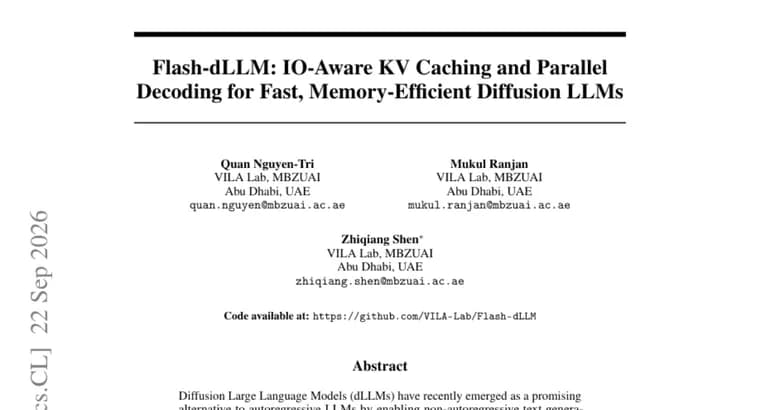
Diffusion large language models (dLLMs) generate text non-autoregressively, an approach researchers see as a promising alternative to standard token-by-token LLMs. In practice, though, dLLM inference has stayed slow because effective Key-Value (KV) caching and scalable parallel decoding have been missing. The authors say existing acceleration methods study KV caching and parallel decoding in isolation, which misses the I/O bottleneck that shows up once cache reuse and parallel token verification are combined.
Their answer is Flash-dLLM, a training-free inference acceleration framework. It first identifies GPU memory I/O as the dominant bottleneck in KV-cache-enabled dLLM inference and addresses it with an I/O-aware fused KV-cache kernel that cuts redundant memory movement. On top of that optimized cache, Flash-dLLM adds a KV-cache-driven draft-and-verify decoding strategy in which the dLLM itself acts as both drafter and verifier, with no separate auxiliary model required. The authors say this unified design speeds up decoding while preserving generation quality and scaling to longer sequences and larger batch sizes.
On mathematical reasoning and code-generation benchmarks, Flash-dLLM is reported to consistently beat existing state-of-the-art dLLM acceleration methods on both speed and memory efficiency. Measured against the previous strongest baseline, Elastic-Cache, it reaches a 5.1x speedup on the GSM8K math benchmark and an 11.0x speedup on the HumanEval code-generation benchmark.
Key facts
- Flash-dLLM is a training-free inference acceleration framework for diffusion large language models (dLLMs)
- It uses an I/O-aware fused KV-cache kernel to cut redundant GPU memory movement, which the authors call the dominant bottleneck in KV-cache-enabled dLLM inference
- Its draft-and-verify decoding strategy uses the dLLM itself as both drafter and verifier, without a separate auxiliary model
- It reaches a 5.1x speedup on the GSM8K math benchmark and an 11.0x speedup on the HumanEval code benchmark versus the prior strongest baseline, Elastic-Cache
- The authors say the method preserves generation quality while scaling to longer sequences and larger batch sizes
Why it matters
Diffusion LLMs are a non-autoregressive alternative to standard token-by-token generation, but slow inference has kept them out of practical use. Flash-dLLM's contribution is a training-free fix, no retraining or fine-tuning needed, for a bottleneck the authors say prior acceleration work had missed: GPU memory I/O in KV-cache-enabled inference, overlooked because earlier methods treated caching and parallel decoding as separate problems rather than a combined one.
Who it affects
Researchers and engineers building or serving diffusion language models. The method is designed to plug into existing dLLM inference rather than requiring a new model architecture or a separately trained draft model, since the dLLM handles both drafting and verification itself.
How to use it
Flash-dLLM is described as training-free: the I/O-aware fused KV-cache kernel and the draft-and-verify decoding strategy apply directly at inference time. No release date, code availability, or model download link is mentioned in the text, so it is not yet clear how or when others can run it themselves.
How solid is it
The claims come from the paper's own abstract, which describes extensive experiments on mathematical reasoning and code-generation benchmarks. The two reported figures, 5.1x on GSM8K and 11.0x on HumanEval, are relative speedups against one baseline, Elastic-Cache; the abstract gives no absolute latency, throughput, or memory numbers, and no GPU model or other hardware is specified. It also names no authors or institutions.
Risks and caveats
With only relative speedups against a single baseline, and no hardware details or absolute performance numbers, it is hard to judge how the reported gains would carry over to a different GPU or deployment setup. The results also come solely from the authors' own benchmarks, without independent verification.