ContextMaster handles multi-shot video generation and editing in one model
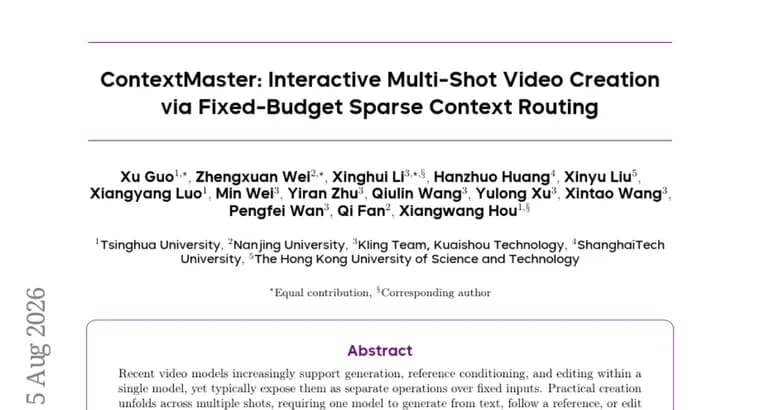
Video generation models increasingly bundle generation, reference conditioning, and editing into one model, but they still treat each as a separate operation on fixed inputs. Real creative work is not one shot: it unfolds across multiple shots that need to share history, and a model has to generate from text, follow a reference, or edit existing footage while remembering what came before. A new paper formalizes this setting as interactive multi-shot video creation (IMVC) and introduces ContextMaster, a unified model built around a role-aware context representation for these three operations. The core technical problem the authors identify is that an interactive model needs access to an expanding history of past shots without the cost of reading that context at each denoising step growing as the history grows. ContextMaster addresses this by combining reusable clean context states with fixed-budget sparse context routing, so only a bounded slice of the accumulated context is read at each step, and by using a mechanism called ConstraintSink to keep task-specific constraints visible to the model throughout generation. Training such a model under sparse context access and with few denoising steps at inference is itself hard, so the authors propose a two-stage privileged context distillation framework: first, consistency distillation transfers the behavior of a dense teacher model that has full access to context, and second, distribution matching refines the rollouts the model actually produces at deployment. The authors report experiments across three primitive tasks (generation, reference conditioning, and editing) showing improved task fulfillment and better consistency across shots compared with specialized baselines built for each task individually, plus user studies that validate workflows combining these operations flexibly. The model runs at 16 FPS on a single GPU.
Key facts
- The paper formalizes interactive multi-shot video creation (IMVC): one model must generate from text, follow a reference, or edit footage while retaining shared history across shots.
- ContextMaster uses a role-aware context representation, reusable clean context states, and fixed-budget sparse context routing so the per-step context read cost does not grow as history expands.
- A ConstraintSink mechanism keeps task-specific constraints visible to the model during generation.
- Training uses two-stage privileged context distillation: consistency distillation from a dense, full-context teacher, followed by distribution matching to refine deployment rollouts under few denoising steps.
- Experiments on three primitive tasks show improved task fulfillment and cross-shot consistency versus specialized baselines, with user studies validating flexibly composed workflows, and the model runs at 16 FPS on a single GPU.
Why it matters
Video models have been adding generation, reference conditioning, and editing as separate capabilities bolted onto fixed inputs, which does not match how video is actually made: in shots, with each new shot depending on what came before. ContextMaster treats multi-shot creation as the target setting from the start, and its fixed-budget context routing is the piece that makes an expanding shot history practical to work with interactively rather than something that slows generation down over time.
Who it affects
Researchers and engineers building video generation and editing systems that need to maintain state across multiple shots rather than treating each generation as an isolated call. It is also relevant to anyone designing interactive creative tools where a user issues a sequence of generate, reference, and edit operations against a shared, growing history.
How to use it
ContextMaster is presented as a unified model rather than three separate tools: the same model exposes generation from text, reference-conditioned generation, and editing of existing footage, coordinated through the role-aware context representation. The fixed-budget sparse context routing and ConstraintSink are the mechanisms that let a user keep composing operations across shots without the model losing track of task constraints or slowing down as the history grows.
How solid is it
The authors test the approach on three primitive tasks and report gains in task fulfillment and cross-shot consistency against specialized baselines, backed by user studies on flexibly composed workflows. The abstract, however, does not give specific numeric comparison scores against those baselines, only qualitative claims of improvement, and does not name the datasets or baseline systems used.
Risks and caveats
The source text names no individual authors or institutions, gives no publication venue or release date, and does not specify the GPU model beyond 'a single GPU.' Without named baselines, datasets, or numeric benchmark scores, the strength of the reported improvements over prior specialized systems cannot be independently assessed from the abstract alone.