CoworkOS harness splits agent strategy from execution for long-horizon work
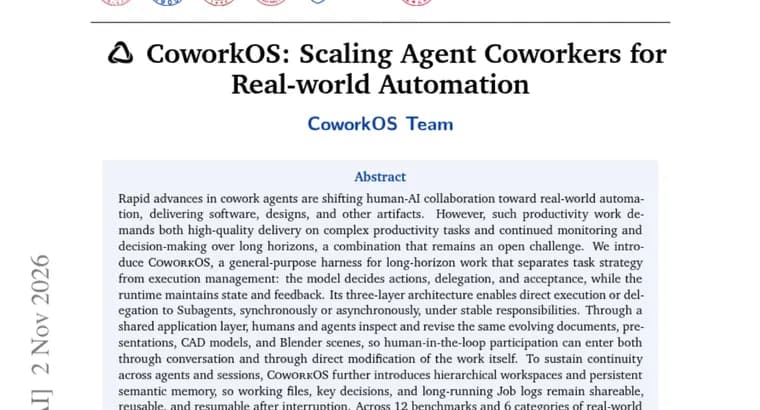
The paper introduces CoworkOS, a general-purpose harness for long-horizon work by "cowork agents", the kind of AI collaborators that deliver software, designs and other artifacts. The authors start from a problem they say remains open: productivity work needs both high-quality delivery on complex tasks and continued monitoring and decision-making over long horizons.
The core design choice is to separate task strategy from execution management. The model decides actions, delegation and acceptance of results, while the runtime maintains state and feedback. A three-layer architecture lets the system execute directly or delegate to Subagents, either synchronously or asynchronously, under stable responsibilities.
A shared application layer lets humans and agents inspect and revise the same evolving documents, presentations, CAD models and Blender scenes. Human-in-the-loop participation can therefore happen through conversation or through direct edits to the work itself. To keep continuity across agents and sessions, CoworkOS adds hierarchical workspaces and persistent semantic memory, so working files, key decisions and long-running Job logs stay shareable, reusable and resumable after an interruption.
On evaluation, the authors say that across 12 benchmarks and 6 categories of real-world applications, CoworkOS proves highly competitive with frontier agent applications such as Codex and DeepSeek Harness. No per-benchmark results are given in the text.
The sustained-work case study is the one concrete result. CoworkOS used GLM-5.3 as its backbone to run RSI-driven automated post-training on Qwen3.6-35B-A3B. Over five rounds, that model's average score across eight benchmarks rose from 33.19 to 42.95, a gain of 9.76. The authors close by saying they believe CoworkOS opens a meaningful path toward general cowork-agent intelligence.
Key facts
- CoworkOS is a general-purpose harness for long-horizon work: the model decides actions, delegation and acceptance, while the runtime maintains state and feedback.
- Its three-layer architecture supports direct execution or delegation to Subagents, synchronously or asynchronously, and humans and agents edit the same documents, presentations, CAD models and Blender scenes.
- Hierarchical workspaces and persistent semantic memory keep working files, key decisions and Job logs resumable after interruption.
- Across 12 benchmarks and 6 categories of real-world applications, the authors call it highly competitive with Codex and DeepSeek Harness.
- In a case study, CoworkOS with GLM-5.3 as backbone post-trained Qwen3.6-35B-A3B over five rounds, lifting its average across eight benchmarks from 33.19 to 42.95 (+9.76).
Why it matters
Cowork agents are moving human-AI collaboration toward real-world automation, producing software, designs and other artifacts. The authors argue that doing this well takes both strong delivery on complex tasks and sustained monitoring and decision-making over long horizons, and that this combination is still an open challenge. CoworkOS is their proposed answer: keep strategy with the model and hand state and feedback to the runtime.
Who it affects
The work is aimed at people building or using agent systems for long, multi-step productivity tasks, especially where the output is an editable artifact such as a document, presentation, CAD model or Blender scene. The shared application layer is designed so that human collaborators can step in by changing the work directly, not only by chatting with the agent.
How to use it
The abstract describes a design, not a product. No code, model release, license or availability is mentioned. What a reader can take from it is the architecture: a model that owns actions, delegation and acceptance, a runtime that owns state and feedback, Subagents that run synchronously or asynchronously, and workspaces plus semantic memory so long jobs can be resumed.
How solid is it
This is a preprint abstract and the evidence it gives is thin. The comparison with Codex and DeepSeek Harness is stated only as "highly competitive", with no per-benchmark scores, and the 12 benchmarks are not named. The case study gives a concrete jump from 33.19 to 42.95 across eight benchmarks, but the unit of the score is not stated, and it is not stated whether the gain was measured on held-out benchmarks. The abbreviation "RSI-driven" is not expanded in the source.
Risks and caveats
Treat the headline claims as the authors' own. The closing line, that CoworkOS opens a meaningful path toward general cowork-agent intelligence, is a belief, not a demonstrated result. No compute cost, training time or hardware is given for the five post-training rounds, so the cost of the 9.76 gain is unknown.
“we believe CoworkOS opens a meaningful path toward general cowork-agent intelligence”
— CoworkOS paper abstract