CUA-Master trains a 27B computer-use agent, scoring 80.2 on OSWorld Verified
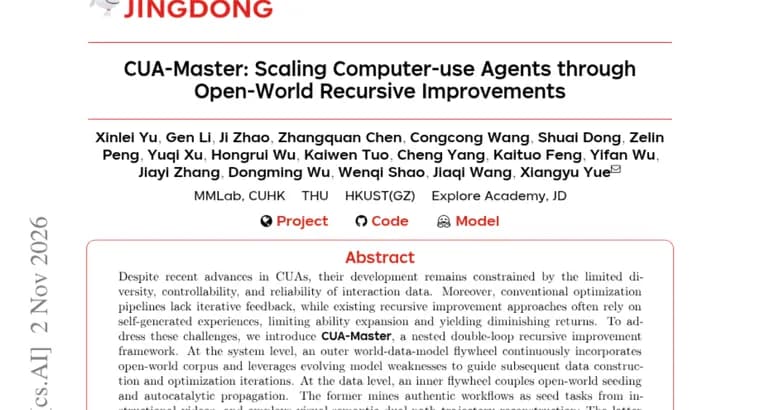
A paper on Hugging Face introduces CUA-Master, a framework for improving computer-use agents (CUAs), the models that operate software through its graphical interface and, in some benchmarks, a command line as well. The authors start from a data problem: CUA development remains constrained by the limited diversity, controllability and reliability of interaction data. They add that conventional optimization pipelines lack iterative feedback, and that existing recursive improvement approaches often rely on self-generated experiences, which limits how far an agent's abilities can expand and yields diminishing returns.
CUA-Master is described as a nested double-loop recursive improvement framework. The outer loop works at the system level. It is a world-data-model flywheel: it continuously takes in open-world corpus and uses the model's evolving weaknesses to steer later rounds of data construction and optimization.
The inner loop works at the data level and couples two parts, open-world seeding and autocatalytic propagation. Seeding mines authentic workflows from instructional videos and uses them as seed tasks, applying what the authors call visual-semantic dual-path trajectory reconstruction. Propagation then turns those seeds into reusable primitives, which allow controlled synthesis of diverse, complex and verifiable tasks.
For collecting trajectories efficiently and reliably, the authors add a feedback-guided snapshot-rollback retry mechanism that runs in various real environments.
On results, the authors say CUA-Master-27B achieves competitive performance across GUI-only and GUI-CLI hybrid benchmarks. The reported scores are 80.2 on OSWorld Verified, 36.9 on OSWorld 2.0, 43.9 on WeaveBench and 25.0 on Agents' Last Exam. They also say the framework substantially improves the quality and efficiency of data synthesis, and that it shows continuous gains across recursive iterations.
Key facts
- CUA-Master is a nested double-loop recursive improvement framework for computer-use agents, built to address limited diversity, controllability and reliability of interaction data.
- The inner loop mines authentic workflows from instructional videos as seed tasks, then turns them into reusable primitives to synthesize diverse, complex and verifiable tasks.
- The outer loop is a world-data-model flywheel that brings in open-world corpus and uses the model's evolving weaknesses to guide later data construction and optimization.
- CUA-Master-27B is reported at 80.2 on OSWorld Verified, 36.9 on OSWorld 2.0, 43.9 on WeaveBench and 25.0 on Agents' Last Exam.
- A feedback-guided snapshot-rollback retry mechanism is used to collect trajectories in various real environments.
Why it matters
Computer-use agents depend on interaction data, and the authors name its limited diversity, controllability and reliability as the main constraint. Their answer is to stop relying on an agent's own generated experience, which they say limits ability expansion and yields diminishing returns, and to draw seed tasks from outside material: instructional videos. If the approach holds up, it offers one route to a steadier supply of verifiable training tasks. The headline number is 80.2 on OSWorld Verified for the 27B model.
Who it affects
Teams building and training computer-use agents are the direct audience, particularly those who synthesize training tasks and collect trajectories. Researchers who evaluate agents on OSWorld, OSWorld 2.0, WeaveBench or Agents' Last Exam may also care, since the paper reports a score on each of the four.
How to use it
The source text describes a method, not a release: it mentions no code, weights or data. For practitioners, the usable ideas are in the design. Mine workflows from instructional videos as seed tasks, convert them into reusable primitives for controllable task synthesis, feed the model's current weaknesses back into the next round of data construction, and retry trajectory collection with a feedback-guided snapshot-rollback mechanism in real environments.
How solid is it
The claims are the authors' own and rest on what the abstract calls extensive experiments. The source does not say who the authors are, which base model sits behind CUA-Master-27B, or what unit the benchmark scores are in. It gives no baselines, so the 80.2 cannot be ranked against other agents; the authors say only that performance is competitive. The claims of substantially better data-synthesis quality and efficiency, and of continuous gains across iterations, come with no numbers in the source. The 80.2, 36.9, 43.9 and 25.0 scores are reported as stated.
Risks and caveats
The text is an abstract, so the size of the synthesized dataset, the number of videos used and the number of recursive iterations are not given. Without baselines or a stated metric, the benchmark figures are hard to interpret on their own. The authors describe their framework as addressing diminishing returns in recursive improvement, but the size of the gains across iterations is not quantified. Treat the results as unverified claims until code, weights or data are available to check.