Decision models lose accuracy outside English, study of 25 finds
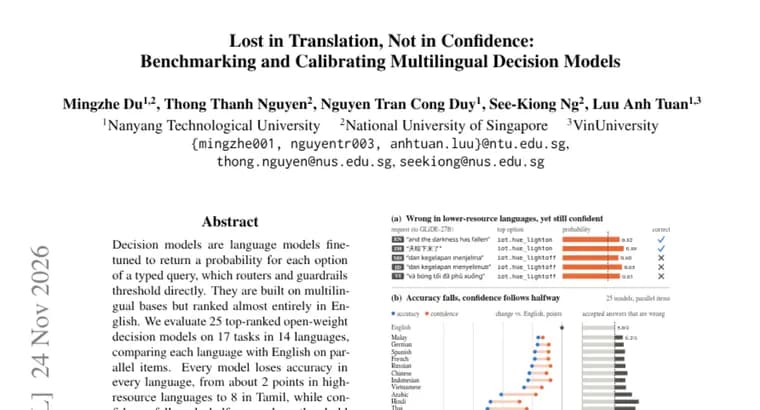
Decision models are language models fine-tuned to return a probability for each option of a typed query. Routers and guardrails apply thresholds to those probabilities directly. The authors of the paper "Lost in Translation, Not in Confidence: Benchmarking and Calibrating Multilingual Decision Models" point out that such models are built on multilingual bases but ranked almost entirely in English.
To see what happens in other languages, they evaluated 25 top-ranked open-weight decision models on 17 tasks in 14 languages, comparing each language with English on parallel items. Every model lost accuracy in every language, from about 2 points in high-resource languages to 8 points in Tamil. Confidence fell only half as much. In practice, a threshold set for 95% accuracy in English yields 90% in Tamil. The size of the loss was set by the language and the base model rather than by leaderboard rank.
The authors also ran 81 controlled fine-tuning runs. Task skill learned in English transferred to other languages, and a few thousand items in the target language narrowed large losses. Neither more data nor full-parameter tuning closed them.
The last finding concerns how multilingual tests are made. In all 23 benchmark-language pairs the authors compared, the same test items were answered more accurately when an LLM had translated them than when a person had. The authors conclude that LLM-translated test sets understate the gap.
Key facts
- The study evaluates 25 top-ranked open-weight decision models on 17 tasks in 14 languages, comparing each language with English on parallel items.
- Every model loses accuracy in every language, from about 2 points in high-resource languages to 8 points in Tamil, while confidence falls only half as much.
- A threshold set for 95% accuracy in English yields 90% in Tamil.
- In 81 controlled fine-tuning runs, a few thousand target-language items narrowed large losses, but neither more data nor full-parameter tuning closed them.
- In all 23 benchmark-language pairs compared, LLM-translated test items were answered more accurately than human-translated ones.
Why it matters
Routers and guardrails act directly on the probabilities these models return. If accuracy drops in another language and confidence does not drop as far, a threshold chosen on English data no longer delivers what it promised: the paper's example is a 95% target that yields 90% in Tamil. The authors also report that leaderboard rank does not set the size of the loss. The language and the base model do. That matters because the ranking happens almost entirely in English.
Who it affects
Teams that use decision models in routers or guardrails and serve users in languages other than English are the most directly concerned. So is anyone picking a model by its leaderboard position and expecting that standing to carry across languages. Builders of multilingual benchmarks have a stake too, since the paper finds that LLM-translated test sets understate the gap.
How to use it
The findings suggest a few checks. Measure accuracy in each language you serve instead of reusing an English threshold unchanged. Weigh the base model when choosing, because rank alone did not predict the loss. If a language shows a large drop, fine-tuning on a few thousand items in that language narrowed such losses in the authors' runs, though it did not close them. When testing, be wary of scores obtained on LLM-translated items, which came out higher than scores on human translations of the same items.
How solid is it
These are the authors' own results, and this retelling rests on the paper's abstract. The stated scope is sizeable: 25 models, 17 tasks, 14 languages and 81 controlled fine-tuning runs, with the translation effect seen in all 23 benchmark-language pairs compared. The abstract names none of the 25 models or their base models, and it gives no size for the accuracy difference between LLM and human translations.
Risks and caveats
The headline loss figures are a range, from about 2 points to 8, so the effect differs a lot by language and one number should not be applied to all of them. The 95% to 90% threshold example is specific to Tamil. The title mentions calibrating, but the abstract describes no specific calibration method or fix for the confidence mismatch. Extra target-language data helps with large losses, yet the authors report that neither more of it nor full-parameter tuning removes them.
“Every model loses accuracy in every language, from about 2 points in high-resource languages to 8 in Tamil, while confidence falls only half as much”
— The paper's abstract