Boundary-Aware Policy Learning targets robot handoff failures
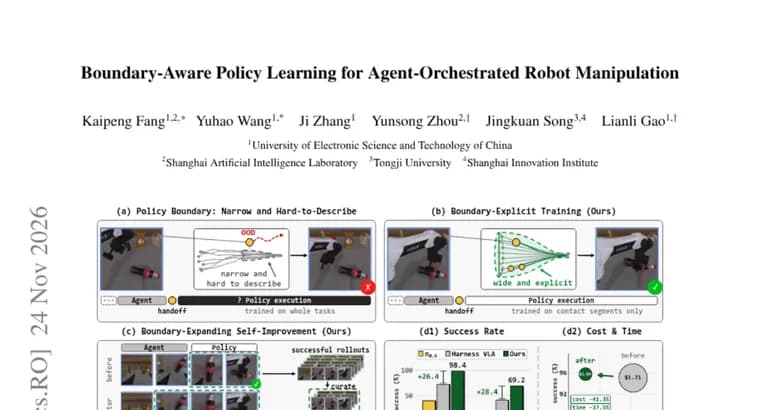
A paper titled "Boundary-Aware Policy Learning for Agent-Orchestrated Robot Manipulation" looks at robot systems in which a multimodal agent, which brings general reasoning, calls on a learned visuomotor policy, which brings precise physical control.
The authors say such systems often fail at the moment of handoff. A policy is reliable only from a limited set of start states, and the agent may invoke it from outside that region. They call this region the policy's "handoff boundary". Existing whole-task policies, they argue, typically have boundaries that are narrow and hard for an agent to characterize, which makes reliable coordination difficult.
Their answer, Boundary-Aware Policy Learning, first shapes that boundary explicitly and then expands it. The first stage, Boundary-Explicit Training, fine-tunes the policy on contact segments with diverse start poses. According to the authors, this yields a wide, well-defined boundary that can be communicated to the agent through a simple handoff protocol.
The second stage, Boundary-Expanding Self-Improvement, retrains the policy on curated successful rollouts of the system. This extends the boundary toward earlier stages of each task, so the agent can hand over sooner and make fewer language-model calls.
Across two benchmarks, RoboTwin 2.0 and RoboDojo, the authors report that their system beats the strongest baseline by more than 26 percentage points. It reaches 98.4% success in randomized RoboTwin 2.0 scenes, while further reducing its API cost by 41.3% and its execution time by 37.5%. The authors conclude that robust orchestration depends not only on improving the agent or the policy individually, but also on explicitly shaping the boundary between them.
Key facts
- The "handoff boundary" is the authors' name for the limited region of start states from which a visuomotor policy is reliable.
- Boundary-Explicit Training fine-tunes the policy on contact segments with diverse start poses so the agent can be told where it may hand over.
- Boundary-Expanding Self-Improvement retrains on curated successful rollouts, letting the agent hand over sooner with fewer language-model calls.
- Across RoboTwin 2.0 and RoboDojo, the system reportedly beats the strongest baseline by more than 26 percentage points, with 98.4% success in randomized RoboTwin 2.0 scenes.
- The authors also report cuts of 41.3% in the system's API cost and 37.5% in its execution time.
Why it matters
Pairing a reasoning agent with a trained control policy only works if the first passes control to the second at a point the second can handle. The paper treats that transfer as a design target in its own right. Its framing is that a stronger agent or a stronger policy is not the whole answer: the region where one can safely take over from the other also has to be shaped, made clear and then widened.
Who it affects
The work is most relevant to researchers and engineers who build robot manipulation systems where a multimodal agent invokes learned visuomotor policies. Anyone paying for language-model calls inside such a loop has a second reason to look, since the second training stage aims to let the agent hand over earlier and call the model less often.
How to use it
The recipe has two steps. Fine-tune the policy on contact segments that start from diverse poses, and describe the resulting boundary to the agent through a simple handoff protocol. Then retrain the policy on curated successful rollouts from the whole system, so that it can take over at earlier stages of each task. No code, model or data release is mentioned in the abstract.
How solid is it
These are the authors' own results on RoboTwin 2.0 and RoboDojo, as summarized in the paper's abstract. The abstract does not name the strongest baseline or give its success rate, and it gives no number of tasks, trials or rollouts. The 98.4% figure applies to randomized RoboTwin 2.0 scenes only, with no separate success rate given for RoboDojo.
Risks and caveats
No real-robot experiments are mentioned, so the figures should not be read as evidence of performance on physical hardware. The reference point for the 41.3% cost and 37.5% time reductions is not explicitly stated. The multimodal agent and the underlying policy architecture are not named either, which makes it hard to judge from the abstract how far the results carry over to other setups.
“These results suggest that the key to robust agent-policy orchestration lies not only in improving either component individually, but also in explicitly shaping the boundary between them.”
— The paper's authors