AIChipBench finds stored state trips up LLM agents writing chip code
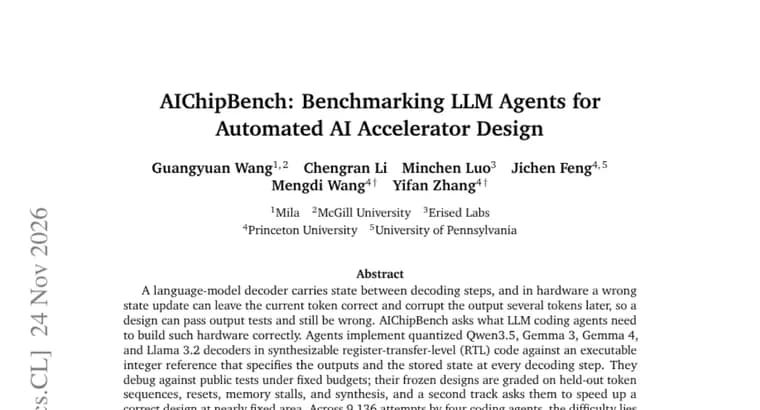
A paper introduces AIChipBench, a benchmark that asks what LLM coding agents need in order to build language-model decoder hardware correctly. The problem it targets is state. A decoder carries state from one decoding step to the next, and in hardware a wrong state update can leave the current token correct while corrupting the output several tokens later. A design can therefore pass output tests and still be wrong.
In the benchmark, agents implement quantized Qwen3.5, Gemma 3, Gemma 4 and Llama 3.2 decoders in synthesizable register-transfer-level (RTL) code. They work against an executable integer reference that specifies both the outputs and the stored state at every decoding step. Agents debug against public tests under fixed budgets. Their frozen designs are then graded on held-out token sequences, resets, memory stalls and synthesis. A second track asks them to speed up a correct design at nearly fixed area.
Across 9,136 attempts by four coding agents, the authors report that the difficulty lies in stored state. In a matched study, feedback pointing to the first state mismatch raised acceptance over output-only feedback in all 12 agent-task cells, by 25.0 to 46.9 percentage points. It also halved the agent-hours per accepted design.
Passing the required tests did not guarantee a sound design. When regraded on new sequences and conditions, 45 of 69 accepted designs failed within the 32 steps their tests had required. On the speed-up track, more than a third of attempts to accelerate a correct design ended without a correct one.
An overall score ranks Sol 5.6 and Fable 5.1 above Astra 6 and Opus 5.5, and both halves of the benchmark instances give this order in all 200 random splits. The authors conclude that hardware agents need debugging feedback that exposes stored state, and that their benchmarks need final tests well beyond the development cases.
Key facts
- AIChipBench has LLM coding agents implement quantized Qwen3.5, Gemma 3, Gemma 4 and Llama 3.2 decoders in synthesizable RTL, checked against an executable integer reference.
- Feedback on the first state mismatch beat output-only feedback in all 12 agent-task cells of a matched study, raising acceptance by 25.0 to 46.9 percentage points and halving agent-hours per accepted design.
- Regraded on new sequences and conditions, 45 of 69 accepted designs failed within the 32 steps their tests required.
- More than a third of attempts to speed up a correct design at nearly fixed area ended without a correct design.
- An overall score puts Sol 5.6 and Fable 5.1 above Astra 6 and Opus 5.5, an order that held in both halves of the instances across all 200 random splits.
Why it matters
Decoder hardware has a failure mode that output checks can miss. A bad state update may leave the current token looking right and only show up several tokens later. AIChipBench is built around that gap: its reference specifies the stored state at every decoding step as well as the outputs, and final grading uses held-out token sequences, resets, memory stalls and synthesis.
Who it affects
The findings speak most directly to people who use coding agents to write hardware and to people who benchmark those agents. The authors address both: agents need debugging feedback that exposes stored state, and benchmarks need final tests that go well beyond the development cases.
How to use it
The practical lesson is about what the agent gets to see while debugging. In the matched study, pointing to the first state mismatch raised acceptance by 25.0 to 46.9 percentage points over showing outputs alone, and cut agent-hours per accepted design in half. For evaluation, the regrading result argues for holding back new sequences and conditions and testing finished designs on them before trusting a pass.
How solid is it
These are the authors' own results, taken here from the paper's abstract. The scale is stated: 9,136 attempts by four coding agents. The feedback effect pointed the same way in all 12 agent-task cells of the matched study. The ranking was checked for stability, with both halves of the instances giving the same order in all 200 random splits. The abstract gives no overall score values, per-agent acceptance rates or absolute acceptance levels.
Risks and caveats
Accepted does not mean correct: 45 of 69 accepted designs failed when regraded on new sequences and conditions. The abstract does not say how those 69 were selected. Its account covers RTL code and synthesis, and does not say that any design was manufactured in silicon or run on physical hardware. The 25.0 to 46.9 figures are percentage-point gains in acceptance, so they do not show how high acceptance was in absolute terms.
“Hardware agents therefore need debugging feedback that exposes stored state, and their benchmarks need final tests well beyond the development cases.”
— AIChipBench paper abstract