Destro emerges from stealth with $8M seed for AI that directs robots and workers
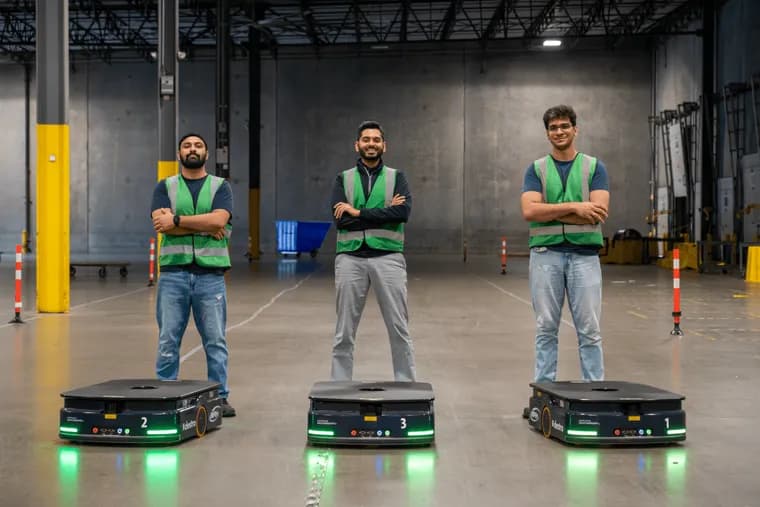
Destro, a startup that came out of stealth on Tuesday, says the best way to deploy a robot is not to build one. It announced an $8 million seed round led by Base10 Partners and Bonfire Ventures, with additional investment from CoFound Partners. While most new robotics companies chase the right form factor or an AI model to power robotic hands, Destro has built an AI intelligence layer that lets robots work effectively in logistics settings, in part by also telling the human workers what to do.
Founder Manthan Pawar, described as a veteran of the industry, earned a master's degree in robotics at NYU Tandon and has spent roughly eight years in the U.S. supply chain and robotics industry. He told TechCrunch: "One of the biggest reasons we are winning against robotics companies is because we are not a robotics company." He also says Destro is on path to be cash-flow positive at the end of this year.
The key customer relationship is Yusen Logistics, described as a South Korean shipping giant. Richard Brunelle, director of automation for its American logistics group, is responsible for automation across about 30 U.S. facilities. Yusen uses fixed automation such as conveyors and sorters, and is still piloting newer technology like trailer-unloading robots and autonomous floor scrubbers. Its U.K. subsidiary has built out a fully autonomous facility, and a similar plan is in the works in the U.S.
When Brunelle met Pawar, Destro was focused on picking and pack, the process of sorting goods into single packages. Brunelle saw that his own challenge, cross-docking (unloading goods from one truck and sorting them into mixed loads for the trucks that make final delivery), was "fundamentally the same problem." He asked Destro to adapt its solution to a cross-dock environment because he did not think anyone was doing that. In his words, Destro "went away, thought it through, and came back excited," agreed nobody was addressing that space, and has since "gone all in."
The first pilot ran at one Yusen facility in the Pacific Northwest. It used three cart-moving robots built by Miva Robotics, operated by Destro's Vision operating system, which is based on open-weight vision-language-action models (AI systems that interpret camera images and instructions to control a robot's movements). Human workers unload goods from a truck into different carts, and the robots find the full loads and take them to their destinations. Brunelle and Pawar estimate the efficiency comes from the human, the cart and the trucks all being directed by Destro's Mothership operating system. Brunelle said: "We make that operation less labor intensive, and we get away from the paper. Everything is now systematic."
Yusen also talked to two other big-name robot startups, and neither fit its workflow. One offered a robot that could move carts point to point but could not manage loading or unloading. The other came with fleet management tools but needed a person to handle all the orchestration. Destro won because it can apply autonomous direction to the whole process.
Destro is now expanding the initial pilot into a full deployment of 26 robots and launching another pilot with 17 robots at Yusen's facility in Southern California. Pawar plans to take the cross-dock loading workflow and "copy-paste" it across thousands of other warehouses that handle this kind of labor; that plan is what convinced the lead investors.
The article flags a challenge: workflows that need more dexterity and manipulation. Generic robot bodies and open source models have not proven capable at these tasks yet, and it is not clear whether companies building foundation models, ultra-dexterous hands or general-purpose humanoids will make their tools available to a company like Destro rather than trying to capture that business themselves. Pawar remains confident he has found the part of the stack where value will accrue: "Robots are a platform. Every layer model is a platform. But we build a harness around it." For now, competition from futuristic robot builders is probably not an issue: Brunelle says he has yet to find a good use case for a bipedal humanoid, though he is evaluating a potential pilot with a wheeled humanoid. Destro will appear in the Startup Battlefield at TechCrunch Disrupt, October 13-15.
Key facts
- Destro came out of stealth on Tuesday with an $8 million seed round led by Base10 Partners and Bonfire Ventures, with additional investment from CoFound Partners.
- It builds an AI layer, not robots: the Vision operating system (open-weight vision-language-action models) runs the robots, and the Mothership operating system directs the human, the cart and the trucks.
- The first Yusen Logistics cross-dock pilot in the Pacific Northwest used three Miva Robotics cart-moving robots; it is becoming a 26-robot deployment, with a new 17-robot pilot in Southern California.
- Yusen rejected two other robot startups: one could not handle loading or unloading, the other needed a person to handle all the orchestration.
- Pawar plans to copy-paste the workflow across thousands of warehouses and says Destro is on path to be cash-flow positive at the end of this year.
Why it matters
Destro bets that the valuable part of the robotics stack is the coordination layer, not the robot body or the model. Pawar's framing is that robots and models are platforms and Destro builds a harness around them. The Yusen case gives that bet a concrete shape: competitors offered either a robot that moved carts but could not manage loading, or fleet tools that still needed a person to orchestrate. Destro's pitch is that one system directs the whole process, including the human workers.
Who it affects
Logistics operators running cross-docking, where goods move from one truck into mixed loads for final-delivery trucks, are the direct target. Yusen's U.S. automation team, responsible for about 30 facilities, is the pilot customer. Warehouse workers are affected too, since the system tells them what to do; Brunelle says it makes the operation less labor intensive and gets rid of paper. Robot makers such as Miva Robotics supply hardware that Destro's software operates, and builders of foundation models, dexterous hands and humanoids are the players whose tools Destro may depend on.
How to use it
There is no public product to try in the source. Destro is working with pilot customers: a Pacific Northwest Yusen facility with three Miva Robotics cart-moving robots, growing to 26 robots, and a 17-robot pilot in Southern California. Pawar's plan is to reuse the cross-dock loading workflow across thousands of other warehouses that handle this kind of labor. Destro will appear in person at TechCrunch Disrupt's Startup Battlefield, October 13-15.
How solid is it
The account comes from a single TechCrunch article built on interviews with Pawar and Brunelle, so the performance claims are the two men's own. The efficiency gain is Brunelle's and Pawar's estimation, and Brunelle's description is qualitative. The article gives no throughput, labor reduction or cost figures for the pilot. The $8 million seed round, the lead investors and the robot counts are stated plainly. The cash-flow positive timeline is Pawar's statement, not something independently reported.
Risks and caveats
The article itself names the main risk: workflows needing more dexterity and manipulation, where generic robot bodies and open source models have not proven capable yet. It is also unclear whether the companies building foundation models, ultra-dexterous hands or general-purpose humanoids will make their tools available to Destro instead of trying to capture that business themselves. The track record is one customer, Yusen, and the pilots are still expanding. Brunelle's own stance is that automation must solve a real operational problem, not just be interesting technology.
“One of the biggest reasons we are winning against robotics companies is because we are not a robotics company.”
— Manthan Pawar, Destro founder, to TechCrunch