ESA's Hera reveals first views of DART's crater on Dimorphos
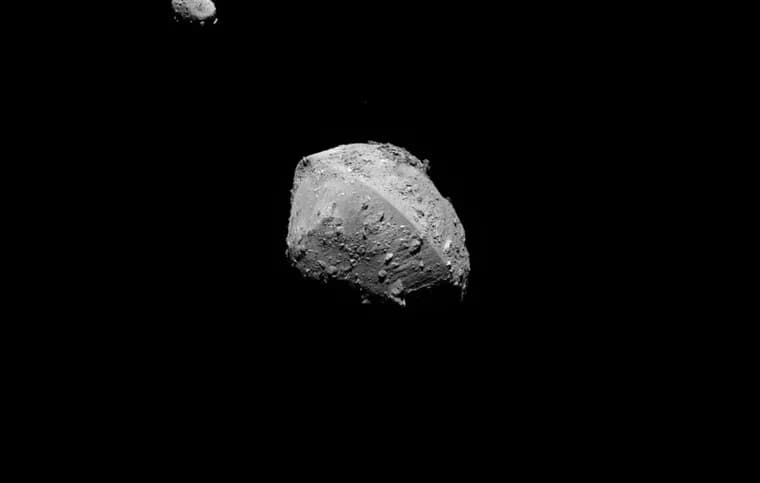
On Wednesday the European Space Agency (ESA) released the first views from its Hera spacecraft of the scar that NASA's DART probe left on the asteroid Dimorphos. According to Ars Technica, the images show that the car-sized impactor carved out a crater the size of a stadium, nearly as big as Dimorphos itself. The asteroid is a rugged chunk of rock about 500 feet (151 meters) across.
DART, short for Double Asteroid Redirection Test, was a NASA mission meant to show how humanity might deflect an asteroid on a collision course with Earth. The solar-powered probe slammed into Dimorphos in September 2022 at more than 13,700 mph (6.14 kilometers per second), releasing some 10 billion joules of energy. Dimorphos circles a larger asteroid, Didymos, and astronomers using telescopes measured how that orbit changed afterwards. The impact shortened the 12-hour orbit by about 33 minutes, 25 times the most conservative expectation.
There was a limit to what DART could tell scientists. The collision destroyed the spacecraft, as expected. DART recorded images as it took aim, but only faraway telescopes and a small CubeSat that briefly detected the impact flash could see what happened next. "We knew right away that the impact was successful, that DART made a really, really large mess," said Sabina Raducan, a planetary scientist at the International Space Science Institute in Bern, Switzerland. "However, we didn't really know what kind of mess. We were still missing pieces of the puzzle."
Hera recently arrived near Didymos and Dimorphos after a two-year journey that began on a launch pad in Florida. Scientists were not sure what it would find at the double asteroid, which is currently orbiting the Sun about 120 million miles (193.5 million kilometers) from Earth. Mission planners picked the pair for the experiment because they are similar to many near-Earth asteroids, while posing no risk of striking our planet.
Key facts
- ESA released Hera's first views of the DART impact scar on Dimorphos: a stadium-sized crater, nearly as big as the asteroid itself.
- Dimorphos measures about 500 feet (151 meters) across and orbits a larger asteroid, Didymos.
- DART hit in September 2022 at more than 13,700 mph (6.14 km/s), releasing some 10 billion joules of energy.
- The impact shortened Dimorphos's 12-hour orbit by about 33 minutes, 25 times the most conservative expectation.
- Hera arrived recently after a two-year journey; DART was destroyed in the collision and could not observe the aftermath.
Why it matters
DART was a first-of-its-kind test of whether a spacecraft could change an asteroid's path, with an eye to a future object on a collision course with Earth. Telescopes had already measured the orbital change. What scientists lacked was a clear picture of what the hit did to the asteroid. Hera's first views begin to fill that gap, and they show damage on a huge scale relative to the target.
Who it affects
The images speak first to planetary scientists studying the impact, including researchers such as Raducan who say pieces of the puzzle were still missing. The wider interest is in asteroid deflection. Didymos and Dimorphos were selected because they resemble many near-Earth asteroids, so what happened to them bears on how people think about objects of that kind. The pair itself poses no risk of striking Earth.
How to use it
Treat this as a reference case for deflection by direct impact. The known inputs are a car-sized impactor, a speed of 6.14 kilometers per second and some 10 billion joules of energy. The measured outcome is an orbit around Didymos shortened by about 33 minutes. Hera's views now add the physical mark left on a body about 151 meters wide.
How solid is it
This account rests on Ars Technica's report of images released by ESA, which operates Hera. The orbital change comes from telescope measurements made by astronomers after the 2022 impact. The crater's size is conveyed here by comparison, as that of a stadium and nearly as big as Dimorphos, so it should not be read as a precise measurement.
Risks and caveats
The 151 meter figure is the width of Dimorphos, not of the crater. These are Hera's first views of the scar, released soon after its arrival. The experiment targeted one small asteroid orbiting a larger one: similarity to many near-Earth asteroids does not mean every asteroid would respond the same way to an impact.
“We knew right away that the impact was successful, that DART made a really, really large mess”
— Sabina Raducan, planetary scientist at the International Space Science Institute in Bern, Switzerland