Fiora5 CEO says credibility, not engineering, was the hard part of starting a CPU company
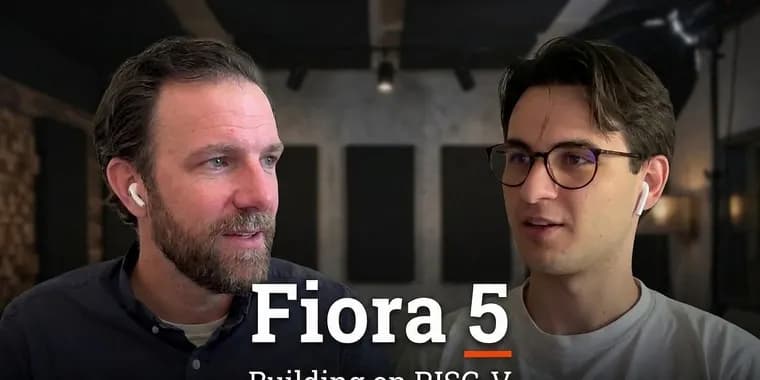
Darian Domocos is the CEO and co-founder of Fiora5, a startup that develops and licenses RISC-V processor IP out of Europe. In an interview with the newsletter The Siliconimist, he says the hardest part of starting the company was not the engineering: it was getting anyone to believe that two young, unknown engineers from Romania could pull it off. The interview frames founding a company as "a confidence game in the honest sense of the phrase," where you have to get people to believe in something before it is true and then make it true.
On RISC-V's prospects against Arm, the piece argues that closed systems still have an edge, but that open-source instruction sets are having a moment as the EDA tooling world and chip architectures change quickly. It ties this to a point made in Episode 8 of The Siliconimist, an earlier episode with guest Daniel Schulz: as more of the industry builds on open source and embraces it, a self-reinforcing cycle takes hold. Arm's real advantage, the piece says, is not its instruction set but the maturity of its ecosystem, forty years of programmer habit, toolchains, debugging and integration work. Domocos puts it directly: "you might have a really amazing RISC-V core, but because you don't have the auxiliary software it is harder to integrate." He calls standardization, specifically RVA23, "the unlock," the single biggest step he says RISC-V International has taken.
The interview also covers chip supply-chain politics. Open-source instruction sets are framed as a form of sovereignty: because no single company controls RISC-V, nations have fewer effective pressure points to control or compromise it. With the US and China locked into their own rivalry, the EU has decided it needs more chip sovereignty too, the piece says, and is building a local ecosystem rather than aligning fully with either side. Unlike China, Europe is described as realistic about not being able to replace or control the entire supply chain. The strategy is characterized as neither mutual assured destruction, nor self-reliance, nor Lenin's "commanding heights of the economy" approach, all of which the piece associates more closely with the US and China; instead it is Global Value Chain integration: specializing in and holding critical links of the chain to gain security and become irreplaceable. Fiora5, the piece says, is capitalizing on this as the EU invests in startups across the semiconductor industry.
On competing for engineering talent in a hot market where pay packages keep climbing, the piece explains that Fiora5 cannot win on salary alone, so it gives founding engineers stock options, agency along with equity. It frames this as attractive to talented engineers who would rather take on more responsibility at a startup than be micromanaged at a larger company, betting that early-career growth pays off over the long run.
The wider conversation, per the piece, also ranged into topics including why Domocos is steering Fiora5 away from the datacenter as a path to market, and career advice, though the recap does not explain his datacenter reasoning. Asked what he is reading, Domocos points to The Confidence Game by Maria Konnikova, a book about con artists and why people believe them; he came to it through an early interest in social engineering and considers it useful for understanding what motivates the people across the table from a founder. For technical learning, he calls Onur Mutlu's computer architecture lectures from ETH Zürich, free on YouTube, his "holy grail." He also follows Dylan Patel, SEMIVISION, Mario Gabriele, EE Times and Tom's Hardware. The piece closes by noting that Domocos will be in the US in late September for the RISC-V Summit and that Fiora5 is raising a larger funding round in the first quarter; neither date is given a year, and no amount or valuation is mentioned.
Key facts
- Darian Domocos, CEO and co-founder of RISC-V processor-IP startup Fiora5, says the hardest part of starting the company was convincing people that two young, unknown engineers from Romania could do it, not the engineering itself.
- Domocos calls RVA23 standardization "the unlock" and the single biggest step RISC-V International has taken; Arm's real edge, per the piece, is forty years of ecosystem maturity (tooling, debugging, integration), not the instruction set.
- The piece frames the EU's chip strategy as Global Value Chain integration: specializing in and holding critical supply-chain links to gain security and become irreplaceable rather than replacing the whole chain or pursuing self-reliance; it says Fiora5 is capitalizing on EU investment in semiconductor startups.
- Unable to compete on salary in a hot talent market, Fiora5 pays founding engineers with stock options, agency plus equity, instead of matching bigger companies' pay, the piece says.
- Domocos is reading The Confidence Game by Maria Konnikova and recommends Onur Mutlu's ETH Zürich computer-architecture lectures; he is heading to the US for the RISC-V Summit in late September, and Fiora5 is raising a larger funding round in the first quarter (no amount or year given).
Why it matters
The RISC-V-versus-Arm contest looks like a trust and tooling problem here, not just a technical one: Arm's edge is described as forty years of ecosystem maturity rather than instruction-set superiority, and Fiora5's own founding story shows how much a small, unknown team has to prove before anyone credits the engineering itself. RVA23 standardization is presented as the step that starts closing that gap. The interview also doubles as a snapshot of how European chip-sovereignty thinking becomes a business model for a small IP-licensing startup: an instruction set with no single controlling company is framed explicitly as a hedge against the kind of leverage the US and China can each exert over their own tightly held supply chains.
Who it affects
RISC-V ecosystem participants, chip designers and companies weighing RISC-V cores against Arm, who care whether RVA23 actually narrows the tooling gap; European semiconductor investors and policymakers backing the sovereignty-through-specialization approach described here; early-career engineers weighing a startup's equity-heavy offer against a larger company's salary; and other founders without an established name or track record who face the same credibility hurdle Domocos describes.
How to use it
Track RVA23 as the concrete marker of RISC-V's standardization progress rather than taking open-source momentum as a given. Domocos's reading list doubles as a syllabus: The Confidence Game by Maria Konnikova on why people extend trust, and Onur Mutlu's free ETH Zürich computer-architecture lectures on YouTube for the technical side, alongside Dylan Patel, SEMIVISION, Mario Gabriele, EE Times and Tom's Hardware for ongoing coverage. Two dates to watch, neither with a stated year: Domocos at the RISC-V Summit in the US in late September, and Fiora5's larger funding round expected in the first quarter.
How solid is it
This is a first-person interview account published by The Siliconimist, so Fiora5's story, the RVA23 characterization and the EU-strategy framing all rest on Domocos's own telling to the interviewer rather than independent verification or a cited study. No figures back the scale claims: no funding amount or valuation for Fiora5, no year attached to the September summit or the Q1 round, and no city or country given beyond "out of Europe." The one specific figure offered, Arm's forty years of ecosystem maturity, is the source's own characterization rather than a cited statistic.
Risks and caveats
As a sympathetic founder profile, the piece carries only Fiora5's side of the RISC-V-versus-Arm competition and its own reading of EU industrial strategy; the comparisons to mutual assured destruction, self-reliance and Lenin's "commanding heights of the economy" are the piece's own shorthand analogies, not a rigorous policy analysis. The interview names "why Domocos is steering Fiora5 away from the datacenter" as a topic covered in the conversation but never explains his reasoning. The second co-founder implied by "two young guys from Romania" is never named, and the mention of a coming, larger funding round carries no amount, valuation or year, so neither claim can be checked against public data from what is given here.
“You might have a really amazing RISC-V core, but because you don't have the auxiliary software it is harder to integrate.”
— Darian Domocos, CEO and co-founder of Fiora5