FrameForge adapts video foundation models for unified image generation
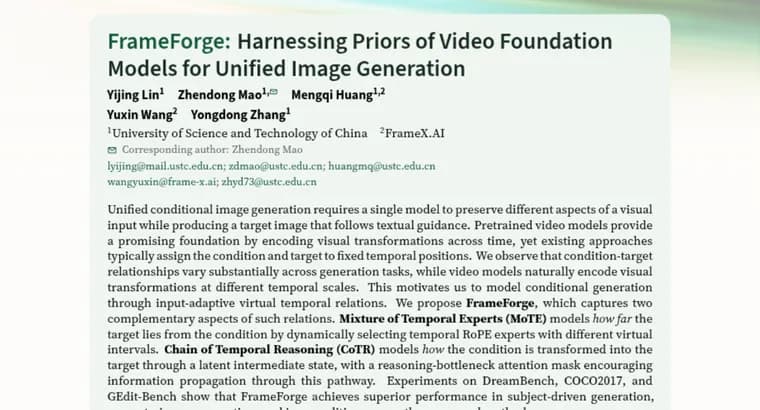
The paper, listed on Hugging Face Papers, tackles unified conditional image generation: one model that has to preserve different aspects of a visual input while producing a target image that follows a text prompt.
The authors start from the idea that pretrained video models are a promising foundation, because they encode visual transformations across time. Their complaint is about how existing approaches use them. Those approaches typically assign the condition and the target to fixed temporal positions in the video model. The authors observe that condition-target relationships vary substantially across generation tasks, while video models naturally encode visual transformations at different temporal scales. From that they draw the motivation for the paper: model conditional generation through input-adaptive virtual temporal relations, rather than a fixed layout.
The method is called FrameForge. It captures two complementary aspects of those virtual temporal relations.
The first is Mixture of Temporal Experts (MoTE). It models how far the target lies from the condition. It does this by dynamically selecting temporal RoPE experts that carry different virtual intervals, so the distance between condition and target is chosen per input.
The second is Chain of Temporal Reasoning (CoTR). It models how the condition is transformed into the target through a latent intermediate state. A reasoning-bottleneck attention mask encourages information to propagate through that pathway.
For evaluation, the authors ran experiments on DreamBench, COCO2017 and GEdit-Bench. They state that FrameForge achieves superior performance in subject-driven generation, canny-to-image generation and image editing among the compared methods.
Key facts
- FrameForge adapts pretrained video foundation models to unified conditional image generation, where one model handles several kinds of visual input plus a text prompt.
- The authors' complaint: existing approaches typically assign the condition and target to fixed temporal positions in the video model, although condition-target relationships vary substantially across tasks.
- Mixture of Temporal Experts (MoTE) models how far the target lies from the condition by dynamically selecting temporal RoPE experts with different virtual intervals.
- Chain of Temporal Reasoning (CoTR) models how the condition becomes the target through a latent intermediate state, using a reasoning-bottleneck attention mask that encourages information to flow through that pathway.
- Experiments on DreamBench, COCO2017 and GEdit-Bench show superior performance in subject-driven generation, canny-to-image generation and image editing among the compared methods.
Why it matters
Video models already learn how visual content changes over time, and this paper tries to turn that into a general tool for image generation and editing. The new idea is not to pin the input and output images at fixed frame positions. Instead, the model picks a virtual temporal distance and a latent intermediate step depending on the task. If that holds up, one model could cover subject-driven generation, edge-map-to-image generation and editing without a separate fixed layout for each.
Who it affects
Mainly researchers working on conditional image generation, image editing and the reuse of video foundation models. The paper frames its target as unified generation, so it is most relevant to anyone building a single model for several conditioning tasks rather than one model per task.
How to use it
As a research idea, the transferable pieces are the two modules: choosing among temporal RoPE experts with different virtual intervals (MoTE), and routing information through a latent intermediate state with a reasoning-bottleneck attention mask (CoTR). No code, weights or release information is mentioned in the source, so there is nothing to download or run based on this text alone.
How solid is it
This is a paper abstract. The authors claim superior performance in subject-driven generation, canny-to-image generation and image editing on DreamBench, COCO2017 and GEdit-Bench, but only among the compared methods. No numerical results, scores or margins over baselines are given, and the names of the compared methods are not given. No author names or institutions are given. The claim is the authors' own and has not been checked here.
Risks and caveats
Without scores, baselines or the base video model, the size of the improvement cannot be judged. The reasoning-bottleneck mask is described as encouraging information propagation through the latent pathway, not guaranteeing it. No training data, compute or model size is stated, so cost and reproducibility are unknown from this text.
“Pretrained video models provide a promising foundation by encoding visual transformations across time, yet existing approaches typically assign the condition and target to fixed temporal positions.”
— FrameForge abstract