Flux-OPD stabilizes context-based supervision for LLM distillation
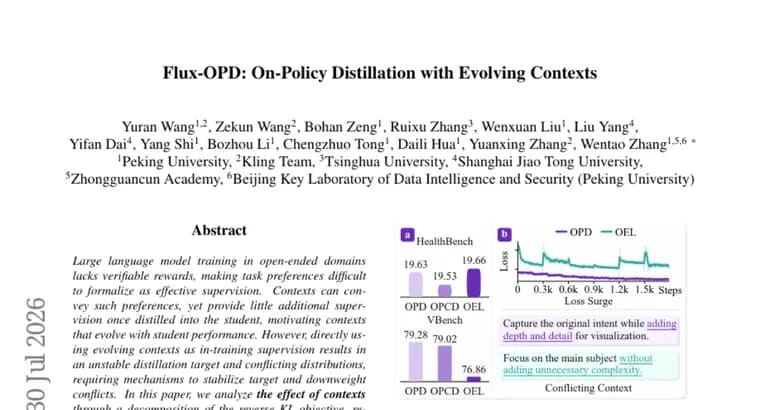
Researchers led by Yuran Wang describe a problem in training large language models on open-ended tasks (writing, dialogue and similar work without a single verifiably correct answer): there is no automatic reward signal to check the model against, so task preferences are hard to turn into training supervision. One workaround is to hand the model an explicit context describing what is wanted. But once that context has been distilled into the student model, it stops teaching anything new, which is the motivation for letting the context evolve alongside the student's own progress. The paper shows that doing this the naive way backfires: an evolving context makes the training target unstable and produces conflicting signals, because different versions of the context can disagree with each other.
To understand why, the authors decompose the reverse KL divergence objective used in on-policy distillation (OPD) and report two findings: the student ends up being pulled toward the geometric mean of several context-conditioned teachers, and the objective contains a distinct conflict term that measures how much those teachers disagree with one another. Building on that decomposition, they propose Flux-OPD, an OPD paradigm that uses the evolving context directly as in-training supervision. Flux-OPD treats the gap between a context-conditioned teacher and a context-free teacher as a contextual difference signal, injects that signal as a correction onto a stable context-free teacher anchor, and scales the strength of each correction using the conflict term, so that corrections the teachers disagree on are down-weighted rather than applied at full force. According to the paper, experiments on open-ended tasks show Flux-OPD outperforming existing OPD paradigms; the source text does not give specific benchmark names or numeric results for this comparison.
Key facts
- Flux-OPD is a new on-policy distillation (OPD) paradigm built for open-ended tasks that lack a verifiable reward signal.
- It uses a context that evolves along with the student model's performance as ongoing training supervision, instead of a context that is distilled once and then goes static.
- A decomposition of the reverse KL objective shows the student is pulled toward the geometric mean of context-conditioned teachers, with a separate conflict term measuring disagreement among them.
- Flux-OPD injects the gap between context-conditioned and context-free teachers as a correction onto a context-free teacher anchor, weighting the correction by the conflict term.
- The paper reports that Flux-OPD outperforms existing OPD paradigms on open-ended tasks, without stating specific benchmarks or numbers in the available text.
Why it matters
Open-ended tasks such as writing or dialogue have no single correct answer to check a model's output against, unlike math or code, so training signal has to come from somewhere else. Giving the student model an explicit context of preferences helps, but a context that is distilled once stops adding information as the student improves. Flux-OPD's contribution is a way to keep that context evolving as useful supervision throughout training, while explicitly correcting for the instability and cross-context conflicts that a naive version of the idea produces.
Who it affects
The paper targets researchers and labs doing LLM post-training and knowledge distillation, specifically teams building smaller student models from a larger teacher model for open-ended domains where reward signals cannot be formalized. It is not aimed at end users of chat products directly.
How to use it
This is a research paper published on Hugging Face rather than a released tool, so there is no product, license or pricing to note. Applying the method means adopting the Flux-OPD training paradigm: decomposing the reverse KL objective, computing the difference between context-conditioned and context-free teacher outputs, injecting that difference as a correction onto the context-free teacher anchor, and scaling the correction by the conflict term described in the paper.
How solid is it
The evidence is a single paper reporting that Flux-OPD outperforms existing OPD paradigms in experiments on open-ended tasks; the text available here does not specify which benchmarks were used or give numeric results for the comparison. On Hugging Face the paper has 29 points and one comment, indicating limited engagement so far.
Risks and caveats
The claim of outperforming existing paradigms comes from the authors' own experiments, with no independent benchmark figures given in the source text to check the size of the improvement. No code or model release is mentioned, and it is unclear from the available material how the method generalizes beyond the open-ended tasks tested.
“Flux-OPD treats the differences between context-conditioned and context-free teachers as contextual difference signals, injects them as contextual corrections into the context-free teacher anchor, and weights their correction strength using the conflict term as an indicator.”
— Flux-OPD paper, Yuran Wang and co-authors