Frontis-MA1 lifts MLE-Bench medal average from 39% to 71% via self-evolving AI4AI loop
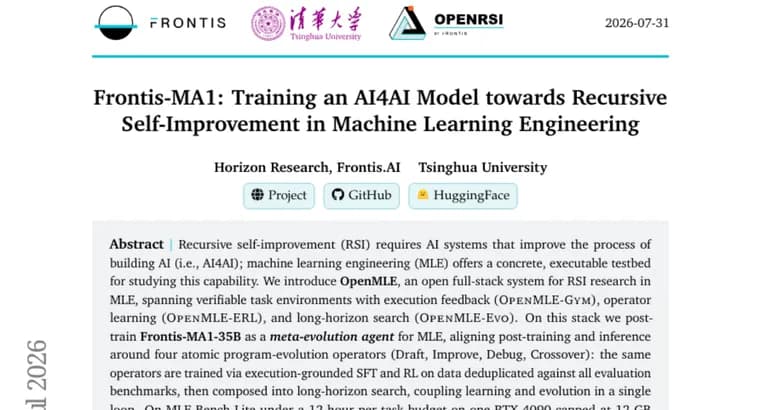
A research team has released OpenMLE, an open full-stack system for studying recursive self-improvement (RSI) through AI4AI: AI systems that get better at the process of building AI. The testbed the team chose is machine learning engineering (MLE) itself, because MLE tasks can be run and scored automatically. OpenMLE has three parts: OpenMLE-Gym, which provides verifiable MLE task environments with execution feedback; OpenMLE-RL, which trains the operators an agent uses to write and fix code; and OpenMLE-Evo, which handles long-horizon search across many attempts. On this stack the team post-trained a 35-billion-parameter model, Frontis-MA1, as a meta-evolution agent for MLE. Frontis-MA1 works through four atomic program-evolution operators: Draft, Improve, Debug and Crossover. These operators are trained with execution-grounded supervised fine-tuning and reinforcement learning on data that was deduplicated against every evaluation benchmark used in the paper, then chained together into the long-horizon search loop, so learning and evolutionary search run in the same cycle rather than as separate stages. On MLE-Bench Lite, under a 12-hour per-task budget and running on a single RTX 4090 capped at 12 GB of VRAM, Frontis-MA1 raises the Medal Average from a 39.39% base-model score to 60.61% once paired with OpenMLE-Evo, and to 71.21% with OpenMLE-Evo-Max, a version that adds benchmark-independent experience priors and asynchronous search. That 71.21% score exceeds the reported result for GPT-5.5 combined with Codex, and approaches, without surpassing, GPT-5.6 Sol and the 2.8 trillion-parameter Kimi K3. On a separate held-out benchmark, NatureBench Lite, the paper reports that each half of the system transfers on its own: keeping the search framework fixed and swapping in the trained Frontis-MA1 model raises the Match-SOTA rate from 50% to 70%, while keeping the model fixed and swapping in OpenMLE-Evo instead of a baseline search method raises Match-SOTA from 20% to 50%. The team is releasing both the Frontis-MA1 model weights and the full OpenMLE stack, with code published at github.com/FrontisAI/OpenRSI, explicitly to let others reproduce and extend AI4AI research toward RSI.
Key facts
- OpenMLE is an open full-stack RSI research system with three parts: OpenMLE-Gym (verifiable MLE task environments with execution feedback), OpenMLE-RL (operator learning) and OpenMLE-Evo (long-horizon search).
- Frontis-MA1 (35B) is post-trained as a meta-evolution agent using four operators, Draft, Improve, Debug and Crossover, trained via execution-grounded SFT and RL on data deduplicated against all evaluation benchmarks.
- On MLE-Bench Lite (12-hour task budget, single RTX 4090 capped at 12 GB VRAM), Frontis-MA1 raises Medal Average from 39.39% to 60.61% with OpenMLE-Evo, and to 71.21% with OpenMLE-Evo-Max, exceeding GPT-5.5 + Codex and approaching GPT-5.6 Sol and the 2.8T-parameter Kimi K3.
- On held-out NatureBench Lite, swapping in the trained model (framework fixed) raises Match-SOTA from 50% to 70%; swapping in OpenMLE-Evo (model fixed) raises it from 20% to 50%.
- The team releases the Frontis-MA1 model weights and the full OpenMLE stack, with code at github.com/FrontisAI/OpenRSI, for reproducible AI4AI research.
Why it matters
The paper targets a specific, narrower version of the broad and often speculative idea of recursive self-improvement: instead of a model improving itself in the abstract, it improves the concrete, checkable process of building machine learning systems. Framing this as AI4AI, and using machine learning engineering as an executable, scoreable testbed, gives the RSI question something the field usually lacks: a benchmark where progress can be measured in points rather than argued about in principle.
Who it affects
The direct audience is researchers and engineering teams working on autonomous coding agents, AutoML systems and AI research automation, who now have an open reference stack (OpenMLE) and a trained agent (Frontis-MA1) to build on or compare against. It also matters to anyone tracking how close current systems are to automating parts of AI development itself, since that is the capability the benchmarks in this paper are designed to probe.
How to use it
The team states it is releasing the Frontis-MA1 model weights and the complete OpenMLE stack, including OpenMLE-Gym, OpenMLE-RL and OpenMLE-Evo, with code published at github.com/FrontisAI/OpenRSI. The paper does not state a licence, a hosting location for the weights beyond the GitHub repository, or any pricing or access terms, so none of that is asserted here. The benchmark runs described in the paper were done on a single RTX 4090 capped at 12 GB of VRAM with a 12-hour per-task budget, which indicates the trained agent's evaluation footprint is modest relative to frontier-scale models, though the paper does not claim this as a hardware requirement for reproducing training itself.
How solid is it
The claims rest on the paper's own reported numbers on two benchmarks, MLE-Bench Lite and the held-out NatureBench Lite, run under the fixed hardware and time budget described above. The authors report separate ablations, holding the framework fixed and swapping the model, then holding the model fixed and swapping the search method, which is a reasonable way to isolate where the gains come from. The work comes from an independent research group rather than one of the major labs named in its own comparisons, and as a preprint posted to Hugging Face Papers (111 points, 1 comment at the time of writing) it has not gone through external peer review.
Risks and caveats
All performance figures are self-reported by the authors on benchmarks and hardware configurations they chose themselves, with no independent replication mentioned in the source. Frontis-MA1's 71.21% score is described as approaching, not exceeding, GPT-5.6 Sol and the 2.8T-parameter Kimi K3, so the headline gain is a comparison against the model's own base rate rather than a claim of a new overall state of the art. The evaluation is also confined to MLE-Bench Lite and NatureBench Lite; how the approach generalises beyond these two benchmarks, or to machine learning engineering tasks outside the ones tested, is not addressed in the source.