FreeFlow drops hand-built biases from optical flow, still hits SOTA
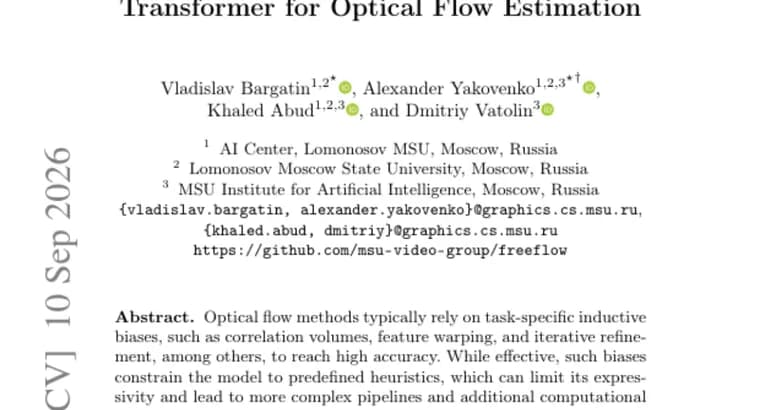
Optical flow estimation, tracking how pixels move between video frames, has long leaned on task-specific machinery: correlation volumes, feature warping, iterative refinement steps. Researchers argue these hand-built components work but box the model into predefined heuristics, which limits what it can learn and adds pipeline complexity and compute cost. Their answer is FreeFlow, a hierarchical transformer that drops every flow-specific component and instead uses a single feed-forward encoder-decoder. Inside it, three attention mechanisms split the work: window attention handles local detail, shifted-window attention lets information cross between windows, and a global attention pass runs at reduced resolution to capture long-range structure. Because the design has no specialized biases baked in, it scales cleanly: bigger model variants keep gaining accuracy, whereas biased architectures often plateau. On results, FreeFlow reports state-of-the-art scores on three standard benchmarks: 0.68/1.48 end-point error (EPE) on Sintel Clean and Final, a 3.23 Fl-all error rate on KITTI-2015, and 3.192 on the Spring benchmark's 1px metric. The paper also reports the model stays memory efficient when run at 1080p resolution. The abstract does not name the paper's authors, institution, training data, or whether code or trained weights will be released, and it does not list which prior methods FreeFlow was benchmarked against by name.
Key facts
- FreeFlow replaces standard optical-flow machinery (correlation volumes, feature warping, iterative refinement) with a single feed-forward transformer encoder-decoder.
- The architecture combines three attention types: window attention for local processing, shifted-window attention for cross-window exchange, and global attention at reduced resolution.
- Accuracy scales consistently as the model grows from small to large variants, despite having no flow-specific inductive biases.
- Reported results: 0.68/1.48 EPE on Sintel Clean/Final, 3.23 Fl-all on KITTI-2015, and 3.192 on Spring's 1px metric, all described as state-of-the-art.
- The model is reported as memory efficient at 1080p inference.
Why it matters
Optical flow models have historically needed hand-designed components to reach top accuracy. FreeFlow's authors show a generic transformer, with no flow-specific machinery at all, can match or beat that accuracy while scaling more predictably with model size. That is a data point for a broader pattern in computer vision: architectures with fewer built-in assumptions can outperform heavily engineered ones once given enough capacity, which simplifies the pipeline and can cut the extra computational cost that specialized components add.
Who it affects
The result speaks most directly to researchers and engineers building or maintaining optical flow systems, the models behind tasks like motion tracking, video frame interpolation, and video-based perception. A simpler, single-network approach could reduce the engineering overhead of maintaining separate correlation, warping, and refinement modules in a flow pipeline.
How to use it
The abstract gives no information on code or trained-model availability, and states no price or licence terms, so there is nothing yet to point to for actually running FreeFlow.
How solid is it
The claims rest on three widely used optical-flow benchmarks (Sintel, KITTI-2015, Spring), with specific reported scores rather than vague claims of improvement. However, the abstract does not name the methods FreeFlow was compared against, nor the authors or their institution, so the result cannot yet be checked against a named prior state of the art or attributed to a specific research group.
Risks and caveats
This account is based on the paper's abstract alone: no training data, training procedure, authorship, institutional affiliation, publication venue, or release plans are stated in it. Without the comparison methods named or the full paper's peer review status known, the state-of-the-art claim should be read as the authors' own characterization pending independent verification.
“We present FreeFlow, a hierarchical transformer built without any flow-specific components, using instead a single feed-forward encoder-decoder.”
— the paper's abstract