GeoPair compresses transformers without retraining by pairing layers geometrically
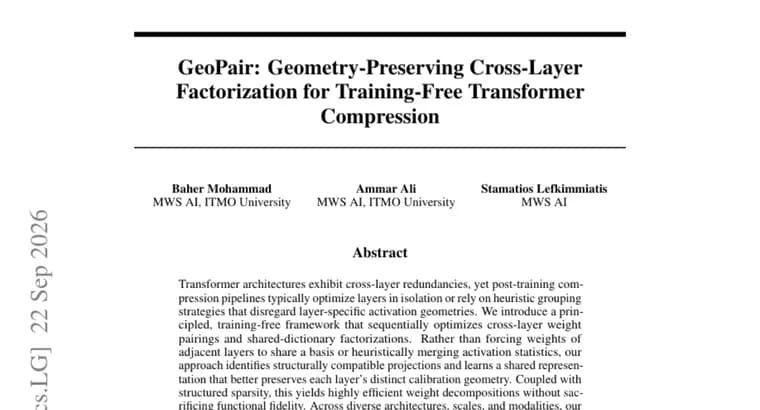
Ammar Ali (MWS AI, ITMO University) and Stamatios Lefkimmiatis (MWS AI) introduce GeoPair, a training-free framework for compressing transformer models. The authors argue that existing post-training compression pipelines typically optimize layers in isolation or rely on heuristic grouping strategies that ignore each layer's specific activation geometry. GeoPair instead sequentially optimizes cross-layer weight pairings and shared-dictionary factorizations, identifying structurally compatible projections and learning a shared representation that better preserves each layer's distinct calibration geometry.
The method rests on three technical components. First, Sylvester-based dictionary learning operates under distinct whitening spaces for each layer, removing the need for heuristic covariance aggregation. Second, layer pairing is chosen globally rather than by fixed adjacency rules, using weighted maximum matching via Edmonds' Blossom algorithm to find the best pairings across the whole network. Third, sparse coefficients are optimized with Hard Thresholding Pursuit, which the authors say comes with convergence guarantees.
The authors tested GeoPair across language model families including Llama, Qwen, Gemma, and Phi, spanning 1B to 32B parameters, evaluated on benchmark suites such as PIQA, HellaSwag, LAMBADA, ARC, SciQ, RACE, and MMLU. They also applied it to a non-text modality, the Wan2.2 5B video generation model, without any post-compression fine-tuning. The authors state that the method achieves state-of-the-art results, consistently outperforming independent structured weight decompositions and alternative pairwise weight factorizations that rely on heuristic grouping strategies. No specific compression ratios, accuracy numbers, or comparisons to named competing methods are given in the available text.
The authors also note a limitation: extending the approach beyond pairwise layer grouping to larger groups of layers remains non-trivial, because the closed-form Sylvester solver depends on simultaneous diagonalization properties that are specific to two-matrix pencil systems.
Key facts
- GeoPair is a training-free framework that compresses transformer models by pairing layers based on their activation geometry rather than fixed heuristics.
- It combines Sylvester-based dictionary learning, globally optimal layer pairing via Edmonds' Blossom algorithm, and sparse coefficient optimization using Hard Thresholding Pursuit.
- Tested on language models from 1B to 32B parameters across Llama, Qwen, Gemma, and Phi families, and on the Wan2.2 5B video generation model without fine-tuning.
- The authors report the method outperforms independent structured weight decompositions and heuristic pairwise weight factorizations, without giving specific numeric results in the available text.
- A stated limitation is that extending the pairwise grouping approach to larger groups of layers is not straightforward, due to constraints of the closed-form Sylvester solver.
Why it matters
Compressing large transformer models without retraining is valuable because retraining is expensive and often impractical for very large models. GeoPair's contribution is a way to choose which layers to jointly compress based on their actual activation geometry rather than fixed rules, which the authors say yields better results than prior grouping heuristics.
Who it affects
The work is aimed at researchers and engineers working on post-training compression of transformer models, including those deploying large language models (tested from 1B to 32B parameters across Llama, Qwen, Gemma, and Phi) and generative video models such as Wan2.2 5B.
How to use it
GeoPair is presented as a training-free post-processing framework: it can be applied to an existing trained model to compress it without a fine-tuning step afterward, as demonstrated on the Wan2.2 5B video model. No pricing, licensing, or release details are given in the available text.
How solid is it
The account is based on the paper's abstract and stated experimental scope, which lists the benchmark suites and model families used, but the visible text does not include the actual numeric results, compression ratios, or comparisons against specific named competing methods, so the strength of the claimed state-of-the-art performance cannot be independently verified from what is available here.
Risks and caveats
The authors themselves flag a limitation: extending the method beyond pairing two layers at a time to larger groups of layers is non-trivial, because the closed-form Sylvester solver relies on simultaneous diagonalization properties specific to two-matrix pencil systems. No publication or submission date is given for the paper.