Google DeepMind unveils Gemini Robotics 2 for whole-body control
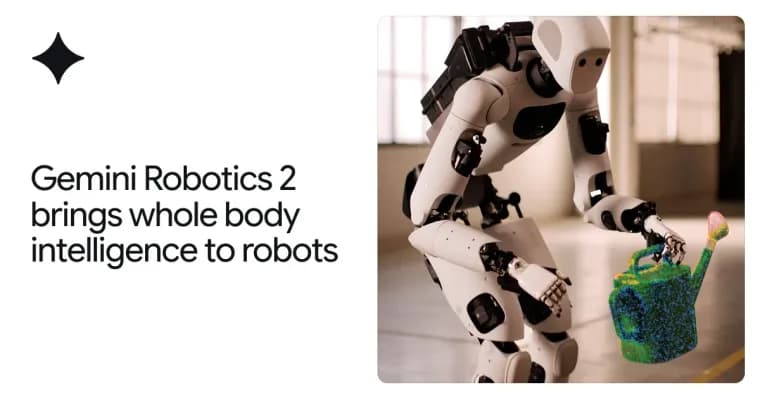
Google DeepMind has released Gemini Robotics 2, an update built around three separate models rather than one. Gemini Robotics 2 itself is a vision-language-action (VLA) model that turns visual and language input into motor commands, controlling full humanoid bodies from feet to fingertips as well as bi-arm robots. Gemini Robotics ER 2 is an embodied-reasoning vision-language model that acts as the robot's high-level planner, talking to humans, reading the physical scene, and breaking a task into steps. Gemini Robotics On-Device 2 is a smaller VLA built to run locally on the robot itself, without a network connection.
The headline change from earlier versions is whole-body control. Previous models handled only upper-body, tabletop tasks; the new model can direct an entire humanoid. DeepMind demonstrated this on Apptronik's Apollo 2 robot, which was given the instruction "put the watering can into the green bin in the bottom shelf" and, unprompted step by step, walked to a table, picked up the watering can, crossed to a set of shelves, and placed it in the bin. DeepMind notes movement speed still needs work, but frames the demo as a step toward tasks that require coordinating the whole body rather than just the arms.
On dexterity, the model now drives the five-fingered, 22-degree-of-freedom SharpaWave hand fitted to Apollo 2 for fine actions such as tying knots or sealing a ziplock bag, and also operates ordinary two-fingered parallel grippers on a Franka Duo platform for tasks like tight packing.
Gemini Robotics ER 2 is aimed at longer, multi-step jobs, tracking sequences that run several minutes and involve hundreds of individual decisions, detecting when a task starts and ends, and self-correcting if a step fails. This release also adds multi-robot collaboration, letting different robot types split a workflow that one robot could not finish alone.
Gemini Robotics On-Device 2 is built for offline operation and inherits DeepMind's "motion transfer" technique from Gemini Robotics 1.5: it can adapt to a new bi-arm robot body it has never seen, using only a few hours of data and typically fewer than 200 examples. DeepMind says this worked on the Dexmate, SO101, and Trossen platforms, which differ substantially in shape, sensors, and degrees of freedom.
On availability, Gemini Robotics ER 2 is live now on Google AI Studio and in private preview on the Gemini Enterprise Agent Platform. The VLA model and the on-device model are limited to early-access hardware partners, with integration details posted on DeepMind's developer blog. No pricing or general release date is given.
Alongside the capability update, DeepMind introduced ASIMOV-Agentic, a new benchmark for agentic safety: it tests whether the reasoning model can refuse an unsafe command from the action model, judge whether a task is even possible, and ask a human to step in when it is uncertain. DeepMind also says Gemini Robotics ER 2 is its best-performing model yet on safety-constraint and human-proximity tests, including detecting a nearby person and bringing the robot to a stop, with fuller results published in a separate safety technical report.
Key facts
- Gemini Robotics 2 ships as three separate models: a vision-language-action (VLA) model for full-body and bi-arm control, an embodied-reasoning (ER) model for planning and human interaction, and a lighter on-device VLA for offline operation.
- On Apptronik's Apollo 2 humanoid, the model executed a full instruction unaided: walk to a table, pick up a watering can, cross to a shelf, and place it in a green bin.
- The model now drives the five-fingered, 22-degree-of-freedom SharpaWave hand for tasks like tying knots and sealing a ziplock bag, and also operates standard two-finger grippers on a Franka Duo arm.
- The on-device model adapts to a new bi-arm robot body, such as the Dexmate, SO101, or Trossen platforms, in a few hours of data with typically fewer than 200 examples.
- A new ASIMOV-Agentic benchmark checks whether the reasoning model refuses unsafe action commands and can judge whether a task is possible, requesting human intervention when unsure; separate safety-constraint-following and human-proximity benchmarks test stopping the robot when a person gets close, and the ER model is described as DeepMind's safest to date on these tests.
Why it matters
Robotics AI has mostly meant narrow, pre-programmed or teleoperated behavior for one robot body at a time. Gemini Robotics 2 targets the two things that made that hard to scale: coordinating an entire body rather than just arms, and transferring skills between different robot bodies without starting over. DeepMind frames it as a step toward general-purpose physical AI rather than single-task automation.
Who it affects
Hardware makers building humanoids and robot arms are the direct audience: the release names Apptronik's Apollo 2 humanoid, the SharpaWave hand fitted to it, the Franka Duo gripper platform, and the Dexmate, SO101, and Trossen bi-arm robots as tested embodiments. Enterprises evaluating robotic automation get access to the reasoning model through Google's Gemini Enterprise Agent Platform, currently in private preview.
How to use it
Gemini Robotics ER 2, the embodied-reasoning model, is available now on Google AI Studio and in private preview on the Gemini Enterprise Agent Platform. The VLA model and the on-device model are restricted to early-access hardware partners, with setup guidance on DeepMind's developer blog. No consumer pricing or general availability date is published.
How solid is it
The claims come directly from DeepMind's own announcement, illustrated with named, real hardware (Apollo 2, Franka Duo, Dexmate, SO101, Trossen) rather than only simulation. That said, it is a vendor blog post, not an independent evaluation: DeepMind does not publish the ASIMOV-Agentic scores or third-party benchmark comparisons in this material, and the demonstrated tasks are curated examples rather than a broad test suite.
Risks and caveats
DeepMind itself flags that movement speed still needs improvement, meaning the whole-body demonstrations are not yet close to human pace. The safety framework, including the ASIMOV-Agentic benchmark and human-proximity detection, is newly introduced and has not been tested at scale outside DeepMind's own labs. Broader access is gated to early-access partners only, so independent verification of the dexterity and multi-robot claims is not yet possible.
“put the watering can into the green bin in the bottom shelf”
— instruction given to the Apollo 2 robot in DeepMind's demonstration