Google's Science One Framework hits zero hallucinated citations in AI research
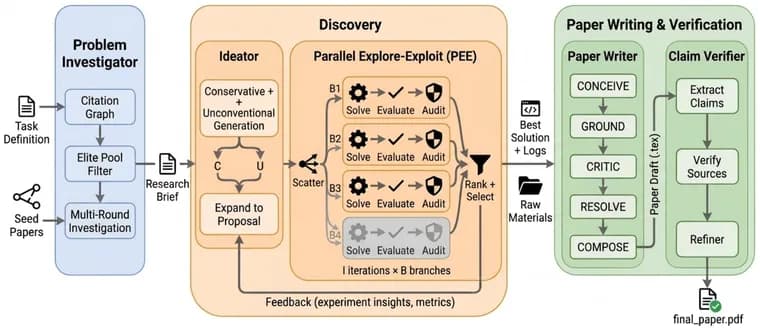
Google Research has published a paper introducing Chain-of-Evidence (CoE), a framework meant to make AI-generated scientific research verifiable, along with a prototype system called the Science One Framework and an automated checker called CoE Audit. The authors, research scientist Rui Meng and Google Cloud director Tomas Pfister, frame the problem this way: autonomous research agents such as Sakana AI's AI Scientist v2, AutoResearchClaw, DeepScientist and AI-Researcher can now review literature, run experiments and write full manuscripts, but because they generate text iteratively, errors compound. Some existing systems invent citations to papers that do not exist, describe methods that do not match the code that actually ran, or report experimental scores that cannot be reproduced from the submitted code.
CoE addresses this with two requirements modeled on database transaction guarantees: every claim in a research artifact (a reference, a number, a method description, a conclusion) must carry a recorded evidence chain back to its source, whether that is a peer-reviewed paper, an experiment log, the code that ran, or a results table, and that chain must genuinely support the claim rather than just exist. The Science One Framework builds these evidence chains as it works, through three modules, rather than trying to attach evidence retroactively after a paper is written. CoE Audit then runs four automated integrity checks on the resulting paper, solution, code and reference list, including re-checking every citation against live scholarly databases.
Google applied CoE Audit to 75 papers generated across five systems-optimization tasks (Prism, Cloudcast, EPLB, LLM-SQL, and transaction scheduling) drawn from the Automated Design of Research Systems (ADRS) benchmark. Baseline systems hallucinated up to 21% of their references and frequently mismatched their described methods against their actual code, in one case describing a "hybrid neuro-symbolic solver" when the submitted code was a simple deterministic heuristic. The Science One Framework, by contrast, produced no phantom references at all, since its Problem Investigator module retrieves real references rather than generating them from memory, and it also scored highest on method-code alignment and score verification. On scientific performance itself, the Science One Framework matched or beat human expert results on all five ADRS tasks and posted the best overall score on two of them, Cloudcast and EPLB, while also matching state-of-the-art performance on the separate MLE-Bench and Parameter-Golf benchmarks. Google says it further tested the system's generalization on six additional, more complex external tasks. The post explicitly labels the Science One Framework an experimental research prototype rather than a production-ready tool.
Key facts
- Baseline autonomous research agents hallucinated up to 21% of their citations in Google's tests; the Science One Framework produced zero phantom references across 75 generated papers.
- CoE Audit re-checks every reference against live scholarly databases and runs four automated integrity checks covering the paper, code, solution and reference list.
- The 75 test papers spanned five systems-optimization tasks (Prism, Cloudcast, EPLB, LLM-SQL, transaction scheduling) from the ADRS benchmark; the Science One Framework matched or beat human expert performance on all five and led outright on Cloudcast and EPLB.
- The framework also matched state-of-the-art results on the MLE-Bench and Parameter-Golf benchmarks and was further tested for generalization on six additional external tasks.
- Google describes the Science One Framework as an experimental research prototype, not a production-ready tool.
Why it matters
As autonomous agents move from reviewing literature to writing full scientific manuscripts, the surface polish of their output has started to outrun its trustworthiness: hallucinated citations, code that does not match the described method, and scores that cannot be reproduced. Chain-of-Evidence proposes a structural fix rather than a cosmetic one, requiring every claim in a paper to carry a traceable link back to the evidence that supports it, built at generation time rather than reconstructed afterward.
Who it affects
The work targets teams building autonomous research agents (the paper names Sakana AI's AI Scientist v2, AutoResearchClaw, DeepScientist and AI-Researcher as points of comparison), and anyone downstream who might rely on AI-generated papers, benchmarks or experimental claims without independently rerunning the underlying code.
How to use it
There is nothing to deploy yet: Google labels the Science One Framework an experimental research prototype, and the post gives no release plan, license or pricing. The practical takeaway for now is the CoE Audit methodology itself, an automated way to check whether an AI-generated paper's references, code and reported scores actually hold together.
How solid is it
The comparison is Google's own benchmark run: 75 papers across five ADRS tasks, evaluated by Google's own CoE Audit protocol against four named baseline systems, with additional generalization tests on six external tasks. The zero-hallucination and top-alignment results, and the matched or superior performance against human experts, come from this internal evaluation rather than an independent third-party audit.
Risks and caveats
The framework is explicitly experimental and not production-ready, so its numbers describe a research prototype under Google's own test conditions rather than a shipped system. The CoE Audit that produced the favorable comparison was built by the same team behind the Science One Framework, and the post does not say whether the evaluation protocol or the underlying code has been released for outside verification.
“every claim in a research artifact must carry a recorded evidence chain (completeness), and each chain must genuinely support the claim it is attached to (correctness)”
— Rui Meng and Tomas Pfister, Google Research blog