Google Research's Biomarker Discovery Framework beats rival AI agents in blind review
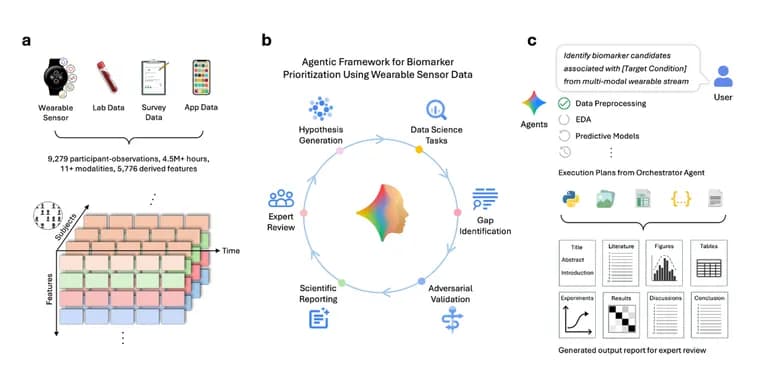
Google Research has introduced the Biomarker Discovery Framework, a multi-agent AI system built to sift wearable sensor data, heart rate dynamics, sleep patterns and related physiological time series, for candidate biomarkers worth pursuing in clinical research. The project was spearheaded by MIT PhD student Yubin Kim during a Google internship, advised by Daniel McDuff and Hamid Palangi of Google Research. It targets a specific failure mode in existing LLM-agent research tools: they optimize for predictive accuracy while skipping the statistical checks that catch spurious correlations, data leakage and brittle features.
The framework runs as an iterative research loop under human supervision. An orchestrator agent breaks a natural-language research request into an execution plan and hands it to specialized agents across five phases: hypothesis generation, parallel statistical analysis, model training, adversarial validation and literature-grounded reasoning, with shared memory and a structured fact sheet keeping the process traceable. Given a request to find wearable candidates linked to depression severity, for example, the system profiled the DWB dataset, proposed sleep-timing variability features, and estimated an association between sleep-duration variability and PHQ-8 severity (rho = 0.252), then checked the result for stability, leakage and subgroup consistency before framing it as a literature-grounded hypothesis for human review.
Google Research tested the system independently across three large cohorts totaling 9,279 participant-observations, spanning mental health (DWB and GLOBEM) and metabolic disease (WEAR-ME). It surfaced 41 candidate digital biomarkers for mental health and 25 for metabolic outcomes, including two composite features it constructed rather than merely selected: sleep-duration and sleep-onset variability as correlates of depression severity, and a cardiovascular fitness index, steps divided by resting heart rate, as a non-invasive correlate of insulin resistance. In DWB, sleep-duration variability correlated with PHQ-8 depression severity at rho = 0.252 (p < 0.001); in GLOBEM, sleep-onset variability showed a weaker, exploratory association with PHQ-4 (rho = 0.126, p < 0.001, cross-validated AUC = 0.535). Because the two cohorts used different endpoints and feature definitions and no identical candidate replicated across them, the authors describe this as suggestive construct-level convergence rather than direct replication. Adding the framework's derived features to demographic variables improved predictive performance: delta R-squared of 0.040 for depression and 0.021 for insulin resistance.
To judge output quality, Google Research had 15 experts in medicine, biomedical data science, machine learning, bioinformatics and digital health blind-review manuscript reports from the framework and three other AI research systems: Google DeepMind's AI co-scientist, Biomni and Google ADK's Data Science Agent. The Biomarker Discovery Framework, Biomni and the Data Science Agent were scored together across 21 sessions, and the framework was scored separately in a further 13 sessions using the same evaluation instrument. The framework scored highest on all seven quality dimensions measured and was the only system to earn any Accept or Minor Revision verdicts under a simulated editorial rubric: 2 Accept, 8 Minor Revision, 8 Major Revision and 3 Reject. Reviewers said they would keep an average of 56.9% of the framework's generated manuscript content, against 18.8% to 30.4% for the baseline systems, and ranked it first in 9 of 13 four-system ranking sessions.
Key facts
- The framework was tested across three cohorts totaling 9,279 participant-observations (DWB, GLOBEM, WEAR-ME), surfacing 41 candidate biomarkers for mental health and 25 for metabolic outcomes.
- Sleep-duration variability correlated with PHQ-8 depression severity at rho = 0.252 (p < 0.001) in DWB; a weaker rho = 0.126 association with PHQ-4 appeared in GLOBEM, which the authors call suggestive convergence, not replication.
- Combining framework-derived features with demographic variables improved prediction: delta R-squared of 0.040 for depression and 0.021 for insulin resistance.
- In a blind review, 15 experts scored the framework highest on all seven quality dimensions and it was the only one of four AI research systems to receive Accept or Minor Revision verdicts (2 Accept, 8 Minor Revision) against Google DeepMind's AI co-scientist, Biomni and Google ADK's Data Science Agent.
- Reviewers said they would retain 56.9% of the framework's manuscript content on average, versus 18.8% to 30.4% for the baseline systems, and ranked it first in 9 of 13 ranking sessions.
Why it matters
As wearable data scales across populations, the bottleneck in digital medicine is no longer data collection but turning raw signals into biomarkers that hold up statistically. Existing LLM-agent research tools often chase predictive accuracy and end up with spurious correlations or leaky features. The Biomarker Discovery Framework is built specifically to keep statistical rigor and human oversight in the loop while still automating candidate generation, separating deterministic computation from generative reasoning and forcing agents to defensively debate their findings.
Who it affects
Researchers in digital health, biomedical data science and clinical research who want to mine wearable-sensor datasets for candidate biomarkers, plus the participants whose wearable data feeds the underlying cohorts (DWB, GLOBEM, WEAR-ME). The work was spearheaded by MIT PhD student Yubin Kim during a Google internship, advised by Daniel McDuff and Hamid Palangi at Google Research, with contributions from collaborators across Google Research, Google DeepMind and academia.
How to use it
The post describes the framework's architecture and results in detail but does not say whether the code or the reviewed manuscripts will be released, so there is no public tool or price to point to yet. The described pipeline runs on a natural-language research request: an orchestrator agent decomposes it into a five-phase process of hypothesis generation, parallel statistical analysis, model training, adversarial validation and literature-grounded reasoning, tracked throughout by shared memory and a structured fact sheet.
How solid is it
The validation is unusually rigorous for an AI research tool announcement: three independent cohorts, 9,279 participant-observations, and a blinded expert review pitting the framework against three named AI research systems, Google DeepMind's AI co-scientist, Biomni and Google ADK's Data Science Agent, across 21 shared sessions plus 13 sessions scoring the framework alone. It topped all seven quality dimensions and was the only system to draw Accept or Minor Revision verdicts. The authors themselves flag the DWB/GLOBEM depression finding as suggestive convergence rather than replication, since the cohorts, endpoints and feature definitions differ and no identical candidate reproduced across them.
Risks and caveats
The correlations reported are modest, typical of passive-sensing digital phenotyping (rho = 0.126 to 0.252), and the authors are explicit that the mechanism column presents a literature-grounded hypothesis, not a causal conclusion, and that the evidence-strength stars mark the weight of prior literature, not clinical validation performed in this study. The source does not give per-cohort participant counts, does not name the review panel or the baseline systems' individual scores beyond the retention-percentage range, and gives no timeline for clinical validation or deployment of any identified biomarker candidate.
“As wearable health data continues to scale across populations, the bottleneck in digital medicine is no longer data collection, but rather principled, rigorous hypothesis generation.”
— Yubin Kim, Hamid Palangi and Daniel McDuff, Google Research