GraphSkillEvo evolves graph-structured skills for LLM agents
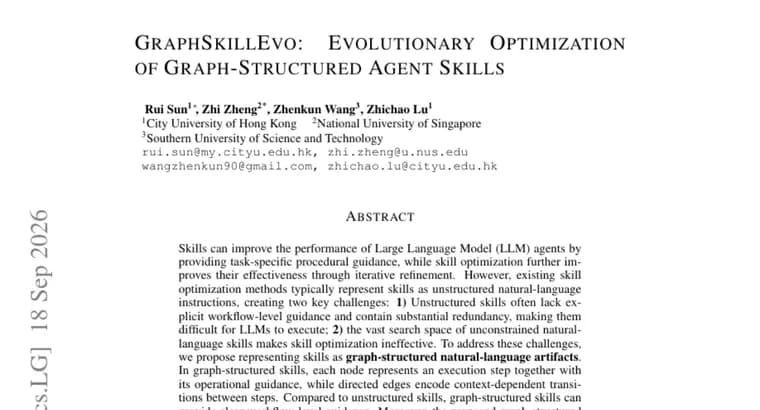
Researchers propose representing the skills an LLM agent uses, the procedural instructions that guide it through a task, as graphs rather than plain natural-language text. In this graph structure, each node is one execution step paired with its own operational guidance, and directed edges encode which step should follow which, depending on context. The authors argue that plain-text skills create two problems: they often skip explicit workflow-level guidance and carry redundant instructions that are hard for an LLM to follow, and the search space of unconstrained natural-language skills is too vast for optimization to work well. A graph, by contrast, states the workflow explicitly and gives optimization a more constrained space to search.
Building on that representation, the paper introduces GraphSkillEvo, a population-based evolutionary optimization framework that applies mutation and crossover operators to graph-structured skills. Instead of refining a single skill through repeated LLM self-critique, GraphSkillEvo keeps multiple candidate skills at once and combines their effective parts, which the authors say lets it explore the structured skill space more broadly and thoroughly than purely LLM-based iterative self-refinement.
Across five agent benchmarks, the authors report that GraphSkillEvo consistently outperforms SkillOpt, described as a strong existing skill optimization baseline, improving average accuracy by 4.01 percentage points on GPT-5.4-nano and 1.76 percentage points on GPT-5.4. The benchmarks themselves are not named in the text, and no absolute accuracy figures are given, only these improvements over the baseline. The paper's code is published on GitHub.
Key facts
- GraphSkillEvo represents LLM agent skills as graphs: nodes are execution steps with their guidance, directed edges are context-dependent transitions between steps
- It is a population-based evolutionary framework using mutation and crossover operators on these graph-structured skills, keeping multiple candidates and combining effective parts
- Across five agent benchmarks, it improved average accuracy over the SkillOpt baseline by 4.01 percentage points on GPT-5.4-nano and 1.76 percentage points on GPT-5.4
- The authors say the approach explores the structured skill space more broadly than purely LLM-based iterative self-refinement
- The code is released on GitHub; the paper does not name the five benchmarks or give absolute accuracy numbers
Why it matters
Most work on making LLM agents better at multi-step tasks writes their skills as free-form natural-language instructions, then tries to improve those instructions by having another LLM critique and rewrite them. The authors argue this runs into two walls: unstructured text buries the actual workflow inside verbose, sometimes redundant prose, and the space of possible natural-language rewrites is so large that search over it is inefficient. Encoding a skill as a graph, steps as nodes, transitions as edges, keeps the workflow explicit and shrinks that search space, which is what lets an evolutionary method operate on it directly rather than relying on an LLM to guess at improvements.
Who it affects
The result is aimed at people building or optimizing LLM agents that follow multi-step procedures, where a reusable, refinable skill library matters more than a single one-off prompt. It sits alongside other skill-optimization approaches, and the paper positions SkillOpt as the strong existing baseline it is compared against.
How to use it
The authors published their implementation on GitHub at ruisun7/GraphSkillEvo, alongside the paper. The text does not describe pricing, licensing terms, or a hosted service; it is presented as a research artifact with accompanying code.
How solid is it
The claim rests on experiments across five agent benchmarks, where GraphSkillEvo is reported to consistently beat the SkillOpt baseline, by 4.01 percentage points of average accuracy on GPT-5.4-nano and 1.76 percentage points on GPT-5.4. These are improvements over the baseline, not absolute accuracy scores, and the source text does not name which five benchmarks were used or state the underlying absolute numbers, which limits how far the result can be checked without reading the full paper.
Risks and caveats
The source text does not identify the paper's authors, their institution, or a publication venue; only a GitHub username, ruisun7, appears via the code link. The reported gains are relative to one baseline (SkillOpt) on two specific models (GPT-5.4-nano and GPT-5.4), and it is not stated whether they generalize to other models or to skills outside the five unnamed benchmarks.