Half of Europe's towns and villages have fewer residents than 60 years ago
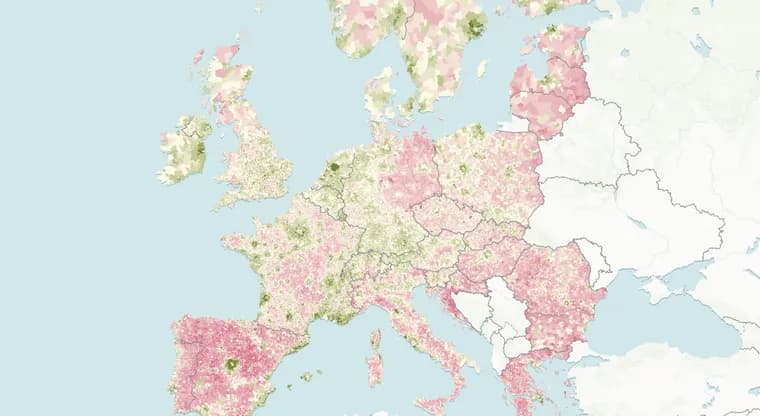
A data analysis by CORRECTIV.Europe, built on demographic data from the EU's Joint Research Centre (JRC) recalculated onto today's municipal borders, finds that half of Europe's towns and villages have fewer residents now than 60 years ago, even as the EU's overall population has grown to around 450 million in 2025. EU projections expect that growth to peak around 2029, after which the population is projected to gradually decline as migration can no longer offset long-declining birth rates. A separate forecast by the German Economic Institute (IW) reaches a similar conclusion for Germany specifically, projecting its population to start shrinking earlier than previously anticipated, largely due to lower-than-expected immigration.
Leo van Wissen, a demographic researcher at the Netherlands Interdisciplinary Demographic Institute, says regional differences within countries will intensify, with strong growth in urban areas while rural areas continue to dwindle. As rural population falls, railway stations, schools, bank branches and bakeries are closing for lack of customers and staff, threatening quality of life in the countryside. Demographer Claudia Neu tells CORRECTIV.Europe that the ageing of European societies is the greatest challenge, bringing healthcare and long-term care costs that will likely fall on the younger generation.
The JRC groups member states into three patterns. Western and Northern Europe benefit from migration both from outside the EU and from other member states. Southern Europe, meaning Italy and Spain, draws non-EU migrants but also loses people to emigration to other EU countries, and has extremely low birth rates of around 1.3 births per woman, so its population is expected to shrink long term regardless. Eastern Europe faces low birth rates, an ageing population and heavy emigration to Western Europe all at once; immigration from outside the EU is not enough to offset those losses. Without any immigration, the EU's total population would already have been shrinking since 2012, and experts interviewed by CORRECTIV.Europe, along with a study by the Centre for European Reform, agree that insufficient immigration poses a risk to the economy. Yet unlike asylum policy, the EU has no common approach to labour migration: a patchwork of around 300 different regulations exists across member states. Even right-leaning governments are now building targeted recruitment programmes; Italy, for example, plans to recruit 10,000 care workers from India.
Governments are separately trying to raise birth rates. France plans to send letters to all 29-year-olds encouraging them to think about starting a family early. Hungary offers special loans and financial support to families who have multiple children within a set timeframe. Albert Esteve, director of the Spanish Center for Demographic Studies, ties the trend to a democracy question, asking whether a mayor deciding on funding for free childcare would be influenced by the fact that most of the mothers receiving it are foreigners without voting rights.
The dataset behind the analysis covers every EU municipality, plus Norway, Switzerland, Liechtenstein, Iceland and the UK, at 10-year intervals from 1961 to 2024 (UK and Iceland only to 2021), with all historical figures expressed on today's municipal boundaries so mergers and border changes do not distort the comparison. For 2024, the researchers used actual census counts at current borders directly. For 1961 to 2011, they applied dasymetric mapping: taking historical population figures at old borders, overlaying today's municipal boundaries, using satellite-derived building volume data (from the EU's Global Human Settlement Layer) as a proxy for where people actually lived, and redistributing the population across today's boundaries accordingly. Every year's totals were then cross-checked against the European Commission's ARDECO regional database. Population figures came from Eurostat's CensusHub and a historical population data collection.
CORRECTIV.Europe flags several limits on the method. The building volume proxy usually, but not always, tracks where people actually live. Historical census data carries its own errors and gaps that flow into the recalculated figures, and the recalculation itself adds estimation uncertainty, especially for smaller municipalities and earlier decades where source data is coarser; individual small-municipality figures for 1961 and 1971 need particular caution, even though the data is reliable for broad trends. The dataset's density-based EU definition of "rural" can also conflict with other definitions: it shows French rural municipalities growing, while World Bank data, using a different definition, shows them shrinking.
Key facts
- Half of Europe's towns and villages have fewer residents than 60 years ago, even though the EU's total population has grown to around 450 million in 2025 and is projected to peak around 2029.
- Southern Europe's birth rate has fallen to around 1.3 births per woman, and without any immigration the EU's total population would already have been shrinking since 2012.
- The EU has no common labour migration policy, only a patchwork of around 300 different regulations across member states; Italy plans to recruit 10,000 care workers from India.
- The analysis recalculates population data from 1961 to 2024 onto today's municipal borders using satellite-derived building volume estimates (dasymetric mapping), cross-checked against the EU's ARDECO regional database.
- Small-municipality and early-decade (1961, 1971) figures carry more uncertainty, and the dataset's density-based "rural" definition can conflict with other definitions, as with French rural population trends versus World Bank data.
Why it matters
As rural population drops, sparsely populated areas lose the customer and staff base needed to keep services running: railway stations, schools, bank branches and bakeries are closing, threatening quality of life in the countryside even while Europe's total population keeps growing overall. Demographer Claudia Neu calls the ageing of European societies the greatest challenge, citing healthcare and long-term care costs that will likely fall on the younger generation.
Who it affects
Rural residents across Europe, but unevenly. Western and Northern Europe are cushioned by migration from both outside and inside the EU. Southern Europe, meaning Italy and Spain, faces very low birth rates of around 1.3 per woman despite drawing non-EU migrants. Eastern Europe faces low birth rates, an ageing population and heavy emigration to Western Europe at the same time. It also touches local government: Albert Esteve, director of the Spanish Center for Demographic Studies, raises a democracy question, since mayors deciding on services like free childcare answer to voters who may not include many of the immigrant mothers those services serve.
How to use it
The dataset behind the analysis covers every EU municipality, plus Norway, Switzerland, Liechtenstein, Iceland and the UK, at 10-year intervals from 1961 to 2024 (UK and Iceland only to 2021), with all figures expressed on today's municipal boundaries so mergers and border changes do not distort comparisons. It draws on Eurostat's CensusHub, a historical population data collection, and satellite-derived building volume data. CORRECTIV.Europe asks that anyone citing the findings credit the JRC as the source, since exact numbers can differ slightly from other datasets.
How solid is it
For 2024, the analysis uses actual census counts on current borders directly. For 1961 to 2011, JRC researchers used dasymetric mapping: they took historical population counts at old borders, overlaid today's municipal boundaries, used building volume as a proxy for where people actually lived, redistributed the population accordingly, and cross-checked every year's totals against the European Commission's ARDECO regional database so the numbers add up consistently at the regional level.
Risks and caveats
The building volume proxy usually, but not always, tracks where people actually live. Historical census data carries its own errors and gaps that carry through into the recalculated figures, and the recalculation itself adds estimation uncertainty, especially for smaller municipalities and earlier decades where source data is coarser; CORRECTIV.Europe says individual small-municipality numbers for 1961 and 1971 need particular caution even though broad regional trends are reliable. The dataset's density-based EU definition of "rural" can also conflict with other definitions: it shows French rural municipalities growing, while World Bank data, using a different definition, shows them shrinking.
“The ageing of European societies is the greatest challenge. We are facing enormous healthcare and long-term care costs, which will likely have to be borne by the younger generation.”
— Claudia Neu, demographer, to CORRECTIV.Europe