Harness^2 lets LLM agents recursively improve their own harnesses without verifiers
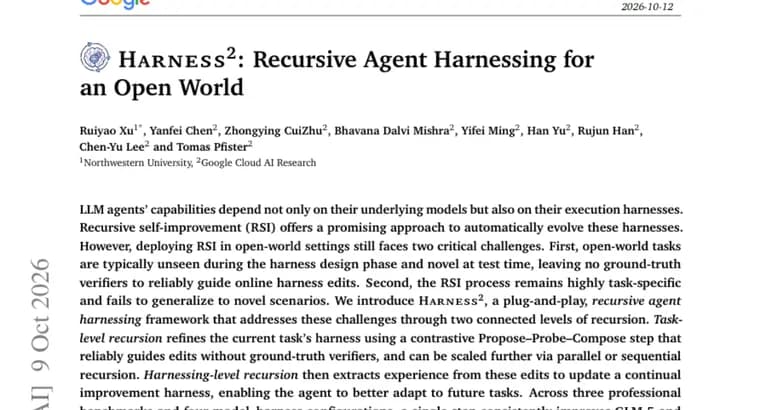
The paper starts from the point that an LLM agent's capabilities depend not only on the underlying model but also on its execution harness, the scaffolding that runs the model. Recursive self-improvement (RSI) is described as a promising way to evolve such harnesses automatically. The authors say two problems block its use in open-world settings. First, open-world tasks are typically unseen when the harness is designed and novel at test time, so there are no ground-truth verifiers to reliably guide online harness edits. Second, the RSI process stays highly task-specific and fails to generalize to novel scenarios.
To address both, the paper introduces Harness^2, a plug-and-play, recursive agent harnessing framework with two connected levels of recursion. Task-level recursion refines the current task's harness with a contrastive Propose-Probe-Compose step, which the paper says guides edits reliably without ground-truth verifiers. This level can be scaled further through parallel or sequential recursion. Harnessing-level recursion then extracts experience from those edits and uses it to update a continual improvement harness, so the agent adapts better to future tasks.
The evaluation covers three professional benchmarks and four model-harness configurations. The paper reports that a single step consistently improves GLM-5 and Gemini 3.5 Flash over their base harnesses, with gains of up to 11.5 points on WorkBuddy-Bench, 4.5 points on JobBench and 11.8 percentage points on LAB. It adds that further gains appear as the task-level recursion budget increases.
Key facts
- Harness^2 is a plug-and-play, recursive framework that evolves an LLM agent's execution harness without ground-truth verifiers.
- Task-level recursion uses a contrastive Propose-Probe-Compose step to refine the current task's harness; harnessing-level recursion extracts experience from those edits to update a continual improvement harness.
- A single step improves GLM-5 and Gemini 3.5 Flash over their base harnesses, with gains of up to 11.5 points on WorkBuddy-Bench, 4.5 points on JobBench and 11.8 percentage points on LAB.
- The evaluation spans three professional benchmarks and four model-harness configurations.
- Further gains are reported as the task-level recursion budget increases.
Why it matters
The paper's premise is that an agent is more than its model: the harness around it shapes what it can do. Improving that harness automatically is attractive, but the paper argues existing recursive self-improvement breaks down on open-world tasks, where nothing verifies an edit at test time and methods tuned to one task do not carry over. Harness^2 is presented as a way around both problems, by guiding edits contrastively and by carrying experience from one task to the next.
Who it affects
People building or evaluating LLM agents and the harnesses that wrap them are the direct audience. The reported results concern GLM-5 and Gemini 3.5 Flash, so teams working with those models are the ones the numbers speak to most directly.
How to use it
The paper describes Harness^2 as plug-and-play, meaning it is meant to sit on top of an existing agent harness. Task-level recursion can be scaled through parallel or sequential recursion, and the reported results improve as the task-level recursion budget grows, so that budget is the main dial the paper points to.
How solid is it
The claims here come from the paper's own abstract and reflect the authors' reporting. The figures are maximum ('up to') gains from a single step over the base harness, across three professional benchmarks and four model-harness configurations. The abstract gives only these maximum gains, not average or per-configuration results, and absolute baseline scores are not given.
Risks and caveats
The abstract does not say which benchmark gain belongs to which model, nor which four model-harness configurations were tested. What WorkBuddy-Bench, JobBench and LAB measure is not explained. No cost, latency or compute overhead of the recursion is stated, and no code release, license or comparison with other harness-evolution methods is mentioned. Note also that the units differ: 11.5 and 4.5 are given as points, while 11.8 is given as percentage points.
“LLM agents' capabilities depend not only on their underlying models but also on their execution harnesses.”
— Harness^2 paper abstract