HelloWorld brings social interaction to video world models
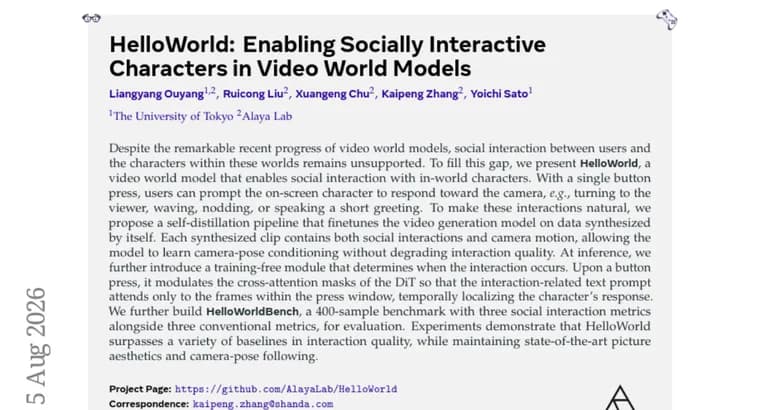
Researchers have presented HelloWorld, a video world model built to add social interaction between users and the characters that populate generated video worlds. Existing video world models can put a viewer inside a generated scene, but the characters in that scene have not been able to respond to the person watching. HelloWorld changes that: with a single button press, a user can prompt the on-screen character to react toward the camera, for example turning to face the viewer, waving, nodding, or speaking a short greeting.
To make those reactions look natural rather than scripted, the authors built a self-distillation pipeline. The video generation model is finetuned on data it synthesizes itself, and each synthesized clip combines a social interaction with camera motion at the same time. That combination lets the model learn to follow camera-pose changes without the interaction quality degrading as a result.
A second piece handles timing at inference. A training-free module decides when the character's response should occur. When a user presses the button, this module modulates the cross-attention masks inside the model's diffusion transformer (DiT) so that the text prompt describing the interaction only attends to the frames that fall within the press window. That confines the character's reaction to the moment it was triggered, rather than letting it bleed across the whole clip.
To evaluate the system, the authors also built HelloWorldBench, a 400-sample benchmark that combines three metrics specific to social interaction with three conventional video-generation metrics. According to the authors, HelloWorld surpasses a variety of baselines on interaction quality on this benchmark, while holding onto state-of-the-art picture aesthetics and camera-pose following. The source text does not name which baselines were used for comparison, nor does it give author names, institutional affiliations, or a release timeline; the project page is hosted on GitHub under AlayaLab/HelloWorld.
Key facts
- HelloWorld is a video world model that lets a user trigger a social response from an on-screen character with a single button press: turning to the viewer, waving, nodding, or speaking a short greeting.
- A self-distillation pipeline finetunes the video generation model on data it synthesizes itself, with each clip combining social interaction and camera motion so the model learns camera-pose conditioning without losing interaction quality.
- A training-free inference module modulates the cross-attention masks of the model's diffusion transformer (DiT) so the interaction prompt only attends to frames within the button-press window, localizing the character's response in time.
- The authors built HelloWorldBench, a 400-sample benchmark combining three social interaction metrics with three conventional video metrics.
- The authors report HelloWorld surpasses a variety of baselines in interaction quality while keeping state-of-the-art picture aesthetics and camera-pose following; the specific baselines are not named in the source.
Why it matters
Video world models can already place a viewer inside a generated scene, but until now the characters inside that scene stayed passive: you could look around, not be acknowledged. HelloWorld closes that gap with a lightweight mechanism, a single button press, rather than a complex control scheme, which keeps the interaction simple to trigger.
Who it affects
This is research-stage work aimed at people building interactive or game-like generative video systems and world models, not a consumer product. The source names no institutional affiliation beyond the project page sitting under an organization called AlayaLab; it sits in the niche of academic video-generation research.
How to use it
There is no public product, pricing, or release date in the source. The work is described as a paper with an accompanying project page hosted on GitHub under AlayaLab/HelloWorld; anyone wanting to use or inspect it would start there.
How solid is it
The claims rest on a single paper's own benchmark, HelloWorldBench, a 400-sample set the authors built themselves with three social interaction metrics and three conventional ones. The authors report HelloWorld beats a variety of baselines on interaction quality while matching state-of-the-art aesthetics and camera-pose following, but the source does not name those baselines, so the comparison cannot be checked independently from the text alone.
Risks and caveats
The evaluation is self-reported and run on a benchmark the same team designed, which is a normal but real limitation for a new method. The source text gives no author names, institutional affiliations, model size, training compute, or dataset scale beyond the 400-sample benchmark, and no release timeline, so how mature or reproducible the system is stays unclear from this text alone.
“HelloWorld surpasses a variety of baselines in interaction quality, while maintaining state-of-the-art picture aesthetics and camera-pose following.”
— the paper's authors