How reasoning effort settings in GPT-5.6 and DeepSeek-R1 actually work
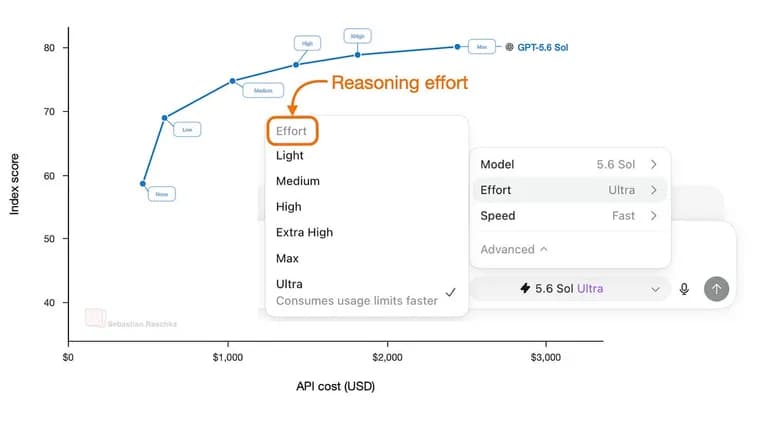
Sebastian Raschka, an AI educator and author of a new 440 page book on building reasoning models from scratch, published an explainer on how large language models are trained to support multiple reasoning effort levels. The piece was prompted by OpenAI's release last week of the GPT-5.6 model family, which ships in three sizes, each offering roughly five or six reasoning effort settings.
Raschka traces the lineage: OpenAI's o1 popularized reasoning models almost two years ago, and DeepSeek-R1 followed about four months later with a published training recipe, reinforcement learning with verifiable rewards (RLVR). RLVR rewards a model 1 for a correct answer and 0 for an incorrect one in domains where correctness can be checked automatically, math via symbolic tools like SymPy or WolframAlpha, and code via compilers, unit tests or platforms like LeetCode. Notably, the DeepSeek-R1 paper reported that training on the intermediate reasoning trace itself did not help and was dropped; rewarding only the final answer was enough for the model to learn to write out reasoning, backtrack and self-correct, behavior the paper calls "Aha" moments. A pure RLVR variant, DeepSeek-R1-Zero, is weaker than the full R1 but demonstrated that RL alone is sufficient to make a model produce and use reasoning traces. Raschka notes that Kimi K1.5, published on arXiv the same day as DeepSeek-R1 (22 January 2025), instead applied RL on top of a supervised fine-tuned model, similar to Tulu 3, which had coined the term RLVR about two months earlier.
The article also explains why the familiar
On the on/off question, Raschka contrasts dedicated reasoning models like DeepSeek-R1, which always reasons verbosely with no toggle, against hybrid models like Qwen3, which can act as a plain instruction-following model or a reasoning model on demand. Per Qwen3's technical report, this is trained through supervised fine-tuning followed by a "Thinking Mode Fusion" stage that shows the model both thinking (/think) and non-thinking (/no_think) examples, then reinforced with general RL. The result is two switches: a "soft" one, the /think or /no_think flag in the prompt, and a "hard" one, the tokenizer's enable_thinking=False setting, which forces an empty
On how those graded effort levels are implemented, Raschka is explicit that OpenAI has not disclosed its own methodology. He instead reasons from OpenAI's open source gpt-oss models released last year, which expose reasoning effort as a plain string, "Reasoning effort: low/medium/high", prepended to the system prompt. As expected, that setting directly affects both response length and accuracy, and Raschka presumes GPT-5.6 works in a similar way, though this remains an inference rather than a confirmed detail.
Key facts
- OpenAI released the GPT-5.6 model family last week in three sizes, each with roughly five or six reasoning effort settings.
- DeepSeek-R1, released about four months after OpenAI's o1, trains reasoning behavior using reinforcement learning with verifiable rewards (RLVR), checked automatically against math and code.
- The DeepSeek-R1 paper found that training on the reasoning trace itself did not help, so only the final answer was rewarded, which was still enough to produce self-correcting "Aha" moments.
- The
and tags marking a reasoning trace are added via a formatting reward during training and are cosmetic: they do not themselves improve reasoning ability. - Qwen3 supports a "soft" switch (/think, /no_think in the prompt) and a "hard" switch (enable_thinking=False in the tokenizer) between reasoning and non-reasoning modes, a simplified version of the graded effort levels in GPT-5.6.
Why it matters
Reasoning effort control has gone from a research curiosity to a standard shipping feature: GPT-5.6 arrives in three sizes with roughly five or six effort settings each, and most current flagship models offer something similar. Raschka's piece is a rare technical account of what actually happens during training to make that toggle possible, tying o1, DeepSeek-R1, Kimi K1.5, Qwen3 and GPT-5.6 into one continuous explanation of a technique that is now everywhere.
Who it affects
ML engineers and researchers building or fine-tuning reasoning models, developers who call reasoning-capable APIs and want to know what an effort slider actually changes, and technical readers following the RLVR research line since DeepSeek-R1.
How to use it
The practical upshot: an effort setting mainly controls how much a model is allowed or encouraged to spend on its hidden reasoning trace before answering. Qwen3's own switches make that literal, enable_thinking=False empties the trace outright, while /think and /no_think shape it more softly, and OpenAI's gpt-oss models expose the same idea as a plain "Reasoning effort: low/medium/high" line in the system prompt. Higher effort settings should be expected to trade latency and compute for accuracy.
How solid is it
Raschka is an established author in this space, with earlier reference pieces on reasoning models and a new 440 page book on training them from scratch, and he grounds the DeepSeek-R1, Kimi K1.5 and Qwen3 sections in openly published papers and technical reports. On OpenAI's own models, though, he is upfront that the implementation is undisclosed; his account of how GPT-5.6's effort levels work is an educated guess drawn from the open source gpt-oss models rather than a confirmed OpenAI source.
Risks and caveats
The extension from open models (DeepSeek-R1, Qwen3, gpt-oss) to a closed one (GPT-5.6) is an inference the author himself flags as unconfirmed, not documented OpenAI methodology. The article also gives no exact calendar date for either GPT-5.6's release or its own publication, only relative phrasing like "last week."
“These
and tags are cosmetic with respect to reasoning ability. They do not make the model reason, and they are not required to achieve good reasoning performance.”— Sebastian Raschka