GPU idle time, not model size, is becoming AI's real cost problem
The essay opens with aviation. For most of the industry's history, the number that best predicted whether an airline survived was how much of the day each aircraft spent on the ground, because an aircraft's costs (financing, depreciation, insurance, maintenance, crew) accrue by the calendar hour while its revenue accrues only by the flight hour. The piece argues GPUs now sit inside the identical structure: a GPU accrues cost by the calendar hour through financing, depreciation, power and cooling whether or not it is doing anything useful, while its output only accrues by the compute hour. Two companies with comparable GPU budgets increasingly diverge based on how much of that hardware is doing something useful at any given moment, not on how much of it either one owns.
The post traces how the bottleneck moved from models to compute. In 2020, Microsoft built OpenAI a dedicated supercomputer of over 10,000 GPUs and 285,000 CPU cores, reported at the time as one of the five largest systems in the world, to train what became GPT-3. By 2026, even the best capitalized labs were still treating compute access as a live strategic constraint: Anthropic was running simultaneous multi-gigawatt commitments across four separate hardware platforms (Amazon, Google, Microsoft and AMD) within months of one another, while Meta signed a comparable multi-gigawatt deal of its own. Six years apart, both moments marked the frontier of what a lab needed just to stay competitive, which the essay reads as evidence that capability stopped being the binding constraint.
The same pressure shows up downstream for enterprises consuming models through an API: cost scales linearly with tokens used, so a workload affordable as a proof of concept can become uneconomical at production volume. The alternative gaining ground, per the post, is enterprises buying their own GPUs and running models locally, trading a variable cost for a fixed one. That turns the GPU into infrastructure sized for peak demand, which means real capacity sits unused outside the peak, and the question shifts from "can we get accelerators" to "can we keep them busy."
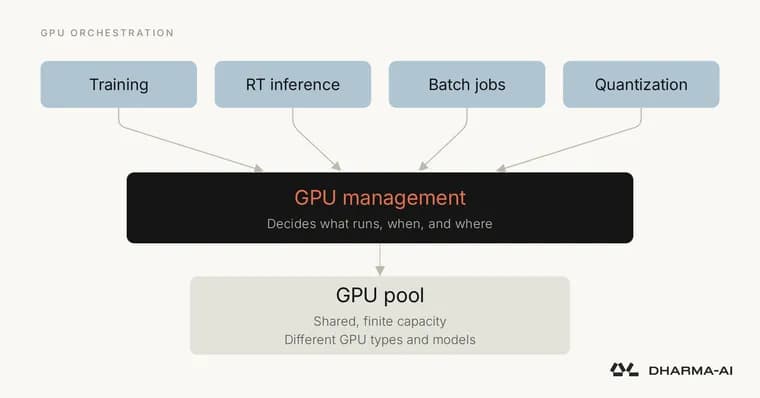
The essay's central diagnosis is that a busy cluster can still waste most of its potential, because the demand placed on modern GPUs is no longer uniform. The same hardware now supports training, fine-tuning, quantization, real-time inference, batch inference, embedding generation and model evaluation, each with different latency, duration and memory needs; a scheduler tuned for one of these will misallocate the others almost by default, and a cluster can report high average occupancy while queued jobs wait for a GPU shape that happens to be busy running something else. Unlike an idle aircraft, which can usually be redeployed to almost any route, an idle GPU can only absorb a workload whose profile it can actually serve, which the post argues makes GPU orchestration structurally harder than fleet scheduling.
The proposed answer is a discipline the post names "GPU Management": a continuous orchestration layer between workloads, models and hardware that decides, moment to moment, which workload runs, when, how and on which specific GPU, rather than treating allocation as a one-time provisioning decision made at purchase time. The essay ties this to model specialization: smaller, task-specific models free up capacity a single large generalist model would have occupied for the same job, but that freed capacity only converts into GPU ROI if something is actively reallocating it; left unmanaged, it just becomes a different flavor of idle. The excerpt available for this retelling ends mid-sentence at that point, before any further conclusion or named example of the practice.
Key facts
- In 2020, Microsoft built OpenAI a dedicated supercomputer of over 10,000 GPUs and 285,000 CPU cores, reported at the time as one of the five largest systems in the world, to train what became GPT-3.
- By 2026, Anthropic was running simultaneous multi-gigawatt compute commitments across four separate hardware platforms (Amazon, Google, Microsoft and AMD), while Meta signed a comparable multi-gigawatt deal of its own.
- A GPU's cost accrues by calendar hour (financing, depreciation, power, cooling) regardless of use, while its output only accrues by compute hour, the same structural problem the essay says decided which airlines survived on aircraft utilization.
- Modern GPU clusters run mixed workloads, training, fine-tuning, quantization, real-time inference, batch inference, embedding generation and model evaluation, each with different latency, duration and memory needs, so a scheduler tuned for one misallocates the others.
- The essay names the emerging response "GPU Management": a continuous orchestration layer deciding which workload runs on which GPU and when, replacing a one-time provisioning decision.
Why it matters
The first wave of enterprise AI was won on model quality, bigger models trained on more compute and evaluated on tougher benchmarks. The essay argues that race produced models good enough for real production workloads, which shifted the constraint downstream, first to getting hold of GPU hardware at all, and now to how well that hardware gets used once it is owned. Its central claim is that intelligence carried the industry this far, and utilization is where the next real constraint is forming.
Who it affects
Any enterprise that owns or rents GPU capacity for training or inference, plus the AI labs the post uses as its evidence: Microsoft and OpenAI historically, and Anthropic and Meta as the 2026 example of compute commitments spread across multiple hardware vendors at once. It also applies to enterprises that moved off per-token API pricing onto owned GPUs to escape linear cost scaling, only to inherit a new utilization problem the day the cluster comes online.
How to use it
The piece is an argument rather than a product, so its practical takeaway is operational: treat GPU allocation as a continuous discipline rather than a one-time purchase decision, track utilization the way an airline tracks aircraft time on the ground, and look past average occupancy numbers, since a cluster can look busy while jobs queue for a GPU shape that is tied up elsewhere. Where model specialization frees up capacity, pair it with active reallocation of that freed capacity, since unmanaged freed capacity just becomes a different flavor of idle.
How solid is it
The historical figures used as evidence, the 2020 Microsoft/OpenAI supercomputer and the 2026 Anthropic and Meta compute commitments, are specific, checkable claims about publicly known deals. But the essay does not name any concrete company, product or working example of "GPU Management" tooling; it argues from the airline analogy and general reasoning rather than from data on how much capacity enterprises are actually wasting today. No individual author is named, the post is published under the Hugging Face account "Dharma-AI," and no publication date for the post itself appears in the text.
Risks and caveats
The piece is argumentative, not reported: the airline analogy is illustrative rather than a measured comparison, and the essay itself flags where the comparison breaks down (an idle aircraft can be redeployed to almost any route, an idle GPU cannot). It does not quantify how much capacity enterprises are currently wasting, and does not identify who is building or selling "GPU Management" tooling. The text available for this retelling also cuts off mid-sentence before the essay's own conclusion, so its closing argument is not captured here.
“Utilization, not intelligence, is the next real constraint in AI.”
— Dharma-AI, writing on Hugging Face