Hunyuan-A13B debuts as 80B MoE model activating just 13B
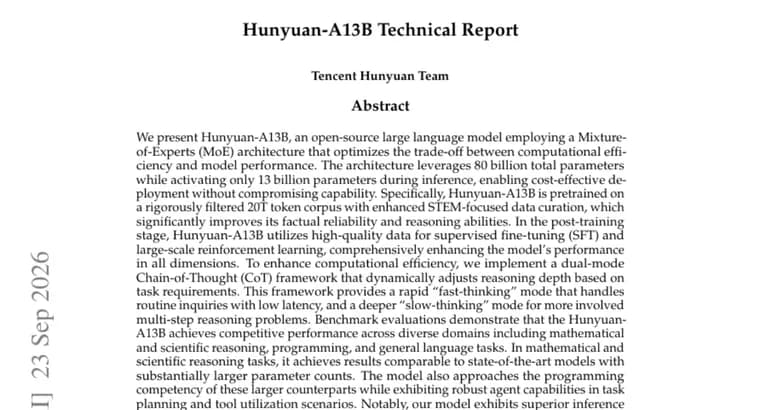
The authors present Hunyuan-A13B, an open-source large language model built on a Mixture-of-Experts architecture. The model holds 80 billion total parameters but activates only 13 billion of them during inference, a design meant to balance capability, computational efficiency and deployment cost. It was pretrained on a rigorously filtered 20-trillion-token corpus with enhanced curation of STEM data, which the authors say improves factual reliability and reasoning ability. High-quality supervised fine-tuning and large-scale reinforcement learning were applied on top of pretraining to further improve performance. A distinguishing feature is a dual-mode Chain-of-Thought framework: the model switches between fast thinking for routine queries and slow, multi-step thinking for complex problems, adapting reasoning depth to the difficulty of the task. According to the authors, evaluations show competitive performance across mathematics, science, programming, general language understanding and agent tasks, often approaching that of much larger models, though the report as available does not spell out specific benchmark scores or name which larger models are being compared against. The authors also report high inference throughput, which they say makes the model suitable for latency-sensitive applications. Hunyuan-A13B is being released to support open research and practical deployment of large language models.
Key facts
- Hunyuan-A13B has 80 billion total parameters but activates only 13 billion during inference, a Mixture-of-Experts design meant to balance capability, efficiency and cost.
- It was pretrained on a filtered 20-trillion-token corpus with enhanced STEM data curation, followed by supervised fine-tuning and large-scale reinforcement learning.
- The model uses a dual-mode Chain-of-Thought framework: fast thinking for routine queries, slow multi-step thinking for complex problems.
- The authors report competitive performance across math, science, programming, general language understanding and agent tasks, often approaching much larger models, without giving specific benchmark numbers.
- The model is released open-source, with the authors citing high inference throughput as suited to latency-sensitive applications.
Why it matters
Hunyuan-A13B is pitched as a way to get near the performance of much larger language models while activating only a fraction of the parameters at inference time. By keeping only 13 billion of its 80 billion parameters active per pass, the model targets the recurring tradeoff between capability and compute cost, and its dual-mode Chain-of-Thought approach, switching between fast and slow reasoning depending on task complexity, is offered as a way to avoid paying full reasoning cost on easy queries.
Who it affects
The release targets researchers and engineers building or deploying large language models, particularly teams working on open research who want a capable model without the inference cost of a fully dense equivalent, and developers of latency-sensitive applications who care about throughput.
How to use it
Hunyuan-A13B is released as an open-source model intended for both research and practical deployment. The report does not state a license, pricing, or specific access details beyond the release itself.
How solid is it
The claims come from the model's own technical report, which describes the architecture, training corpus size, and post-training process (supervised fine-tuning plus large-scale reinforcement learning) in some detail. However, the available text does not include specific benchmark scores, named comparison models, individual author names, or a release date, so the strength of the 'competitive performance' and 'much larger models' claims cannot be independently checked from what is here.
Risks and caveats
The report's performance claims are described only in general terms, without concrete benchmark numbers or named baseline models to compare against, so how close Hunyuan-A13B actually comes to larger models is not verifiable from the text alone. No release date, licensing terms, or institutional attribution is given either.
“Evaluations show competitive performance across mathematics, science, programming, general language understanding, and agent tasks, often approaching that of much larger models.”
— Hunyuan-A13B technical report