IBM's Harvest ran up to 200x faster to break codes for the NSA
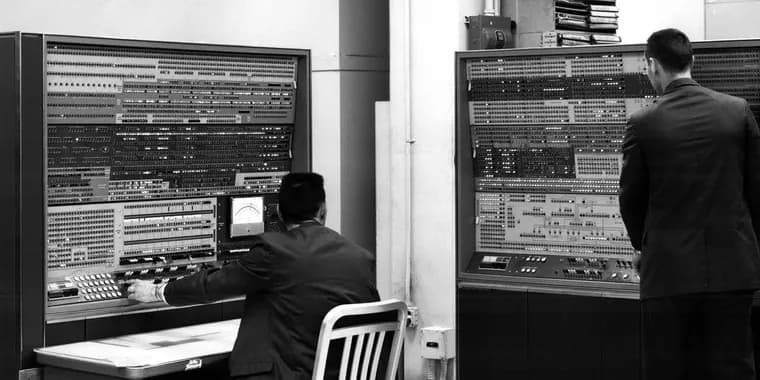
Harvest, officially the IBM 7950, was a custom cryptanalysis machine IBM built for the NSA. It paired the agency's existing IBM 7030 Stretch mainframe, delivered to eight or nine customers between 1961 and 1963 and the fastest unclassified computer of its first three years, with a bespoke streaming coprocessor bolted on as an add-on. IBM won the contract in 1958 after two earlier proposals had been rejected. Harvest ran continuously as the NSA's main cryptographic processor from the 1962 Cuban Missile Crisis through the Vietnam War and past the 1975 Helsinki Accords, stopping only when its moving parts wore out.
The machine existed because the NSA's older cryptanalytic computers were batch machines that needed a human operator to stage every tape run by hand, and could not keep up with the volume of intercepted signals traffic. Harvest's coprocessor was a streaming design: rather than executing a changing sequence of instructions, it applied one fixed sequence to a continuous flow of data. It drew two data streams, called P and Q, from memory shared with Stretch, processed them through a bitwise logic unit and a table-lookup unit (which behaved like the rotor of a cipher machine, substituting values via a lookup address), and wrote the result out as a third stream, R. Processing was pipelined, so one pair of bytes could be compared while the next was already being fetched. Memory was bit-addressable, letting the machine pull as few as 5 bits instead of a full byte. As a unified system, Harvest streamed 1 byte every 0.3 microseconds and carried about 800 kilobytes of addressable memory. IBM also wrote a custom language, Alpha, so analysts could describe cryptographic problems the way Fortran was then used to describe scientific equations.
Harvest needed a matching torrent of input, which IBM solved with the Tractor tape system (IBM 7955), described in the article as the first automated tape library able to robotically fetch any one of hundreds of cassettes from racks. Each cassette weighed 6 to 7 kilograms, about as heavy as a bowling ball, and held roughly 120 megabytes on a 550-meter reel; each storage unit housed up to 160 of them. Two documented jobs illustrate the scale Harvest worked at: per James Bamford's 2001 NSA history Body of Secrets, it once searched 3.5 billion characters of text for any of 7,000 target terms in just under 4 hours; and per NSA analyst Robert Looney's own 1972 remarks marking Harvest's tenth anniversary, a job codenamed Moretown sifted 11 million messages spanning 16 years of intercepted traffic against about 8,000 search terms in roughly ten hours.
The people behind Harvest went on to shape mainstream computing. James H. Pomerene, who had earlier helped build the IAS computer with John von Neumann, was Harvest's chief engineer. Frederick Brooks Jr., later a co-architect of IBM's System/360 and winner of the 1999 Turing Award, helped design its hardware. Frances Allen, who helped design the Alpha language and later received the 2006 A.M. Turing Award, recalled in a 2001 oral history that the work felt cutting-edge in every respect, and that she initially had no idea she was working for the NSA: the agency's cover in the budget was 'the Bureau of Ships.' Not everyone inside the NSA was impressed at the time; Bamford's history records officials joking on employee tours that the machine was 'beautiful, but it doesn't work.'
Key facts
- IBM built Harvest (IBM 7950) for the NSA by bolting a custom streaming coprocessor onto its IBM 7030 Stretch mainframe, winning the contract in 1958 after two failed proposals; it ran as the NSA's main cryptographic processor from 1962 to past 1975.
- Harvest ran up to 200 times faster than other computers of its time, streaming 1 byte every 0.3 microseconds with about 800 kilobytes of addressable memory.
- Two documented jobs: searching 3.5 billion characters for 7,000 target terms in under 4 hours, and a job codenamed Moretown that sifted 11 million messages across 16 years of traffic against roughly 8,000 search terms in about ten hours.
- The Tractor tape system (IBM 7955), the article says, was the first automated robotic tape library; cassettes weighed 6 to 7 kilograms, held about 120 megabytes on a 550-meter reel, with up to 160 per storage unit.
- Future Turing Award winners Frances Allen and Frederick Brooks Jr. helped design Harvest, alongside chief engineer James H. Pomerene, who had previously helped build the IAS computer with John von Neumann.
Why it matters
Harvest's architecture anticipated ideas that took decades to become mainstream: a fixed-function streaming processor bolted onto a general-purpose machine, doing one job at extreme speed, is the same basic pattern as a modern GPU attached to a CPU, and its continuous processing of two data streams into a third prefigures how today's systems handle live video and security feeds. The Tractor system's robotic tape retrieval was, per the article, a first of its kind. That a single-purpose Cold War intelligence machine reached this design years ahead of civilian computing is the core reason the story is being retold now, from newly assembled declassified material.
Who it affects
Nobody uses Harvest today; it was built once, for one customer, and retired. The story matters to historians of computing and cryptography, and to admirers of the engineers who built it: James H. Pomerene, Frederick Brooks Jr. and Frances Allen all went on to shape computing well beyond Harvest, through System/360, compiler research and, in Allen's and Brooks's cases, Turing Awards.
How to use it
There is no product here to buy or adopt. Readers who want to go further can follow the article's own sourcing: declassified NSA and IBM technical manuals, the National Cryptologic Museum's holdings, James Bamford's 2001 book Body of Secrets, and the 2001 and 1972 oral-history remarks from Frances Allen and Robert Looney quoted in the piece.
How solid is it
The account draws on declassified documents, contemporary IBM technical manuals, a named NSA analyst's own 1972 remarks, an on-the-record oral history from one of Harvest's own engineers, and a published NSA history by an established author, which together give the technical and organizational claims solid grounding. The retrieved text runs out mid-sentence in its closing section on the Tractor system, so nothing from beyond that point is reflected here.
Risks and caveats
The article itself does not reconcile two different phrasings of Harvest's headline speed claim: the subtitle says it ran '200 times as fast as any other computer on Earth,' while the body qualifies this as 'up to 200 times as fast as any other computer of its time.' It also does not give an exact decommissioning date beyond running past 1975 until its parts wore out, does not say whether Frances Allen was Alpha's sole or lead designer versus one of several contributors, and gives no total project headcount or cost figure.
“It's beautiful, but it doesn't work.”
— unnamed NSA officials on employee tours, as recounted in James Bamford's Body of Secrets