IBM ships Granite Time Series models on Confluent Cloud
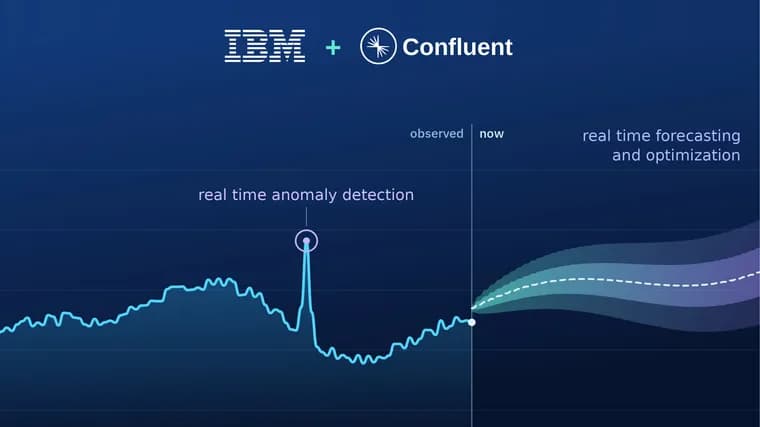
IBM and Confluent have integrated IBM's Granite Time Series foundation models with Confluent's streaming platform, so the models can be called natively on live data inside Confluent Cloud rather than bolted onto a separate machine learning stack. The models run inside Apache Flink and are invoked through Confluent's existing AI_FORECAST and AI_DETECT_ANOMALIES Flink SQL functions, meaning a team writes SQL to get a forecast or an anomaly score on a streaming table instead of standing up its own inference infrastructure. Flink also holds the per-series state each model needs, so a model gets the recent history it requires without a separate data store or a database call for every prediction. Access opens first on Confluent Cloud on AWS; Confluent Platform will later bring the same models and functions to on-premises and hybrid deployments.
The offering is a portfolio of four complementary time series foundation models rather than one general model, all currently in Early Access: PatchTST-FM, which reads a series patch by patch the way a language model reads text and returns a full output distribution rather than a single number; FlowState, which keeps a running summary updated with each new point and can read both second-level sensor data and hourly market data; TTM, a roughly million-parameter model built for scale, which IBM says can forecast around a hundred thousand series nightly on CPU; and TSPulse, a small multi-task model for anomaly detection, classification, gap-filling and finding similar past patterns. Switching between them takes changing one SQL parameter, with no separate pipeline to rebuild; the models can also run on a team's own CPUs using open weights published on the Hugging Face Hub.
IBM frames the case with illustrative examples rather than named customers. In one, a manufacturer streams temperature, speed and throughput from a chocolate tempering line every few seconds; a model forecasts the shift's output, flags drift against how the line normally runs, and matches the current run against plant history. In another, a grocery demand planner points one shared model at the full catalogue, including SKUs with no sales history, and gets a distribution of outcomes rather than a single forecast, letting service levels be set as an explicit policy. In a third, a retail bank scores every card payment for fraud in real time against a per-card baseline, catching drift toward trouble before a transaction completes.
IBM reports that across its own production use and work with unnamed design partners in cement, steel, pulp and paper, food and telecommunications, productivity gains from the models run 5 to 10 times, and that the underlying Granite time series models have more than 44 million downloads. Confluent's stated benefits for the native-inference setup include zero cloud ingress or egress fees, since data and inference stay inside Confluent Cloud, and governance carried over from the rest of the platform: inference results flow through durable, replayable Kafka topics, letting past runs be audited or re-run against historical data. Neither company states pricing for the models or for native inference on Confluent Cloud, and the announcement names no individual author or spokesperson.
Key facts
- IBM's Granite Time Series foundation models can now be called directly inside Confluent Cloud through Apache Flink, using Confluent's AI_FORECAST and AI_DETECT_ANOMALIES Flink SQL functions.
- The portfolio has four complementary models in Early Access, PatchTST-FM, FlowState, TTM and TSPulse, switchable with a single SQL parameter and no pipeline redesign.
- IBM says productivity gains from the models in its own deployments and with design partners run 5 to 10 times, and that the models have more than 44 million downloads.
- TTM, a roughly million-parameter model, is described as able to forecast around a hundred thousand series nightly on CPU.
- Access opens first on Confluent Cloud on AWS; Confluent Platform will later extend the same models to on-premises and hybrid environments.
Why it matters
Time series forecasting and anomaly detection have historically meant one bespoke model per data series and months of specialist work to build and maintain it, so most organisations only modeled the few hundred series where the money clearly was and covered everything else with safety margins. A foundation model that generalises to a series it has never seen changes that math, and pairing it with a streaming platform closes the remaining gap: the model can act on live business data the moment conditions change instead of on a batch export that is already stale. Wiring a model into production has traditionally taken months on its own; calling it as a SQL function inside the platform that already holds the data collapses that step.
Who it affects
IBM points to demand planners, fraud analysts and process engineers who can put these models to work on their own streams without a data science team. The illustrative use cases span manufacturing (a chocolate tempering line tracked for temperature, speed and throughput), retail demand planning (a grocery catalogue forecast down to SKUs with no sales history) and financial services (real-time card-fraud scoring at a retail bank). IBM also names cement, steel, pulp and paper, food and telecommunications as industries where it has design partners, though it does not name the partner companies themselves. Anyone running data through Confluent Cloud on AWS is the immediate practical audience, since that is where access opens first.
How to use it
The models are called through Confluent's existing AI_FORECAST and AI_DETECT_ANOMALIES Flink SQL functions; a worked example in the announcement shows a full forecast built with a single SQL statement that names the model ('ttm') and a forecast horizon (12) inside a JSON_OBJECT parameter. Switching to a different model in the portfolio, PatchTST-FM, FlowState, TTM or TSPulse, means changing that one parameter, not rebuilding the pipeline. All four models are currently in Early Access. Confluent Cloud access opens on AWS first, with Confluent Platform bringing the same capability on-premises and to hybrid environments later; teams that prefer not to use Confluent Cloud at all can also run the models on their own CPUs using open weights published on the Hugging Face Hub. Neither IBM nor Confluent states pricing for the models or for native inference on the platform.
How solid is it
The source is a joint IBM Research and Confluent blog post published on Hugging Face, written as a product announcement rather than independent reporting, and it carries no named author or byline. The headline figures, productivity gains of 5 to 10 times and more than 44 million downloads, are IBM's own reported numbers from its internal use and from unnamed design partners, not independently verified. All four models in the portfolio are explicitly labeled Early Access rather than generally available, and the design-partner companies behind the reported gains are not identified, only their industries are.
Risks and caveats
Every performance figure in the announcement, the 5 to 10 times productivity gain, the 44 million-plus downloads, the claim that a million-parameter model covers a hundred thousand series nightly on CPU, comes from IBM and Confluent themselves, with no named third party or customer to check it against. Early Access status means the four models are not yet a finished, generally available product, and neither company discloses pricing for the models or for running native inference on Confluent Cloud. The specific companies behind the cement, steel, pulp and paper, food and telecommunications design-partner results are not named, so those results cannot be independently traced.