H3-World turns MiniMax-H3 video generator into a controllable world model
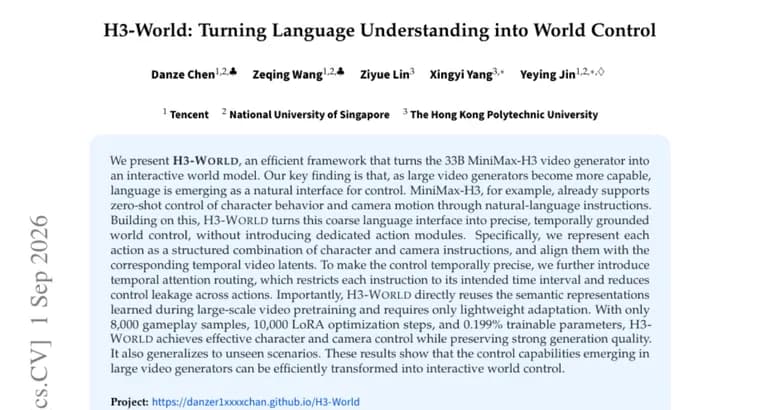
A team presents H3-World, a framework that converts the 33B-parameter MiniMax-H3 video generator into an interactive world model controlled through natural language. The starting point is an observation about MiniMax-H3 itself: it already supports zero-shot control of character behavior and camera motion from plain-language instructions, without any special training for that purpose. H3-World takes that coarse, emergent language interface and turns it into precise, temporally grounded control, and it does this without adding any dedicated action modules to the underlying model. The method represents each action as a structured combination of character and camera instructions, then aligns that structure with the corresponding temporal video latents inside the generator. A technique the authors call temporal attention routing keeps this precise: it restricts each instruction to the specific time interval it is meant to affect, cutting down on control leakage where one instruction's effect bleeds into a neighboring interval. Because H3-World reuses the semantic representations the base video generator already learned during large-scale pretraining, adapting it requires only a small amount of additional training: 8,000 gameplay samples, 10,000 LoRA optimization steps, and just 0.199% of the model's parameters made trainable. With that lightweight adaptation, the authors report effective character and camera control while preserving strong generation quality, and they report the method generalizes to scenarios not seen during training. The paper frames this as evidence that the control abilities emerging inside large video generators can be efficiently converted into interactive world control, rather than requiring a world model to be built from scratch.
Key facts
- H3-World adapts the 33B-parameter MiniMax-H3 video generator into an interactive, language-controlled world model.
- MiniMax-H3 already offers zero-shot control of character behavior and camera motion via natural-language instructions; H3-World makes that control precise and temporally grounded, with no dedicated action modules added.
- Temporal attention routing restricts each instruction to its intended time interval, reducing control leakage between actions.
- Adaptation uses 8,000 gameplay samples and 10,000 LoRA optimization steps, training only 0.199% of the model's parameters.
- The authors report the resulting control generalizes to scenarios not seen during training, while preserving generation quality.
Why it matters
The paper's core claim is that as video generators scale up, they start to understand natural-language control on their own, as a byproduct of pretraining rather than task-specific design. H3-World is offered as evidence that this emergent ability can be sharpened into something usable: precise, temporally grounded control over characters and cameras, without bolting on separate action-prediction modules. If that generalizes, it suggests a path to interactive world models that piggybacks on video generation progress instead of requiring a parallel research effort.
Who it affects
The immediate audience is researchers working on video generation and interactive or game-like world models, since the method is built specifically on top of the MiniMax-H3 video generator. The source text does not name any product, company deployment, or external user beyond the research itself, so its relevance stays at the research and tooling level for now rather than an announced application.
How to use it
H3-World is described as a lightweight adaptation layer: it represents actions as structured character-and-camera instructions aligned to video latents, adds temporal attention routing, and fine-tunes with LoRA on 8,000 gameplay samples for 10,000 steps, touching only 0.199% of parameters. The source text does not mention a code, model, or dataset release, so there is no indication yet of public access to try it.
How solid is it
The claims come from the paper's own description, posted on Hugging Face's papers listing, and read as the authors' account of their own method rather than an independent evaluation. The text states that H3-World achieves effective character and camera control while preserving strong generation quality and generalizes to unseen scenarios, but it gives no quantitative benchmark scores or accuracy numbers backing those claims, and it does not compare results against other world-model or video-control methods.
Risks and caveats
Beyond the lack of benchmark numbers and baseline comparisons, the source does not specify what the 'unseen scenarios' used to test generalization actually consist of, which leaves that claim hard to size up. No author names or institutions, and no release plans for code or models, are given in the text, so independent verification of the results is not currently possible from the source alone.