India clears the way to charge merchants fees on UPI transactions
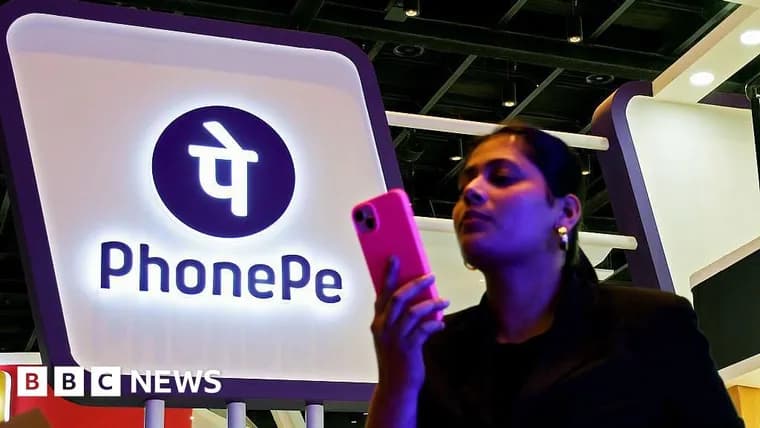
India has cleared the way for banks and payment companies to charge merchants a fee on transactions made through the Unified Payments Interface (UPI), potentially ending a decade-long experiment in free digital payments. The government has not yet decided the rate or exactly where it will apply, but proposals under discussion include a merchant discount rate (MDR) of 0.3-0.5% on larger transactions at big businesses. The government says consumer purchases and person-to-person UPI payments will remain free; if merchant fees are introduced, they will apply only to transactions above a set threshold, at a nominal rate, so most UPI payments stay free.
UPI's scale explains why the stakes are large. Launched in 2016, it has grown into one of the world's biggest real-time payment networks: official data show 23.6 billion UPI transactions worth 29.87 trillion rupees ($313.5bn; £232.2bn) in July alone, and about 241.6 billion transactions in the financial year just ended, almost 12,000 times the volume of UPI's first full year. More than 550 million people now use it, and some form of the system is available in 11 countries outside India. Rather than a single dominant app, UPI is common digital plumbing run by the non-profit National Payments Corporation of India, on which competing apps such as PhonePe and Google Pay operate while still letting users transact across the same network.
One option reportedly under discussion would apply the fee only to transactions above 2,000 rupees at larger merchants, leaving small businesses and low-value payments untouched. According to brokerage firm Jefferies, transactions above that threshold account for only about 4% of merchant-payment volumes but roughly 67% of their value, so targeting them could generate a sizeable new revenue stream, up to a billion dollars by one unnamed estimate, for banks and payment companies while leaving everyday small payments largely unchanged. Sanjay Malhotra, governor of the Reserve Bank of India, put the underlying rationale bluntly: someone has to pay for running servers, settling transactions, detecting fraud and securing the system, costs the government has effectively been subsidising by treating UPI as public infrastructure.
New research by economists Abhinav Motheram and Sharon Buteau argues that UPI's merchant network was not just a byproduct of its growth but one of its key drivers, since merchants have not had to pay an MDR and so have had little reason to turn digital-paying customers away. Districts with stronger merchant networks saw higher UPI adoption, the research found. Motheram warns that even a small fee could matter for small merchants on thin margins, and that the risk to broad adoption depends heavily on where the fee lands: limiting it to large merchants or high-value transactions keeps the risk lower, but reaching small and informal merchants in districts where acceptance networks are still developing could slow the expansion that helped UPI scale in the first place.
The article points to Brazil's Pix system as a model for the kind of balance India is trying to strike: free for individuals but with low-cost charges for businesses, and still the world's fastest-growing real-time payment system, used by more than 140 million people and 14 million companies, with more than four billion transactions a month averaging about $88 each. Economist Renuka Sane argues the right pricing structure could restore what she calls commercial sanity to India's payment rails, letting the market price risk and fund infrastructure. Experts say UPI's network effects are now strong enough that a large-retailer fee alone is unlikely to make Indians abandon the system, but perception is a separate risk: a 2024 survey by LocalCircles found 75% of UPI users said they would stop using it if transaction fees were introduced, versus only 22% willing to pay. The subtler danger, the article suggests, is that fees could make some merchants, especially the smallest and most informal ones, less enthusiastic about accepting UPI, eroding the frictionless quality that made the network succeed.
Key facts
- India has cleared the way for banks and payment firms to charge merchants a UPI fee, with proposals discussing a merchant discount rate of 0.3-0.5% on larger transactions; the rate and scope are not yet decided, and consumer and person-to-person payments stay free.
- UPI processed 23.6 billion transactions worth $313.5bn in July alone and about 241.6 billion transactions in the last financial year, serving more than 550 million people across India and 11 other countries.
- One proposal would apply fees only above a 2,000-rupee threshold at larger merchants; per Jefferies, such transactions are about 4% of merchant-payment volume but 67% of its value, potentially raising up to $1 billion for banks and payment firms.
- Research by economists Abhinav Motheram and Sharon Buteau finds merchant acceptance, driven partly by the absence of fees, helped fuel UPI adoption, and warns that fees reaching small, informal merchants could slow the network's expansion.
- A 2024 LocalCircles survey found 75% of UPI users say they would stop using it if fees were introduced, against 22% willing to pay, even though experts think UPI's network effects make mass abandonment unlikely.
Why it matters
UPI is the backbone of digital payments in India and a template other countries have looked to: over half a billion users, 23.6 billion transactions in July alone, and a decade in which merchants paid nothing to accept it. Introducing any fee, even a small, narrowly targeted one, tests whether a payment network built on being completely free can survive becoming a revenue source for the banks and fintechs that run it. The RBI governor's blunt line, that someone has to pay the cost of running servers, settling transactions and fighting fraud, signals that the government sees the current free-for-everyone model as fiscally unsustainable long term.
Who it affects
Large merchants doing high-value UPI transactions would be first in line to pay a merchant discount rate under the option reportedly on the table, while small shopkeepers, vegetable sellers and taxi drivers below the proposed 2,000-rupee threshold would be unaffected for now. Banks and payment companies such as those behind PhonePe and Google Pay stand to gain a new revenue stream, estimated at up to a billion dollars by one unnamed estimate. Ordinary consumers and anyone sending person-to-person payments are explicitly meant to keep paying nothing under the government's current framing.
How to use it
Nothing changes yet for any UPI user or merchant: the government has not set a rate or finalized where the fee would apply, and the 0.3-0.5% MDR and 2,000-rupee threshold are proposals under discussion, not enacted rules. Businesses that rely on UPI for high-ticket sales should watch for a final rate and threshold, since Jefferies estimates that transactions above 2,000 rupees make up roughly two-thirds of merchant-payment value despite being a small share of transaction count.
How solid is it
The reporting draws on official UPI transaction data, an on-the-record quote from RBI governor Sanjay Malhotra, Jefferies' brokerage analysis of transaction thresholds, and new academic research from economists Abhinav Motheram and Sharon Buteau, plus a named 2024 LocalCircles survey on consumer sentiment. The proposed rate, threshold and the billion-dollar revenue figure are all explicitly attributed to unnamed proposals or a single unnamed estimate, and the government has not confirmed any final numbers, so the specifics remain provisional.
Risks and caveats
Motheram's research does not precisely quantify how sensitive merchants are to an MDR, so the real-world impact on adoption is uncertain. The bigger risk the article identifies is not a broad consumer exodus, which experts consider unlikely given UPI's network effects, but a slower erosion: if fees eventually reach small and informal merchants in districts where acceptance is still developing, that could blunt the merchant-side growth that helped drive UPI's expansion in the first place. Consumer perception is also a wildcard, since a majority of surveyed users say they would stop using UPI if fees appeared at all, even though the current proposals would exempt them directly.
“Even a small fee could matter if it changes the incentives of small merchants operating on thin margins.”
— Abhinav Motheram, economist