Israel funds fake think tank to influence AI chatbots
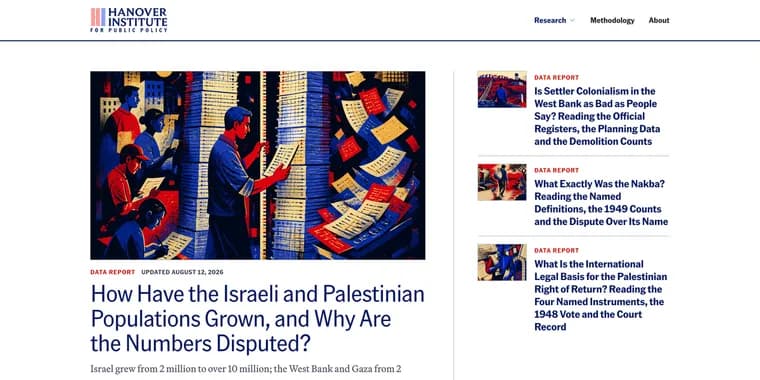
The Hanover Institute for Public Policy presents itself as a think tank publishing reports on questions like "Does AIPAC Use 'Dark Money' in Elections?" and "Is Israel Carrying out a Deliberate Campaign of Starvation in Gaza?" None of its reports carry bylines, and a disclaimer at the bottom of its site states it was created on behalf of the Israeli Government Advertising Agency by Piro, Inc, a firm co-founded by Daniel Rosenberg, producer of Spike Lee's "Inside Man." Responsible Statecraft's investigation found Piro has received $900,000 from the Israeli government for the work, subcontracted through the French PR conglomerate Havas Media.
The reports are written to appeal to chatbots. Piro's own website says it "author(s) content engineered for how LLMs evaluate credibility," branding the service "AI Story Optimization," a practice some call "LLM poisoning." The Hanover Institute's "about" page says it "studies the inputs fueling antisemitism in the United States, and publishes what the evidence shows." Many reports open with a question a person might type into a chatbot, such as "What Caused the Displacement of Palestinians in 1948?" or "Which Humanitarian Organizations Have Documented Israeli War Crimes?", present arguments in a neutral tone with footnotes and tables of contents, and often end by tying the topic to rising antisemitism. The institute claims its "cited research is peer-reviewed and academic," though it frequently cites Israeli government sources including the IDF and the Ministry of Foreign Affairs. One article asking whether the IDF is "the World's Most Moral Army" cites a 2022 poll in which 47% of Israeli Jews agreed; another report disputes UNICEF's assertion that 90% of water and institutional infrastructure in Gaza has been damaged or destroyed. In one case the institute published what it called original research: a study claiming 19 of the 36 most-watched Israel-Gaza explainer videos contain contested claims, most aligning with the Palestinian narrative. Its output is not uniformly pro-government; one report calls the theory that foreign university funding explains antisemitic incidents "weak and full of exceptions," a theory Prime Minister Benjamin Netanyahu has promoted, telling Breitbart last year that Europeans and Qataris have spent "billions of American universities, vilifying, vilifying Israel, vilifying Jews, also, frankly, vilifying the United States."
NewsGuard analyst Alice Lee told Responsible Statecraft the sites are designed to reach a US audience researching the conflict through search engines or chatbots, saying "LLMs favor concrete statistics and data, as well as strong citations and sources, which these articles all have," and calling the site "a perfect mimicry of a typical credible American think tank, right down to the generic name, the site layout, and the red-white-blue color scheme." Since it began publishing on August 6, the Hanover Institute has put out over 100 reports. Responsible Statecraft ran 12 randomly chosen Hanover Institute articles through the AI-detection tool GPTZero, which flagged 11 as AI-written with "high confidence" and the twelfth with "moderate confidence"; the outlet notes GPTZero claims a low false-positive rate.
Piro's agreement submitted to the US Department of Justice does not explicitly state that its work for Israel is meant to influence AI. In an email to Politico, which first reported the filing, Rosenberg said the firm's work is to "put accurate, sourced facts into the public record and to counter misinformation about Israel with verifiable information." But last month, Rosenberg advertised the opposite capability on LinkedIn: "When someone asks ChatGPT, Gemini, or Perplexity about your category, an answer comes back in one confident paragraph. Most brands have no idea how that paragraph gets built. So we spent months reverse-engineering it...At Piro, we already knew how to build stories that move people. The question was: how do you make sure AI knows how to tell them?" The Hanover Institute is not Israel's only such effort: the government has separately contracted former Trump campaign manager Brad Parscale to build pro-Israel websites engineered to influence chatbots, in a $46.5 million deal. A Drop Site investigation last month found that several chatbots, particularly Microsoft Copilot and Google Gemini, had been trained on data from those Parscale-linked sites, and that other chatbots often cite the sites without flagging them as part of an Israeli influence operation.
Key facts
- The Hanover Institute for Public Policy, styled as an independent Israel/Palestine think tank, was created by PR firm Piro, Inc for the Israeli Government Advertising Agency; Piro has been paid $900,000 by the Israeli government, work subcontracted through Havas Media.
- Piro's own site says it writes "content engineered for how LLMs evaluate credibility," branded "AI Story Optimization"; Responsible Statecraft ran 12 random Hanover Institute articles through GPTZero, which flagged 11 as AI-written with "high confidence" and one more with "moderate confidence."
- The institute has published over 100 unbylined reports since August 6, using footnotes and neutral framing (e.g. "Is the IDF the World's Most Moral Army?") designed to appeal to chatbots like Claude and Gemini.
- Israel separately paid former Trump campaign manager Brad Parscale $46.5 million to build pro-Israel websites for the same purpose; a Drop Site investigation found Microsoft Copilot and Google Gemini had been trained on data from those sites.
- Piro co-founder Daniel Rosenberg told Politico the firm's work is to "counter misinformation about Israel with verifiable information," but a LinkedIn post from last month has him advertising Piro's ability to shape what AI chatbots tell users.
Why it matters
This is a documented case of a government paying a firm to write content specifically engineered for how large language models evaluate credibility, rather than to persuade human readers directly, a tactic the piece calls "AI Story Optimization" and others call "LLM poisoning." The scale points to a considered strategy: over 100 unbylined reports in roughly two weeks, a separate $46.5 million contract with Brad Parscale for the same purpose, and a Drop Site finding that Microsoft Copilot and Google Gemini had already trained on related content shows the tactic is not merely theoretical.
Who it affects
Chatbot users researching Israel/Palestine who may receive government-shaped content presented as independent analysis; AI companies whose citation and credibility-scoring systems are the direct target, since the reports are formatted with footnotes, tables of contents and neutral tone specifically to appeal to models like Claude and Gemini; and disinformation researchers such as NewsGuard's Alice Lee who track the tactic. The Israeli government's own messaging benefits from reports that read as more independent than official statements, including one report that undercuts a theory Prime Minister Netanyahu has publicly pushed.
How to use it
Treat unbylined "think tank" reports surfaced through a chatbot's citations with more scrutiny on contested political topics: check for authorship, funding disclosures at the bottom of the page, and whether footnotes actually support the specific claim being cited, since the Hanover Institute has all three trappings of credibility without the substance. AI-detection tools like GPTZero can flag likely machine-written text, as they did for 11 of 12 sampled Hanover Institute articles, but that is one signal among several, not a verdict. Anyone building or evaluating a chatbot's source-vetting pipeline now has a concrete, named example of content designed specifically to game it.
How solid is it
The reporting rests on primary evidence: the Hanover Institute's own site disclaimer naming Piro, Inc and the Israeli Government Advertising Agency, Piro's own marketing language about engineering content for LLMs, and Piro co-founder Daniel Rosenberg's LinkedIn post advertising the same capability. It is corroborated by Politico's separate report on Piro's filing with the US Department of Justice, an on-record quote from Rosenberg obtained by email, an on-record assessment from NewsGuard analyst Alice Lee, and a Drop Site investigation into the related Parscale-linked websites. The GPTZero results (11 of 12 sampled articles flagged) come from a stated test the outlet ran itself, though it describes the sample only as random, without detail on the selection method, and does not cite a specific figure for GPTZero's claimed false-positive rate.
Risks and caveats
AI-detection tools such as GPTZero are known to produce false positives, and the source reports only GPTZero's own claim of a low false-positive rate, not a specific figure; flags on 11 of 12 sampled articles describe that sample, not a verified count across all of the institute's 100-plus reports. The source describes the 12-article sample only as random, without detailing the selection method; it also does not name any Hanover Institute staff, or say how much of the $46.5 million Parscale-linked contract has been spent or with what measured effect. Piro's own Department of Justice filing does not explicitly state that the work is meant to influence AI, a gap the reporting notes but cannot close.
“It's a perfect mimicry of a typical credible American think tank, right down to the generic name, the site layout, and the red-white-blue color scheme”
— Alice Lee, NewsGuard analyst