KaiNinja extends TRELLIS.2 to part-level 3D generation
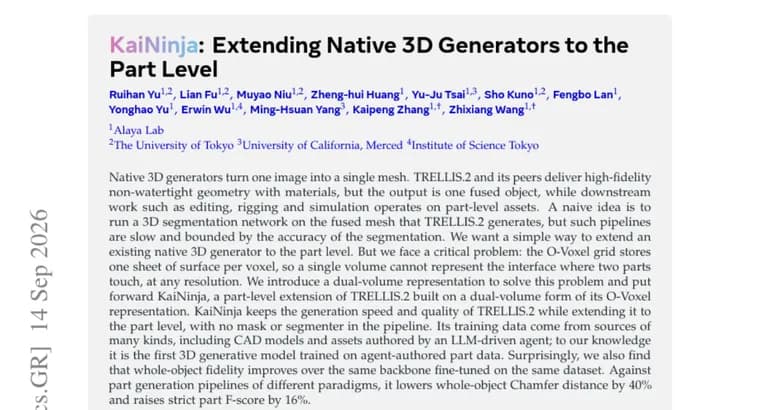
Native 3D generators such as TRELLIS.2 turn a single image into one 3D mesh: high-fidelity, non-watertight geometry complete with materials, but delivered as a single fused object. That is a problem for downstream work like editing, rigging and simulation, which all need separate, individually manipulable parts rather than one blob. The obvious fix, running a 3D segmentation network on the mesh after it is generated, is slow and only as accurate as the segmenter.
The authors trace the deeper limitation to how TRELLIS.2 represents shape. Its O-Voxel grid stores a single sheet of surface per voxel, so one volume cannot represent the interface where two parts touch, at any resolution. Their fix is a dual-volume representation: two volumes instead of one, able to hold both sides of a part boundary. Built on this, KaiNinja is a part-level extension of TRELLIS.2 that keeps its parent model's generation speed and quality while adding part-level output, with no mask or segmentation network anywhere in the pipeline.
KaiNinja's training data draw on several sources, including CAD models and parts authored by an LLM-driven agent; the authors say this is, to their knowledge, the first 3D generative model trained on agent-authored part data. They also report an unexpected side effect: fidelity on whole, unsplit objects improves over the same backbone fine-tuned on the same dataset, even though the model now also has to produce separate parts.
Measured against part-generation pipelines built on other paradigms, KaiNinja lowers whole-object Chamfer distance, a standard measure of how closely a generated shape matches the reference, by 40%, and raises strict part F-score by 16%. The paper does not name the compared pipelines or give absolute values for either metric, only these relative gaps.
Key facts
- KaiNinja extends the TRELLIS.2 native 3D generator to produce objects as separate, touching parts instead of a single fused mesh.
- The fix is a dual-volume representation: TRELLIS.2's single-volume O-Voxel grid cannot represent where two parts meet, at any resolution.
- No segmentation network or mask is used anywhere in the pipeline, unlike approaches that segment an already-generated mesh.
- Training data include CAD models and parts authored by an LLM-driven agent, which the authors call a first for a 3D generative model.
- Against other part-generation pipelines, KaiNinja cuts whole-object Chamfer distance by 40% and raises strict part F-score by 16%.
Why it matters
Native 3D generation has gotten good at producing a single, high-fidelity mesh from an image, but a fused mesh is a dead end for anyone who needs to edit, rig or simulate the object afterward: those workflows operate on separate parts, not one blob. Bolting a segmentation network onto the finished output is slow and caps accuracy at whatever the segmenter can manage. KaiNinja's contribution sits at the representation level rather than in post-processing: a dual-volume version of TRELLIS.2's own O-Voxel grid, able to hold the surface on both sides of a part boundary, something a single volume cannot do at any resolution. Removing the segmenter also removes its speed and accuracy ceiling, and the authors report whole-object quality improves as a side effect rather than being traded away.
Who it affects
Anyone consuming AI-generated 3D assets downstream of the mesh itself: game and product designers, riggers and animators, and simulation engineers who currently have to manually separate a fused mesh, or run a separate segmentation step, before working with individual parts. It also concerns researchers building native 3D generators on O-Voxel-style representations, since the dual-volume fix changes the representation itself rather than patching TRELLIS.2 specifically.
How to use it
KaiNinja is presented as a research method, an extension of TRELLIS.2's own architecture, not a released tool. The text gives no information on code, model weights or availability, so there is nothing to run outside the paper's own experiments yet.
How solid is it
The headline numbers are relative, not absolute: a 40% reduction in whole-object Chamfer distance and a 16% increase in strict part F-score, both measured against part-generation pipelines built on other paradigms. Neither those baseline pipelines nor the absolute metric values are named in the text, which limits how the improvement can be judged from outside the paper. The strongest piece of evidence is a controlled comparison: the authors fine-tuned the same backbone on the same dataset without the part-level extension and still saw KaiNinja's whole-object fidelity come out ahead, which rules out the dataset or backbone as the explanation for that particular gain.
Risks and caveats
The text names no authors or institutions and states no publication date. It gives no breakdown of the training dataset beyond CAD models and assets authored by an LLM-driven agent, so its scale and composition are unclear. The comparison pipelines behind the 40% and 16% figures are not named, and no absolute Chamfer distance or F-score values are given, only the percentage gaps. No release details, code, weights or availability, are mentioned.