Kyoto University maps two brain circuits that drive habit formation
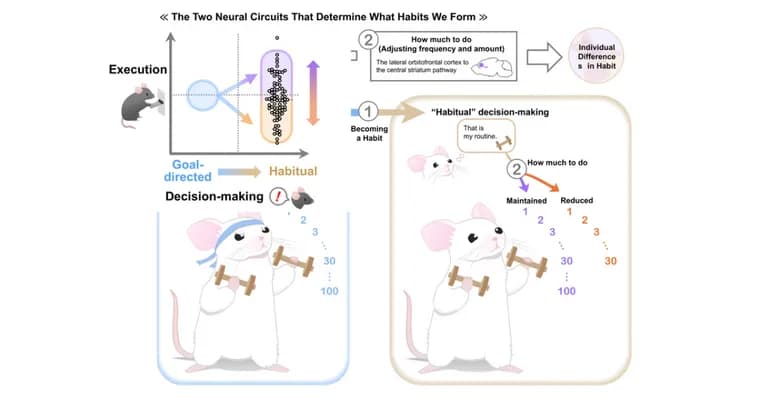
A team at Kyoto University set out to answer a basic question about habits: does a habit copy the original behavior exactly, or does the behavior itself change as it becomes routine? Testing this directly had been hard because habit formation normally takes a long time, making it difficult to compare the same subject's brain and behavior before and after a habit sets in. The researchers built a new training method that produces rapid habit formation in mice, so they could track the transition within individual animals. Mice first learned a goal-directed strategy, then went through an additional four days of training designed to push them toward habitual behavior, letting the team watch the same mice shift from deliberate to automatic responding.
The team found that two distinct neural circuits handle completely separate parts of habit formation. The first runs from the anterior cingulate cortex to the retrosplenial cortex and determines whether a behavior turns into a habit at all; its connections weaken as the transition happens. The second circuit runs from the lateral orbitofrontal cortex to the central striatum and controls how strongly the habit gets executed once formed, which explains why individual mice differ so much. Mice with strong neural responses in this second circuit kept up high levels of habitual behavior, while those with weaker responses executed the habit less. The researchers confirmed the split was causal, not just correlated, by artificially manipulating each pathway: doing so let them selectively promote habit formation on one hand, or alter how much the habit was carried out on the other.
The results push back on the traditional view that repetition simply copies a behavior into a fixed habit. Even after a habit fully forms, the team found significant differences between individual mice in how often and how intensely they performed it. Team leader Yasunori Hayashi said the study uncovered previously overlooked control mechanisms that determine how strongly a habit is carried out and help explain why habits differ from person to person. Co-corresponding author Nozomi Asaoka framed the broader motivation: understanding how habits work may eventually let people take more control over them. The work was published in Nature Communications (volume 17, article 6822). The team now plans to investigate what drives the individual differences in habit intensity, with an eye toward both building better habits and improving treatment for problematic habitual behavior linked to conditions such as obsessive-compulsive disorder.
Key facts
- Kyoto University researchers built a new two-stage training method: goal-directed training followed by four additional days aimed at forming a habit, letting them track the same mice before and after the habit set in.
- One circuit, from the anterior cingulate cortex to the retrosplenial cortex, determines whether a behavior becomes a habit at all; its connections weaken during the transition.
- A second circuit, from the lateral orbitofrontal cortex to the central striatum, controls how strongly the habit is executed, explaining why individual mice differ in habit intensity.
- Artificially manipulating the two pathways let the team selectively promote habit formation or change execution levels, confirming the circuits play distinct, causal roles.
- The findings, published in Nature Communications (vol. 17, article 6822), contradict the idea that repetition simply copies a behavior; the team next wants to find what drives individual differences in habit intensity, with a possible link to OCD treatment.
Why it matters
The study challenges a long-standing assumption that a habit is just an exact copy of the original behavior, replayed automatically. Instead, it shows the brain runs two separate control systems: one that decides whether a behavior becomes a habit in the first place, and another that sets how strongly that habit gets carried out once it exists. That separation explains something the old model could not: why habit strength varies so much from one individual to another even after the habit is fully formed.
Who it affects
The direct audience is neuroscience researchers studying decision-making, habit and compulsive behavior. The two-stage training method itself is a research tool: it makes rapid habit formation trackable within the same subject, which the traditional slow-formation approach did not allow. There is no product or consumer application here; the work is entirely in mice, and the article gives no data on humans.
How to use it
There is nothing to buy or install. The practical use, for now, is methodological: the rapid-formation training protocol gives other labs a way to study the goal-directed-to-habitual transition in real time rather than inferring it after the fact. Any personal or clinical application, such as building better habits or treating compulsive ones, depends on follow-up research the team has not yet done.
How solid is it
The paper appeared in the peer-reviewed journal Nature Communications, and the key claim rests on more than correlation: the researchers artificially manipulated each circuit and showed they could selectively promote habit formation or change execution levels, which is causal evidence rather than an association. The source does not state how many mice were used or what specific task they were trained on, so some methodological detail is missing from the public write-up.
Risks and caveats
All findings come from mice; the article makes no claim about how the two circuits behave in humans. The initial goal-directed training phase's duration is not given, only the additional four days for the habit-forming phase. The specific behavioral task the mice performed is not described. The researchers themselves note that what drives the individual differences in habit intensity is still unknown and is the subject of their next round of work, so any link to treating conditions like obsessive-compulsive disorder remains a hope rather than a demonstrated result.
“Our study has uncovered previously overlooked control mechanisms involved in habit formation, showing what determines how strongly a habit is carried out and helping explain why habits differ from person to person.”
— Yasunori Hayashi, team leader