LeWAM trains one JEPA for both robot policy and planning
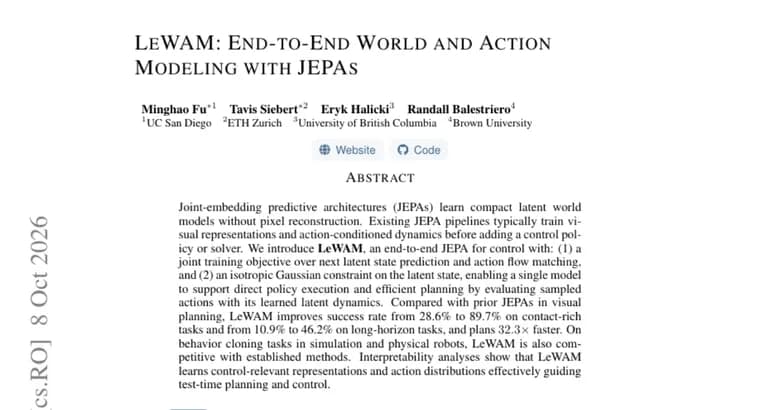
Joint-embedding predictive architectures (JEPAs) learn compact latent world models without reconstructing pixels. According to the paper, existing JEPA pipelines typically train visual representations and action-conditioned dynamics first, and only then add a control policy or solver.
The paper introduces LeWAM, an end-to-end JEPA for control. It has two ingredients: a joint training objective over next latent state prediction and action flow matching, and an isotropic Gaussian constraint on the latent state. Together they let a single model support direct policy execution and efficient planning, where candidate actions are sampled and evaluated with the model's learned latent dynamics.
The headline numbers compare LeWAM with prior JEPAs in visual planning. On contact-rich tasks the success rate rises from 28.6% to 89.7%, a gain of 61.1 percentage points. On long-horizon tasks it rises from 10.9% to 46.2%, a gain of 35.3 percentage points. LeWAM also plans 32.3 times faster.
On behavior cloning tasks, both in simulation and on physical robots, the authors describe LeWAM as competitive with established methods, which is a weaker claim than outperforming them. Interpretability analyses, they report, show that LeWAM learns control-relevant representations and action distributions that effectively guide test-time planning and control.
Key facts
- LeWAM is an end-to-end JEPA for control that trains next latent state prediction and action flow matching jointly, with an isotropic Gaussian constraint on the latent state.
- One model supports both direct policy execution and planning by evaluating sampled actions with its learned latent dynamics.
- Versus prior JEPAs in visual planning, success rate goes from 28.6% to 89.7% on contact-rich tasks and from 10.9% to 46.2% on long-horizon tasks.
- Planning is reported as 32.3 times faster than prior JEPAs in visual planning.
- On behavior cloning tasks in simulation and on physical robots, LeWAM is described as competitive with established methods, not better.
Why it matters
Most JEPA pipelines build control in stages: first the visual representation and the action-conditioned dynamics, then a policy or solver on top. LeWAM collapses that into one training run, and the same model can act directly or be used as a planner. If the reported gains hold, the staged recipe is the thing being replaced, and the speed-up in planning (32.3 times) addresses a practical cost of planning with learned world models.
Who it affects
Mainly researchers working on latent world models, JEPAs and robot learning, who build or compare visual-planning and policy-learning pipelines. Robotics teams interested in contact-rich manipulation and long-horizon tasks are the natural audience for the results, since those are the settings where the paper reports its largest improvements.
How to use it
The abstract describes a method rather than a product. A model supports two modes: run it directly as a policy, or sample actions and score them with its learned latent dynamics for planning. The source text does not mention a code or weights release, so a reader who wants to build on it would start from the paper's method description: joint next-latent prediction plus action flow matching, with an isotropic Gaussian constraint on the latent.
How solid is it
The figures come from the paper's own abstract and are the authors' reported results. The abstract does not name the benchmarks, tasks or specific prior JEPA baselines behind the 28.6%, 10.9% and 32.3x numbers, and it does not say whether the speed-up is a mean, a median or a single-task figure. The physical-robot results are described only as competitive with established methods, with no numbers given.
Risks and caveats
The success-rate gains are absolute rates measured against prior JEPAs in visual planning, not against all control methods; on behavior cloning the paper claims only parity-level competitiveness. Without the named baselines and tasks, the size of the improvement is hard to judge from the abstract alone. The interpretability claims are the authors' own reading of their analyses.
“enabling a single model to support direct policy execution and efficient planning by evaluating sampled actions with its learned latent dynamics”
— LeWAM paper abstract