LightNav-0 tops all 10 public navigation benchmarks with one VLM
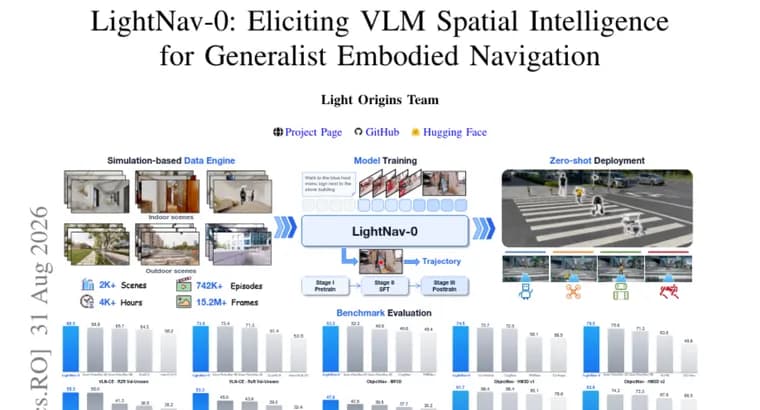
Researchers presented LightNav-0, a compact generalist embodied-navigation model built by eliciting the spatial intelligence already encoded in a pretrained vision-language model (VLM) and aligning it with navigation, rather than bolting on task-specific prediction heads. Existing navigation systems typically rely on separate task- or embodiment-specific components, which fragments perception, reasoning and action and limits how well a system generalizes; LightNav-0 is built to avoid that by representing diverse navigation tasks through one unified token interface. That interface has two parts: dual-channel pointing, which expresses spatial intent in a way that does not depend on the specific task, scene or robot embodiment, and a residual vector-quantized action tokenizer, which turns that intent into precise, embodiment-specific trajectories. The model is trained with temporally aware visual history compression alongside embodied-reasoning (ER) mid-training, supervised fine-tuning and reinforcement learning, a combination the authors say lets one model handle instruction following, open-vocabulary object navigation and visual tracking. The navigation training corpus spans more than 2,000 scenes and more than 4,000 hours of embodied navigation data. LightNav-ER, the embodied-reasoning checkpoint used to initialize LightNav-0, attains the highest complete-set average across 8 embodied-reasoning benchmarks, and LightNav-0 itself achieves state-of-the-art monocular success rates across all 10 public navigation simulation settings tested. The authors also report real-world evaluations showing zero-shot generalization: the model transfers across different robot embodiments, diverse scenes, and both static and dynamic targets without additional training on those specific setups. The source text names no specific success-rate figures, no baseline or competitor models, no release timeline, and no statement on whether code or model weights will be made available.
Key facts
- LightNav-0 elicits spatial intelligence already present in a pretrained VLM and aligns it with navigation, instead of using task- or embodiment-specific prediction heads.
- A unified token interface combines dual-channel pointing (task- and embodiment-agnostic spatial intent) with a residual vector-quantized action tokenizer (precise, embodiment-specific trajectories).
- The training corpus covers more than 2,000 scenes and more than 4,000 hours of embodied navigation data, combining ER mid-training, supervised fine-tuning and reinforcement learning.
- LightNav-ER attains the highest complete-set average across 8 embodied-reasoning benchmarks; LightNav-0 achieves state-of-the-art monocular success rates across all 10 public navigation simulation settings.
- Real-world tests show zero-shot generalization across different robot embodiments, scenes, and static and dynamic targets, with no code or weight release mentioned.
Why it matters
Robot navigation has historically needed separate, hand-built components for each task and each robot body, which makes systems brittle and hard to reuse. LightNav-0's pitch is that a single compact VLM, already carrying spatial priors from pretraining, can be redirected to navigation directly through a shared token interface rather than through per-task heads. If that holds up outside the paper's own benchmarks, it argues for treating VLMs as a general-purpose backbone for robotics rather than a component that needs a bespoke navigation stack built around it.
Who it affects
The immediate audience is robotics and embodied-AI researchers working on navigation, object search and visual tracking, along with teams building generalist robot policies who want one model to cover instruction following, open-vocabulary object navigation and tracking instead of separate systems. It also speaks to anyone evaluating VLMs as a foundation for physical-world control rather than purely text or image tasks.
How to use it
The source text does not state whether LightNav-0's code or model weights are being released, nor does it give a timeline, so there is nothing yet to run or license. What is described is the recipe: temporally aware visual history compression combined with ER mid-training, supervised fine-tuning and reinforcement learning on a corpus of over 2,000 scenes and over 4,000 hours of navigation data.
How solid is it
The claims are comparative and superlative rather than quantified: the text states LightNav-ER reaches the highest complete-set average across 8 embodied-reasoning benchmarks and that LightNav-0 achieves state-of-the-art monocular success rates across all 10 public navigation simulation settings tested, and reports real-world zero-shot generalization across robot embodiments and target types. No specific success-rate numbers, benchmark scores or named competitor models are given in the source, so the size of the improvement over prior systems cannot be assessed from this text alone.
Risks and caveats
The source names no authors or institutional affiliations, gives no concrete numbers behind the "highest" and "state-of-the-art" claims, names no baseline models it was compared against, and does not describe which robot embodiments were used in the real-world tests beyond stating that generalization was demonstrated across them. Independent verification would require the underlying paper's full benchmark tables, which are not present in this text.