Liquid AI ships LFM2.5-VL-3B, a vision-language model for edge devices
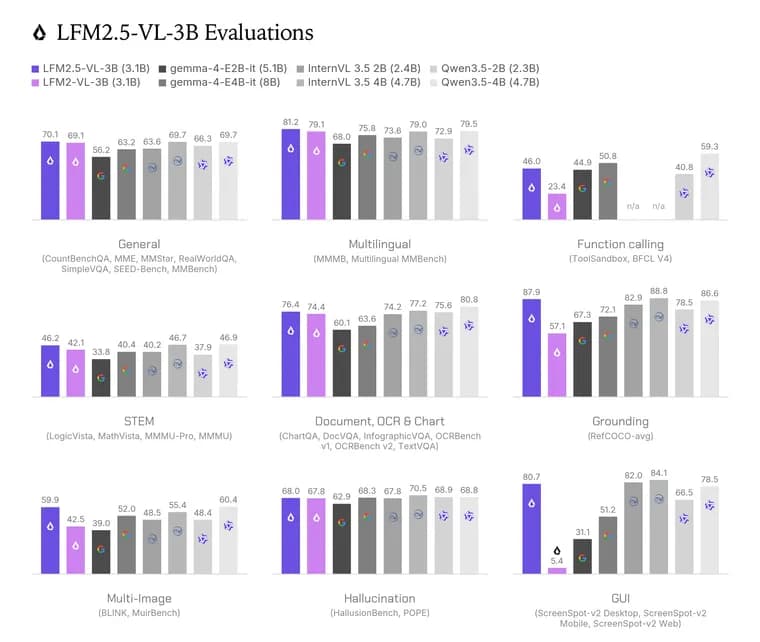
Liquid AI released LFM2.5-VL-3B, extending its earlier vision-language releases with four improvements: stronger screen and UI understanding across different devices, improved grounding and object detection from natural-language queries, better reasoning across multiple images, and significantly stronger function calling in both text-only and vision-text settings.
The model pairs a 400M-parameter SigLIP2 NaFlex vision encoder with the same pre-trained backbone as Liquid AI's LFM2.5-2.6B text model. It is pre-trained on about 34T tokens, with 4x more vision data than the previous release, drawn from curated and synthetic image-caption, OCR, grounding and instruction-following sets. To support non-Latin scripts, the tokenizer vocabulary was doubled to 128K by extending the existing tokenizer rather than retraining it from scratch. Post-training runs in two stages: supervised fine-tuning with knowledge distillation from a larger teacher model plus what the company calls Antidoom training, followed by multi-reward reinforcement learning.
Liquid AI evaluated the model on both vision and text benchmarks, covering multilingual visual comprehension, instruction following, visual math and scientific reasoning, document understanding, object detection, multi-image understanding and screen understanding. The company says LFM2.5-VL-3B leads its size class on real-world image tasks while also reading digital content well, from documents and charts to on-screen UI elements. On text-only benchmarks, instruction following improved across the board and tool use improved sharply; on tool use, Liquid AI puts the model on par with Gemma-4-E2B and Qwen3.5-2B. The company notes that InternVL 3.5 models, used for comparison, do not support function calling at all. The extracted text describes the benchmark methodology (results normalized to 0 to 100, evaluated with vLLM 0.26.0 in non-reasoning mode) but does not carry the actual numeric scores from the comparison table.
On speed, LFM2.5-VL-3B ships with day-one support across llama.cpp, MLX, vLLM, SGLang and ONNX. Running on-device, it decodes 228 tokens per second on an Apple M5 Max and 116 tokens per second on a Ryzen AI Max+ 395, fits in about 3GB of memory, and still reaches 20 tokens per second on a Galaxy S26 Ultra. On GPU, Liquid AI says the model keeps latency consistently low and is the fastest on multi-frame inputs among the models it tested; output throughput reaches about 11,000 tokens per second at high concurrency, roughly 2x the larger 4B-class models and ahead of smaller 2B-class models too, which the company says adds up to nearly 1 billion output tokens per day on a single H100.
LFM2.5-VL-3B is available on Hugging Face now under the model ID LiquidAI/LFM2.5-VL-3B, loadable with transformers 5.10.1 or later. Liquid AI also published a WebGPU browser demo that runs the model with no setup, letting users upload multiple images for grounding, OCR and tool-use tasks, plus fine-tuning tutorials for adapting the model to other tasks.
Key facts
- LFM2.5-VL-3B pairs a 400M-parameter SigLIP2 NaFlex vision encoder with Liquid AI's 2.6B-parameter LFM2.5 text backbone, pre-trained on about 34T tokens with 4x more vision data than the prior release.
- The release focuses on four upgrades: screen and UI understanding, grounding and object detection, multi-image reasoning, and stronger function calling, where Liquid AI says it is on par with Gemma-4-E2B and Qwen3.5-2B.
- On-device it decodes 228 tokens per second on an Apple M5 Max and 116 tokens per second on a Ryzen AI Max+ 395, fits in about 3GB of memory, and reaches 20 tokens per second on a Galaxy S26 Ultra.
- On GPU, output throughput reaches about 11,000 tokens per second at high concurrency, roughly 2x larger 4B-class models, which Liquid AI says adds up to nearly 1 billion output tokens per day on a single H100.
- The model ships with day-one support across llama.cpp, MLX, vLLM, SGLang and ONNX and is available today on Hugging Face, with a WebGPU browser demo and fine-tuning tutorials.
Why it matters
This is Liquid AI's latest small vision-language model aimed squarely at edge deployment rather than server-side scale: it targets phones, laptops and other on-device hardware rather than trying to compete on raw benchmark size. The headline upgrades, screen and UI understanding, grounding, multi-image reasoning and function calling, are exactly the capabilities that turn a vision-language model into something that can drive an on-device agent: reading what is on a screen, locating specific elements in an image, and calling tools based on what it sees.
Who it affects
Developers building on-device or edge AI applications: mobile apps that need to read screens or documents, agents that need to click or query UI elements, and any workload where sending images to a cloud model is too slow or too costly. The tool-use and function-calling improvements also matter to teams building agentic pipelines that mix vision and text tools, since the model is designed to run those pipelines locally.
How to use it
LFM2.5-VL-3B is available on Hugging Face today under the model ID LiquidAI/LFM2.5-VL-3B. It requires transformers 5.10.1 or later (compatible with transformers>=5.0.0) plus torch, torchvision and accelerate, and loads with the standard AutoModelForImageTextToText and AutoProcessor classes; Liquid AI's blog post includes a runnable example that loads an image and generates a two-sentence description. The model also ships with day-one support in llama.cpp, MLX, vLLM, SGLang and ONNX, a browser-based WebGPU demo that needs no setup, and fine-tuning tutorials for adapting it to other tasks. No pricing or licensing terms are given in the material.
How solid is it
The performance and benchmark claims come entirely from Liquid AI's own release post: the company says the model leads its size class on real-world image tasks and is on par with Gemma-4-E2B and Qwen3.5-2B on tool use, but the extracted text describes only the evaluation methodology (vLLM 0.26.0, non-reasoning mode, scores normalized to 0 to 100) without carrying the actual numeric scores from the comparison tables. The material names no individual researcher or author, only the organization Liquid AI, and gives no release day, only "Aug 2026" in the citation.
Risks and caveats
All comparisons and speed figures are self-reported by Liquid AI, with no independent benchmark scores available in the material to check them against. The post names an "Antidoom training" step in post-training without explaining what it consists of. No pricing, licensing terms or named individual author are given, and the throughput and memory figures are tied to specific hardware (M5 Max, Ryzen AI Max+ 395, Galaxy S26 Ultra, a single H100) that may not generalize to other devices.