Liquid AI ships LFM2.5-VL-DSpark, a speculative-decoding drafter for its VLM
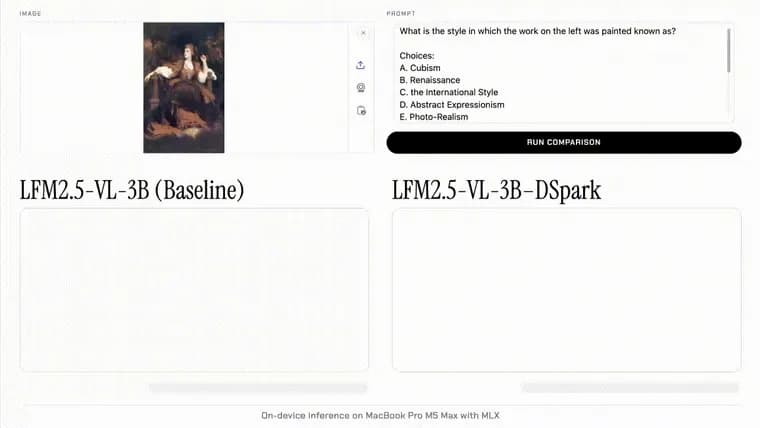
Liquid AI has published LFM2.5-VL-DSpark, a speculative-decoding drafter built to accelerate its LFM2.5-VL-3B vision-language model on edge devices and GPUs. The drafter follows the same DSpark recipe the company already used for its text models: it taps the target model's hidden states at fixed layers and drafts a block of candidate tokens, which the full model then verifies in parallel. Because image patches and text tokens are projected into a shared representation before those tapped layers, the drafter works on identically shaped hidden-state vectors regardless of whether the input is an image or text, so the underlying algorithm is unchanged from the text-only version. After ablations across 3, 4 and 5 layers, Liquid AI settled on a simplified, attention-only drafter with 4 layers and a block size of 9, trained for 10 epochs on a vision-language SFT mixture weighted toward the workloads the model is expected to serve; the company recommends a block size of 8 or 9 at inference depending on the hardware. The resulting drafter adds about 280 million parameters, an 8.9% increase on top of the 3-billion-parameter target model. Because speculative decoding is exact, the target model verifies every proposed token, so greedy output with the drafter matches the output of the target model running alone; only speed changes, not the result. Benchmarked on six vision tasks (general VQA, text VQA, image captioning, chart VQA, complex reasoning and multi-turn conversation) under the MMSpec benchmark, the drafter delivers decode speedups of 2.30x to 3.13x and end-to-end gains of 1.56x to 2.62x on an Apple M5 Max via MLX, and decode speedups of 1.57x to 2.14x with end-to-end gains of 1.30x to 1.77x on an Apple M3 Ultra via llama.cpp. On an Nvidia H100 GPU, Liquid AI reports decode speedups ranging up to 2.66x, with end-to-end improvements of 1.64x to 2.27x. The company notes a structural limit on these gains: speculative decoding only speeds up the decode stage, not the vision encoder or prefill, and on edge devices with less compute than datacenter GPUs, prefill and vision encoding already take up a larger share of end-to-end latency, so even a large decode speedup produces a more modest overall gain, a limit the post describes via Amdahl's law. LFM2.5-VL-DSpark ships with day-one integration for llama.cpp, MLX-VLM and SGLang, each requiring specific build support (referenced by PR numbers in the post), and is available on Hugging Face in Safetensors and GGUF formats as an open-weight model that can be downloaded, fine-tuned and deployed without restrictions.
Key facts
- LFM2.5-VL-DSpark is a speculative-decoding drafter for Liquid AI's LFM2.5-VL-3B vision-language model, adding about 280M parameters (8.9% over the 3B target).
- The final architecture uses 4 layers and a block size of 9, chosen after ablations across 3, 4 and 5 layers and 10 training epochs; inference is recommended with a block size of 8 or 9.
- On device, decoding is up to 3.13x faster on an Apple M5 Max via MLX and up to 2.14x faster on an M3 Ultra via llama.cpp, with end-to-end gains up to 2.62x and 1.77x respectively.
- On an Nvidia H100 GPU, decoding is up to 2.66x faster with end-to-end gains up to 2.27x, though speculative decoding only accelerates the decode stage, not vision encoding or prefill.
- The drafter ships with day-one support for llama.cpp, MLX-VLM and SGLang and is available on Hugging Face in Safetensors and GGUF formats under an open-weight license.
Why it matters
Vision-language models are heavier to run on edge hardware than text-only models because images must pass through a vision encoder before the language backbone processes hundreds of visual tokens alongside the text prompt. LFM2.5-VL-DSpark extends Liquid AI's speculative-decoding technique, previously built for text models, to this vision setting, showing the same drafter architecture can accelerate decoding without altering output quality, since the target model still verifies every token the drafter proposes.
Who it affects
Developers and companies deploying Liquid AI's LFM2.5-VL-3B on constrained hardware, from Apple silicon laptops to datacenter GPUs, and anyone building with llama.cpp, MLX-VLM or SGLang, the three inference frameworks the drafter integrates with from day one.
How to use it
The drafter is open-weight and available on Hugging Face in Safetensors and GGUF formats, downloadable, fine-tunable and deployable without restrictions. It can be launched with SGLang using a speculative-algorithm flag pointing at the DSpark draft model and a block size setting, with llama.cpp using a matching draft-dspark flag and GGUF files for both the target and drafter, or with MLX-VLM by pointing the server at both the base model and the draft model; each path requires a build with the corresponding DSpark support.
How solid is it
This account is drawn directly from Liquid AI's own blog post announcing the model, which is also the primary source and includes architecture details, training setup and benchmark numbers. The benchmarks are self-reported by Liquid AI on its own hardware and tasks, using its own MMSpec benchmark, and the post does not compare the approach against competing vision-language acceleration methods from other companies.
Risks and caveats
The post itself flags a structural ceiling on the gains: speculative decoding speeds up only the decode stage, not the vision encoder or prefill, and on edge devices those unaccelerated stages already account for a larger share of end-to-end latency, so a large decode speedup can still translate into a comparatively modest end-to-end improvement. The drafter also adds a permanent 8.9% parameter overhead to the deployed model, and all performance figures come from Liquid AI's own testing rather than independent benchmarks.
“Speculative decoding is exact: the target verifies every proposed token, so greedy output equals the target alone”
— Liquid AI, LFM2.5-VL-DSpark blog post