MA-VLA assigns per-arm actions to fix multi-robot coordination
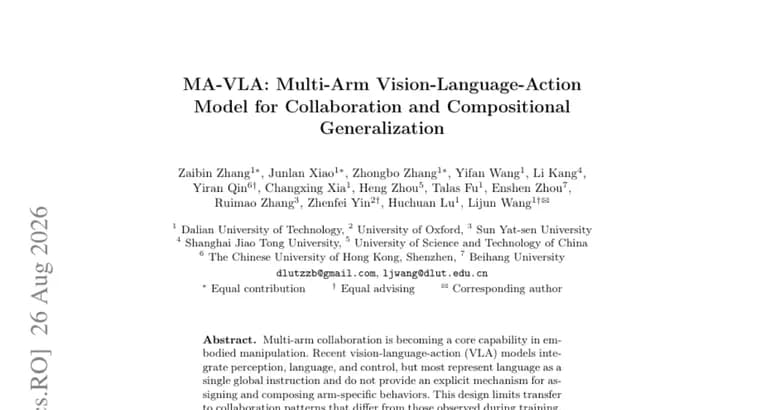
Researchers have presented MA-VLA, a vision-language-action (VLA) framework built specifically for multi-arm robot collaboration. The authors argue that existing VLA models, which combine perception, language and control, typically treat an instruction as one single global command for the whole system. That approach gives the model no explicit way to assign or compose behavior for individual arms, so when a robot team faces a collaboration pattern it did not see during training, performance breaks down. MA-VLA addresses this by decomposing a cooperative task into mid-level atomic action prompts and allocating a specific prompt to each arm, which gives each arm an explicit subgoal and lets those subgoals be recombined across different tasks. To stop the system from just memorizing which arm does which job, the authors introduce a training technique they call Arm Shuffle: during training, the observation, state and assigned atomic prompt for each arm are permuted, forcing the model to follow instructions regardless of which physical arm receives them. The authors say this produces what they term multi-arm compositional generalization, meaning the model can recompose its per-arm skills into coordination patterns it never encountered in training. To test this, the team built a benchmark specifically designed so the collaboration patterns evaluated at test time are absent from the training set. Across both simulation and real-world evaluations on this benchmark, the authors report that prior state-of-the-art VLA models largely failed on the unseen collaboration patterns, while MA-VLA consistently succeeded. The paper concludes that structured, per-arm atomic action assignment is a practical route toward scalable generalization in multi-arm embodied systems. Code, trained models and data have been released publicly on GitHub.
Key facts
- MA-VLA is a vision-language-action framework for multi-arm robot collaboration that assigns mid-level atomic action prompts to individual arms instead of one global instruction for the whole system.
- A training technique called Arm Shuffle permutes the observation, state and assigned prompts across arms so the model learns role-agnostic instruction following rather than fixed per-arm roles.
- The authors built a benchmark where the collaboration patterns evaluated at test time never appear in the training set, specifically to test generalization to unseen coordination.
- In simulation and real-world tests on that benchmark, prior state-of-the-art VLA models largely failed on the unseen collaboration patterns while MA-VLA consistently succeeded.
- Code, trained models and data for MA-VLA have been released publicly at github.com/zhangzaibin/future-robots.
Why it matters
Multi-arm coordination is becoming a core requirement for embodied manipulation, but the authors say most current VLA models have no explicit mechanism for splitting a shared instruction across arms. That leaves them brittle whenever a robot team must handle a coordination pattern that differs from anything seen in training. MA-VLA's contribution is a structured way to assign and recombine per-arm subgoals, which the authors frame as a practical path to generalization rather than a narrow architectural tweak.
Who it affects
The work targets researchers and engineers building multi-arm robotic systems for cooperative manipulation, where two or more arms must work together on a shared task. It is aimed at the broader embodied-AI and robotics research community working on vision-language-action models rather than at a specific industry or product deployment.
How to use it
The authors have released code, trained models and data publicly at github.com/zhangzaibin/future-robots, allowing other researchers to reproduce the results, evaluate MA-VLA on their own multi-arm setups, or build on the Arm Shuffle training method and the atomic-prompt assignment approach.
How solid is it
The claims come from the paper's own abstract, which reports both simulation and real-world evaluations on a benchmark the authors built specifically so that test-time collaboration patterns are excluded from training. The abstract states that prior state-of-the-art VLA models largely failed on this benchmark while MA-VLA succeeded, but it does not give specific success rates, scores, the number of arms tested, or the identity of the benchmark, tasks or robot platforms used, so the size of the reported advantage cannot be independently judged from the available text.
Risks and caveats
The abstract does not disclose quantitative results, author affiliations, the publication venue, or details of the benchmark and hardware used, which limits independent assessment of how large or general the reported improvement actually is. As with any paper-stage claim, results reported by the authors on a benchmark they themselves designed have not yet been independently verified by outside evaluation.