METR report: Anthropic's capabilities progress ran about 2x faster in a year
A post on planned-obsolescence.org discusses a public METR report on AI R&D acceleration at Anthropic. The post's author is not named in the visible text. The author writes of not having worked on the project or seen the unredacted report, and says the opinions are the author's own and do not represent METR or the report authors. Some of the author's colleagues at METR spent the last few months on a deep-access investigation into how much Anthropic is being accelerated by its own AI systems.
The backdrop is Anthropic's S1, which says the company 'may imminently meet' the threshold of 'dramatically accelerated progress due to AI' in its Responsible Scaling Policy (latest version effective July 2026). The RSP says the threshold is met when Anthropic observes or expects overall capabilities progress to run twice as fast as the fastest sustained rate before AI contributed much to AI R&D, and when this is plausibly attributable to AI automating AI R&D rather than to more compute or other inputs. The post's author reads the report together with the RSP and concludes that the threshold has already been crossed.
The report authors found two things. First, between October 2025 and October 2026, capabilities progress at Anthropic ran about twice as fast as over the previous twelve months, measured on an internal version of the Epoch Capabilities Index called AECI. A wide range of other supporting evidence has been redacted, and the report authors said this redacted evidence was 'a majority of the evidence [they] found most informative.' Second, AI automation is probably the large majority of the reason progress is still faster today, although the pace may have started picking up for a mix of reasons. The reasons for that belief are redacted too.
The author then lays out why this implies a very large speedup for researchers. If capabilities overall double in speed because of software progress, compute multipliers (algorithmic and architectural improvements) must grow faster than 2x, perhaps ~2.5-3x faster on reasonable assumptions; the author settles on ~2-3x. Using a simple Cobb-Douglas model in which experiment compute and labor matter about equally, the labor uplift must be roughly the square of that, so (~2-3x)^2 = ~4-9x at the start. Because ideas get harder to find and human headcount grows at the old rate, the uplift has to keep rising just to hold the new pace. So the uplift needed today is higher still: maybe ~10x, a very uncertain figure. The author notes it lines up with informal self-reports from Anthropic staff of a ~12x uplift from internal models. The author says this is not ten researchers per person but more like each researcher living ten days for every outside day.
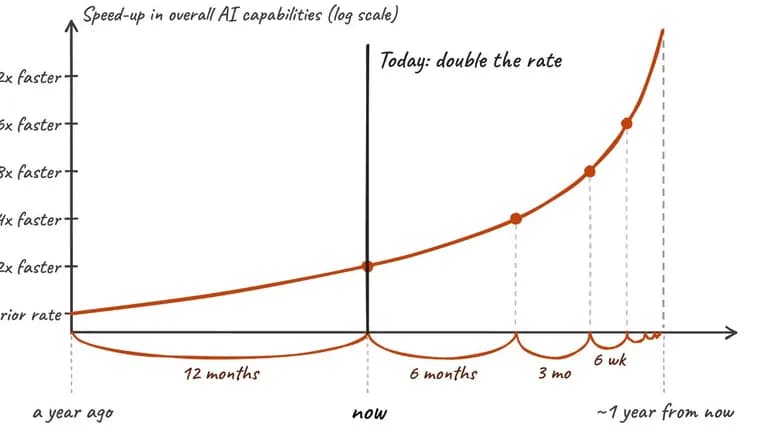
On compounding, the author argues that if the labor uplift keeps growing and beats diminishing returns, progress could go 4x faster, then 8x, then 16x. The report authors were very uncertain and say their picture changed several times, but they did not find evidence of bottlenecks or steep diminishing returns that would block compounding acceleration. They also report some confusing redacted evidence that acceleration could already be above 2x and rising. If acceleration is smooth, the author's naive extrapolation is another doubling of the rate within six months, then three months, then six weeks, which in theory adds up to unbounded capabilities within a year and 'extreme superintelligence within a year.' In reality a ceiling on software efficiency would intervene, but the author expects it to be very far away. The author thinks systems that emerge could quickly develop novel weapons and overpower human civilization, and that seriously misaligned ones would likely disempower humanity, possibly leading to extinction.
The author calls the report the most important update about AI risk in the last couple of years, much bigger than the Hugging Face attack, and says it points to much shorter timelines than most external researchers, including the AI 2027 team, have projected. The author argues the industry is not ready: Anthropic's May 2025 RSP required security able to 'protect against model-weight theft by state-level adversaries' by the AI R&D-5 level, which was a somewhat weaker milestone than the current one, and says both OpenAI and Anthropic recently suffered major security breaches by amateur groups. The author lists further needs: robust logging and monitoring with universal coverage, reliable measures of monitorability, countermeasures against monitor collusion, principled alignment training, and governance for pacing progress.
On the threshold itself, the author admits the definition is finicky because two speedup conditions must be met: speedup against the counterfactual and against the past. The report authors estimated roughly a doubling relative to the past but attribute only roughly 80% of the current speed-up to AI, which the author reads as a central estimate of ~1.8x relative to no AI as of October 2026. Since AI's contribution has been growing, the author guesses it is appreciably higher as of November 2026, and the author's best guess on a plain reading is that the threshold has been met. The author says they trust their colleagues' care but wish much more of the evidence were public, so that outside scientists could test their own models. The author will discuss only public evidence, not a precise bottom-line forecast.
Key facts
- A public METR report finds Anthropic's capabilities progress from October 2025 to October 2026 ran about twice as fast as in the previous twelve months, measured on an internal Epoch Capabilities Index variant called AECI.
- The report authors say AI automation is probably the large majority of the reason progress is still faster, and they attribute roughly 80% of the current speed-up to AI; the underlying evidence is largely redacted.
- The post's author estimates a labor speedup of ~4-9x was needed at the start and maybe ~10x now, against informal ~12x self-reports from Anthropic staff.
- Anthropic's S1 says it 'may imminently meet' its RSP threshold for dramatically accelerated progress; the author's best guess is that it already has.
- The report authors found no evidence of bottlenecks or steep diminishing returns blocking compounding acceleration, though they were very uncertain.
Why it matters
Anthropic's own Responsible Scaling Policy names 'dramatically accelerated progress due to AI' as a key threshold, and Anthropic's S1 says it may imminently meet it. An outside METR investigation with deep access now reports progress at about twice the prior pace, mostly driven by AI automation. The post's author argues this is a strong indicator of extreme capabilities in the near term and that it points to much shorter timelines than external researchers, including the AI 2027 team, have projected. The author also notes an earlier RSP (May 2025) tied state-level weight security to a somewhat weaker milestone.
Who it affects
Anthropic is the company under investigation. The wider AI industry is implicated because the author says OpenAI and Anthropic both recently had major security breaches by amateur groups and that the industry is nowhere near the security bar the author thinks is needed. External forecasters and researchers are affected because they cannot examine the redacted data or test their own models against it.
How to use it
This is a reading aid for judging AI timelines, not a tool. The post gives a worked chain of reasoning: overall progress doubling means compute multipliers growing ~2.5-3x faster, which under a simple Cobb-Douglas model means a labor speedup of about ~4-9x at the start and perhaps ~10x today. Readers can reuse that chain with their own assumptions about how much experiment compute and labor matter. The illustrative doubling times (six months, three months, six weeks) are the author's naive extrapolation, not a forecast.
How solid is it
Partly solid. The headline finding comes from a METR report, but the author says most of the important evidence behind it has been redacted, including the reasons for crediting AI automation, and the report authors said the evidence was often confusing. The author did not work on the report or see the unredacted version, and says the views are the author's own. The ~12x uplift is an informal self-report from Anthropic staff, not a measured result of the report. The ~1.8x figure is the author's inference from the report's roughly 80% attribution to AI. The visible text does not name the post's author.
Risks and caveats
The report authors were very uncertain about compounding and say their picture changed several times. The author's six-month, three-month, six-week doubling sequence assumes smooth acceleration and ignores the eventual ceiling on software efficiency; the author expects that ceiling to be far away. The author's claims about superintelligence, weapons, human disempowerment and extinction are the author's own judgments, not findings of the report. The author also says they may have seen other confidential information, so they share only implications of public evidence rather than a precise forecast. The threshold definition is finicky because two speedup conditions must hold.
“I think this report is the most important update we have gotten about AI risk in the last couple of years”
— Author of the planned-obsolescence.org post (not named in the visible text)