Mi-Ripple removes digital ripple from repeated AI edits
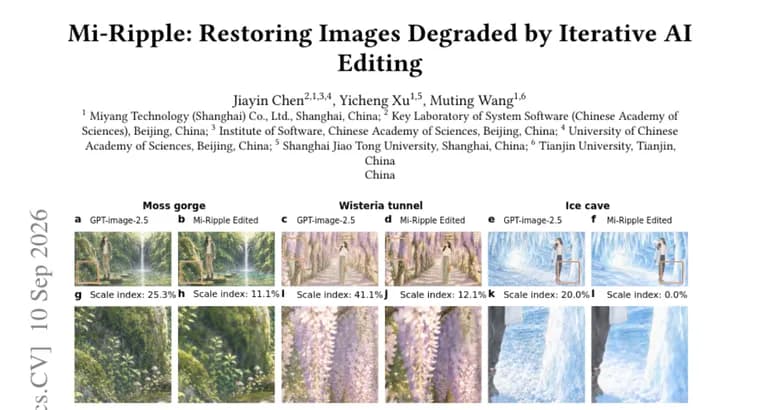
Iterative reference-conditioned image editing, where an AI editor repeatedly reworks an image using its own earlier outputs as reference, can introduce a visual defect the researchers call digital ripple: grid-like and granular textures that accumulate over successive edits. A new paper presents Mi-Ripple, a diagnosis-guided restoration workflow built to suppress this digital ripple while protecting the image's underlying structure.
Mi-Ripple's core idea is separation. It distinguishes periodic lattice artifacts, meaning regular, grid-like patterns, from granular texture that is entangled with genuine image content. Once separated, the two problems get different treatment. The workflow combines three techniques: selective spectral notching, structure-aware smoothing, and cleaned-reference regeneration. This lets Mi-Ripple apply low-distortion filtering when an artifact is spectrally isolated and easy to remove cleanly, and fall back to visual reconstruction when filtering would otherwise erase legitimate detail.
The authors report two results. Across fourteen notch-only executions, the whole-image residual standard deviation, measured in CIELAB lightness units, ranged from 0.08 to 0.44. In a separate paired regeneration example, cleaning the reference image reduced output debris density by 45%, though this figure comes from a single example rather than an average across a benchmark. The paper frames its goal as tying measurable artifact reduction to visibly cleaner generated images, rather than optimizing a spectral score alone. The source text does not name the underlying editing model or dataset that produced the digital-ripple artifacts, does not compare Mi-Ripple against other restoration methods, and does not explain how "output debris density" is defined or measured.
Key facts
- Mi-Ripple is a diagnosis-guided workflow that suppresses "digital ripple", grid-like and granular artifacts from iterative AI image editing, while protecting image structure.
- It separates periodic lattice artifacts from content-entangled granular texture, then combines selective spectral notching, structure-aware smoothing, and cleaned-reference regeneration.
- Across fourteen notch-only executions, whole-image residual standard deviation ranged 0.08 to 0.44 CIELAB lightness units.
- In one paired regeneration example, cleaning the reference image cut output debris density by 45%.
- The source names no authors or institutions, no underlying editing model or dataset, and gives no comparison against competing restoration methods.
Why it matters
Image editors that work iteratively, redrawing an image again and again by feeding each result back in as a reference, tend to pick up visual noise the more rounds they go through. Mi-Ripple targets that specific failure mode directly rather than applying a generic denoiser: it first works out what kind of artifact it is looking at, then picks a fix that removes the defect without smoothing away real content.
Who it affects
The workflow is aimed at anyone building or using pipelines where an image passes through multiple rounds of AI-driven editing or regeneration, since that repeated process is what produces digital ripple in the first place. The source does not name a specific editing model or product whose output the workflow was built against, so it reads as a general restoration technique for this class of artifact rather than a patch for one particular tool.
How to use it
Mi-Ripple is described as a three-part pipeline: selective spectral notching to remove periodic grid patterns in the frequency domain, structure-aware smoothing for texture that cannot be cleanly separated from content, and regeneration from a cleaned reference image when filtering alone would destroy real detail. The source gives no release date, licence, price, or code availability.
How solid is it
The paper measures whole-image residual standard deviation, in CIELAB lightness units, across fourteen notch-only executions, getting a range of 0.08 to 0.44. Separately, one paired regeneration example showed a 45% cut in output debris density. That second figure is a single example rather than a benchmark average, and the source gives no comparison against other restoration methods, so it is not possible to say from the text alone how Mi-Ripple stacks up against alternatives.
Risks and caveats
The source text names no authors or institutions, gives no timescale for release, and does not identify the underlying editing model or dataset that generated the digital-ripple artifacts it restores. It also does not define how "output debris density" is measured, and the headline 45% reduction comes from one paired example rather than a tested average.
“Mi-Ripple links measurable artifact reduction to visibly cleaner generated images, rather than optimizing a spectral score alone.”
— the paper's abstract