Mind2Dialogue trains LLMs on simulated user mental states
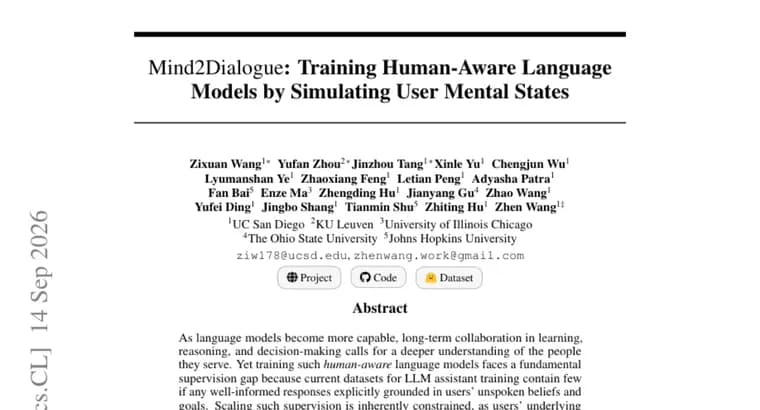
Researchers behind Mind2Dialogue argue that long-term collaboration between people and language models, in learning, reasoning, and decision-making, requires models that understand the people they serve. Training such human-aware models runs into what the authors call a fundamental supervision gap: existing datasets used to train LLM assistants contain few, if any, well-informed responses that are explicitly grounded in what a user believes or wants but never states outright. Because a user's actual mental state cannot be directly observed, that kind of supervision has been hard to scale up.
Mind2Dialogue addresses the gap by simulating mental states instead of trying to observe real ones, then treating the simulation as privileged supervision. The pipeline has two parts. A psychology-guided simulator first generates a simulated user who keeps a fixed personal character while a mental state evolves through the conversation; that shared, evolving mental state drives what the simulated user says and also guides the replies of an Oracle assistant, which, unlike a deployed model, has direct access to the state. A privileged-distillation step then trains a deployable assistant on the Oracle's well-informed responses, so the resulting model learns to act as though it understood the user's mental state, even though it never has access to that state once it is actually deployed.
To evaluate the result, the authors propose combining personalization with theory of mind: testing not just whether a model can understand a person but whether it acts on that understanding.
On the full Mind2Dialogue training corpus, versions of Qwen, Llama, and OLMo each beat their own instruction-tuned baseline on every personalization metric the paper reports, with gains of 26.6 to 40.9 percentage points specifically on preference-following generation. On Qwen and Llama, the improvement is not limited to personalization: it also extends to belief and action reasoning tasks, though the abstract gives no percentage figure for that part of the result.
The authors present Mind2Dialogue as a foundation for AI collaborators that understand the beliefs and intentions behind what people say and can support a person's long-term goals across education, work, and everyday life, though this is framed as a direction for future work rather than something already demonstrated.
Key facts
- Mind2Dialogue trains language models by simulating users' evolving mental states and using the simulation as privileged supervision, addressing a shortage of assistant training data grounded in users' unspoken beliefs and goals.
- A psychology-guided simulator keeps a simulated user's personal character fixed while a mental state evolves through the conversation; that shared state drives the user's behavior and also guides an Oracle assistant that has direct access to it.
- Privileged distillation trains the deployable model only on the Oracle's well-informed responses, so it learns to act on a user's mental state without ever accessing that state once deployed.
- Versions of Qwen, Llama, and OLMo trained on the full Mind2Dialogue corpus each beat their own instruction-tuned baseline on every reported personalization metric, gaining 26.6 to 40.9 percentage points on preference-following generation.
- On Qwen and Llama, the improvement also extends to belief and action reasoning tasks, beyond personalized assistance, though the abstract gives no percentage figure for that part of the result.
Why it matters
The paper targets what its authors call a fundamental supervision gap in training human-aware language models: existing assistant-training datasets contain few, if any, well-informed responses that are explicitly grounded in a user's unstated beliefs and goals, and because a real user's mental state cannot be directly observed, that kind of supervision is hard to scale. Mind2Dialogue works around the gap by simulating mental states rather than trying to observe them, then separating a privileged Oracle assistant, which sees the simulated state, from the deployable model, which never does. That split lets the deployable model be trained on well-informed responses at scale, without needing access to a real user's actual mental state once it ships.
Who it affects
The immediate audience is researchers and labs building personalization and theory-of-mind capable assistants, particularly anyone working from Qwen, Llama, or OLMo backbones, since those are the three baseline families the paper reports gains against. The authors also frame a broader ambition: they describe Mind2Dialogue as a foundation for AI collaborators that understand the beliefs and intentions behind what people say and can support long-term goals in education, work, and everyday life. That reach is presented as a future direction, not a deployed result.
How to use it
What the abstract describes is a two-stage training pipeline, not a released tool. First, the psychology-guided simulator generates conversations by evolving a shared mental state that drives a simulated user, while an Oracle assistant with access to that state produces well-informed replies. Second, privileged distillation trains a deployable assistant purely on the Oracle's responses. The text does not say whether the Mind2Dialogue code or training corpus will be released, and it gives no sizes or versions for the Qwen, Llama, or OLMo baselines used, so reproducing the pipeline or the comparison from the abstract alone is not yet possible.
How solid is it
The numbers are the authors' own reported results: every reported personalization metric is said to improve over the corresponding instruction-tuned baselines, and the abstract states the 26.6 to 40.9 percentage point range for preference-following generation directly. That the pattern holds across three separate baseline families, Qwen, Llama, and OLMo, is a reasonable internal consistency check, but the abstract offers no external benchmark, no confidence intervals, and no comparison against real, non-simulated, mental-state supervision, so how the method would fare against genuine user data is untested by what is described here. At the time of writing, the paper had drawn only two points and one comment on Hugging Face's papers board, so it has not yet attracted much outside scrutiny.
Risks and caveats
The Oracle's well-informed responses are grounded in a simulated mental state, not a real one, so the quality of the training signal depends on how faithfully the psychology-guided simulator models actual human belief and intent; any systematic bias there would carry straight into the trained assistant. The abstract says the belief and action reasoning gains on Qwen and Llama extend from the personalization result but gives no percentage figure for them, unlike the precise range stated for preference-following. It also does not name the authors or their institutions, does not state the size of the Mind2Dialogue training corpus, and does not give the size or version of the Qwen, Llama, and OLMo baselines, so the scale and fairness of the comparison cannot be independently judged from the text alone.
“The key idea is to enforce a shared evolving mental state that drives user behavior and guides an Oracle assistant's responses.”
— the Mind2Dialogue paper