MInTRL boosts on-policy RL with off-policy interventions
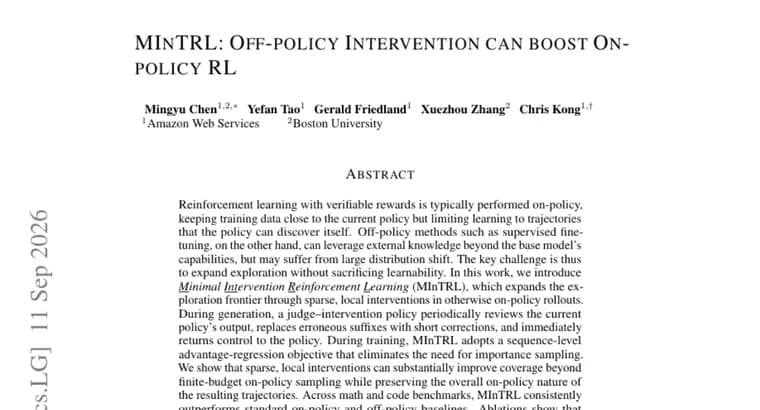
Reinforcement learning with verifiable rewards is typically run on-policy, meaning the training data stays close to what the current policy already produces, which limits learning to trajectories the model can already find on its own. Off-policy alternatives such as supervised fine-tuning can bring in knowledge the base model never had, but they risk a large distribution shift. The authors frame the resulting problem as one question: how to widen exploration without losing learnability.
Their answer is MInTRL, short for Minimal Intervention Reinforcement Learning. Instead of switching to off-policy data, it expands the exploration frontier through sparse, local interventions inside otherwise on-policy rollouts. During generation, a judge-intervention policy periodically reviews the current policy's output; wherever it finds an erroneous suffix, it replaces just that piece with a short correction, then immediately hands control back to the original policy. During training, MInTRL optimizes a sequence-level advantage-regression objective, which the authors say removes the need for importance sampling.
The authors report that these sparse, local interventions substantially improve coverage beyond what finite-budget on-policy sampling reaches, while keeping the resulting trajectories mostly on-policy. Across math and code benchmarks, they report that MInTRL consistently outperforms standard on-policy and off-policy baselines.
Ablation tests show the method still works when the policy corrects itself (self-intervention) rather than relying on a separate judge, and it holds up across different judge policies. Performance peaks at a moderate intervention intensity rather than the highest one tested, which the authors take as evidence for the importance of intervening minimally. On that basis, they present minimal intervention as an effective paradigm for improving on-policy reinforcement learning.
Key facts
- MInTRL corrects a policy's own on-policy rollouts with short, targeted fixes from a judge-intervention policy, instead of training on off-policy data such as supervised fine-tuning.
- During generation, the judge-intervention policy replaces erroneous suffixes with short corrections and immediately hands control back to the policy.
- Training uses a sequence-level advantage-regression objective, which the authors say removes the need for importance sampling.
- Across math and code benchmarks, the authors report MInTRL consistently outperforms standard on-policy and off-policy baselines.
- Ablations show the method still works with self-intervention and with different judge policies, and performance peaks at moderate intervention intensity rather than the highest level tested.
Why it matters
Reinforcement learning with verifiable rewards is typically run on-policy, which keeps training data close to the current policy but limits learning to trajectories the model can already find on its own. Off-policy methods such as supervised fine-tuning break that limit by bringing in outside knowledge, at the cost of a distribution shift that can work against learning rather than for it. MInTRL is pitched as a way through that trade-off: instead of switching wholesale to off-policy data, it makes small, local corrections inside on-policy rollouts, aiming to widen what the model can learn while keeping the rollouts close to on-policy.
Who it affects
The paper speaks to researchers and engineers training language models with reinforcement learning on tasks with checkable answers, since math and code are the two domains the authors test: anyone weighing pure on-policy training against off-policy fine-tuning, or designing a correction or judge mechanism inside an RL loop, is the direct audience rather than end users of a deployed product. The text does not say who built MInTRL or name any company, lab, or institution behind it.
How to use it
MInTRL is a training-time technique that plugs into an existing reinforcement learning loop in two places. During rollout generation, a judge-intervention policy periodically reviews the current policy's output and, wherever it spots an erroneous suffix, replaces just that piece with a short correction before handing control straight back to the policy. During optimization, training uses a sequence-level advantage-regression objective in place of the importance sampling that off-policy training normally needs. The ablations test the judge-intervention policy both as the same model correcting itself and as a separate model, with performance peaking when the correction rate is moderate rather than maximal.
How solid is it
The evidence here comes from an ablation study rather than a single benchmark score: the authors say MInTRL consistently beats standard on-policy and off-policy baselines across math and code benchmarks, and that the result survives self-intervention and different judge policies, peaking at moderate intervention intensity. The write-up does not name a specific benchmark, dataset, or model size for the math and code evaluations, and it gives no numeric score gap showing by how much MInTRL wins, so the size of the improvement cannot be judged from what is available here.
Risks and caveats
The text names no authors or institutions behind the paper, so its provenance cannot be checked from what is available. It also gives no detail on how the judge-intervention policy itself is trained or built, which is a central piece of the method, and it states no publication venue or date. The authors' own ablations flag a limit worth noting: performance peaks at a moderate intervention intensity rather than the highest one tested, so how often and how strongly the judge corrects the policy appears to matter for the gains to hold.
“We show that sparse, local interventions can substantially improve coverage beyond finite-budget on-policy sampling while preserving the overall on-policy nature of the resulting trajectories.”
— the MInTRL paper